How Many Calories Do You Need? Average Daily Calorie Needs
How many calories does a child, teenager, woman, man, older adult or athlete need per day? Average reference values by age, sex and activity, plus a calculator to estimate your own.

The short version: There's no single "right" calorie need. It depends on age, sex, body size, muscle mass and above all activity. As a rough guide, adult women need around 1,800–2,400 kcal and men around 2,200–3,000 kcal per day — children less, athletes considerably more.
How many calories do I need? This can't be answered with a single number. The need is completely different for a child, an office worker, a tradesperson and an endurance athlete. This guide explains, in plain terms, what your calorie need is made of, shows average values for different groups, and gives you a personal estimate with a calculator.
Resting metabolism, total need and activity
Your calorie need is made up of two parts:
- Resting metabolism (BMR): the energy your body uses at complete rest — for breathing, heartbeat, body temperature and organs. For most people that's already around 60 to 70 percent of the daily total.
- Activity energy: everything added by movement — daily life, work, steps and training.
Together they make your total daily need — the amount that holds your weight. In practice it's estimated by multiplying resting metabolism by an activity factor (PAL, "physical activity level").
As a rough guide to the D-A-CH PAL categories:
- 1.4 – barely active: mostly sedentary, little sport
- 1.6 – moderately active: sedentary work with some movement
- 1.8 – active: mostly standing or walking work
- 2.0–2.4 – very active: physically hard work or competitive sport
The calculator below uses simplified activity factors. They give a similar estimate but are not identical to these occupation-based PAL categories of the D-A-CH reference values.
Calculate your calorie needs
Set sex, age, height, weight and activity — the calculator estimates your resting and total daily need. For children and teenagers under 18 it deliberately shows no formula estimate and no weight-loss or -gain target, but an age-appropriate reference value.
Calorie needs calculator
Estimate your approximate resting and total daily energy needs. The figures are guidance, not an exact measurement.
Sex
Activity
3–5 workouts a week
Resting energy
1,452 kcal/day
What your body uses at rest (often loosely called basal metabolism).
Total daily need
2,251 kcal/day
Approximate daily calories to hold your weight.
To lose weight (moderate): 1,801–2,026 kcal/day
To gain weight (moderate): 2,551–2,751 kcal/day
A moderate deficit is often around 10–20% below your estimated total need. Very low calorie targets should not be used without professional guidance — especially during pregnancy, breastfeeding, underweight or an eating disorder.
The calculator uses simplified activity factors. These are not identical to the occupation-based PAL categories of the D-A-CH reference values.
Based on the Mifflin-St Jeor formula, which was developed for healthy adults. The result is an estimate. Actual needs depend on muscle mass, genetics, daily life and other factors.
Average calorie needs by group
The reference values below show the approximate daily need of different groups, based on the D-A-CH reference values. Pick a group. They're averages — your personal need can be higher or lower.
Children
At moderate activity (PAL 1.6). The lower value is the reference for girls, the higher one for boys.
- 1,200–1,300
1–4 years
- 1,500–1,600
4–7 years
- 1,800–1,900
7–10 years
- 2,000–2,200
10–13 years
- 2,200–2,600
13–15 years
Reference values based on the D-A-CH figures (DGE/SGE) for energy intake. Rounded. See each group's description for how its range is derived.

What affects your calorie needs?
Two people of the same age and sex can have very different values. The main factors are:
- Sex: men have more muscle mass on average, and therefore a higher resting metabolism.
- Age: the need drops slightly over the years, especially as muscle mass and movement decline.
- Height and weight: larger, heavier bodies use more.
- Muscle mass: muscle uses more energy at rest than fat tissue.
- Activity and training: the biggest factor you can influence. Volume and intensity make a large difference.
- Everyday movement: steps, standing and fidgeting add up over the day.
- Health and hormones: some conditions and medications can change the need.
Calories to lose or gain weight
Whether you lose or gain weight depends, over time, on your energy balance — how much you eat compared with your need.
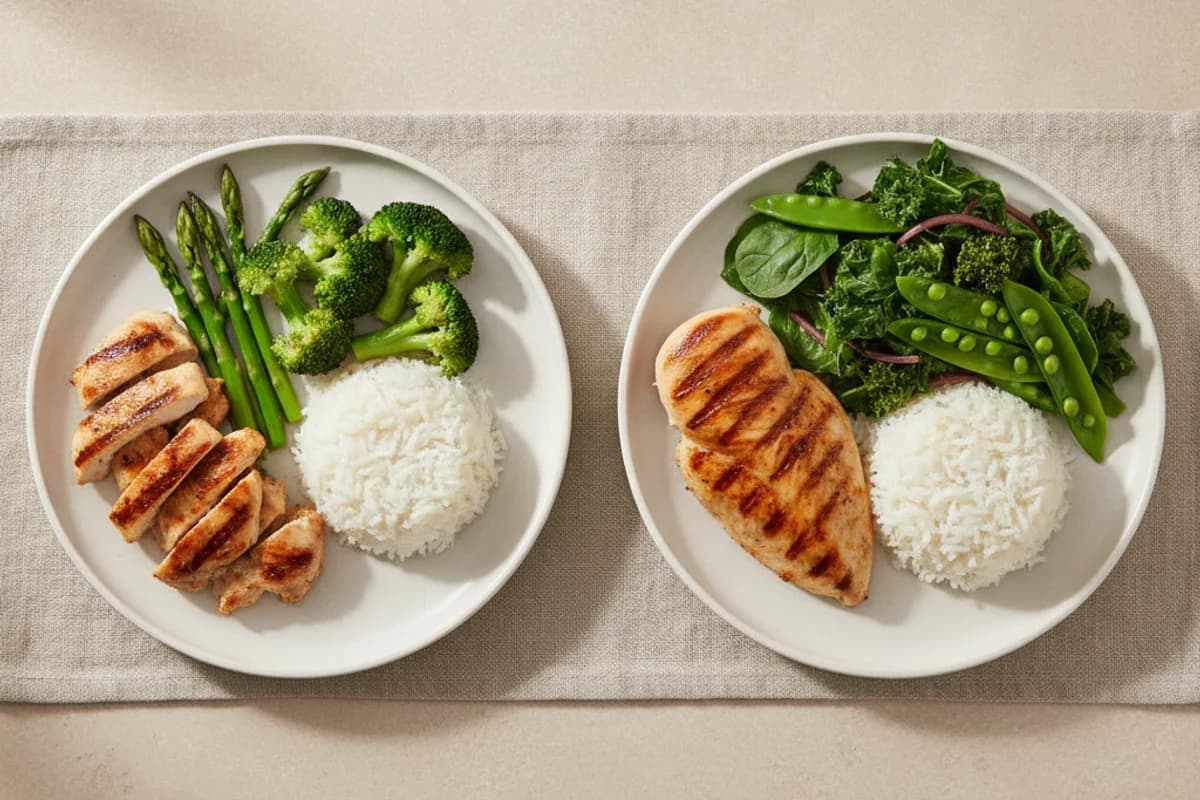
- Losing weight: a moderate deficit of about 10 to 20 percent below your total need is manageable for most people. Very low calorie targets belong under professional guidance.
- Gaining weight: a surplus of about 300 to 500 kcal a day supports a slow build, especially combined with strength training.
- Maintaining: eat roughly at the level of your total daily need.
For children and teenagers, during pregnancy and breastfeeding, and with underweight or an eating disorder, blanket deficits are not appropriate. Medical or nutritional support matters here.
Very large deficits rarely help more. They're hard to keep up, can cost muscle mass and lower training performance. A realistic pace you can hold for months gets you there more reliably.
Frequently asked questions
How many calories do I need per day?
For most adults the total daily need lands somewhere around 1,800–2,400 kcal for women and 2,200–3,000 kcal for men, depending on age, body size and activity. The best guide is your resting metabolism multiplied by an activity factor — the calculator above gives you a personal estimate.
How many calories does a woman or a man need?
On average, a moderately active woman needs roughly 1,900–2,300 kcal a day and a moderately active man roughly 2,400–2,900 kcal. Younger and more active people are at the top of the range or above it; older and less active people are lower.
How many calories do children and teenagers need?
It rises steeply with age. Young children need roughly 1,100–1,500 kcal, primary-school children roughly 1,700–2,000 kcal, and teenagers a lot more — active teenage boys can need 2,700–3,100 kcal or more during growth. These are averages; appetite and growth vary.
How many calories does an athlete need?
Far more than the averages. Depending on body size, sport, training duration and training phase, the need can sit several hundred to over a thousand kcal above the normal daily total. With high endurance volumes, totals of 3,000 to 5,000 kcal are possible.
How do I calculate my calorie needs?
Estimate your resting metabolism (BMR) with the Mifflin-St Jeor formula, then multiply by an activity factor (roughly 1.2 for sedentary up to about 1.9 for very active). The calculator in this article does both for you.
How many calories to lose weight?
A moderate deficit of about 300–500 kcal below your daily need is a sustainable pace for most people. Very aggressive deficits are hard to maintain and can cost muscle. Track the trend over weeks rather than chasing a daily number.
Sources
- German Nutrition Society (DGE): reference values for energy intake
- DGE: FAQ on energy intake (PAL values, pregnancy, breastfeeding)
- Swiss Society for Nutrition (SGE): D-A-CH reference values
- Mifflin MD, St Jeor ST et al. (1990): A new predictive equation for resting energy expenditureThe basis of the calculator — developed and validated for healthy adults, not for children or teenagers.
Your calorie target, built into your coaching
GetMyCoach plans your training and derives your calorie and protein targets from it — matched to your goal and your daily life.
This article is general nutrition information, not medical advice. Calorie needs are individual and the figures here are typical starting points, not prescriptions. If you have a medical condition or are pregnant or breastfeeding, get individual advice before changing your intake.