Loading…
Your nutrition coach for everyday decisions
You want to eat in a way that supports your goal, but working out what and how much can be confusing. GetMyCoach is an app with AI-powered nutrition coaching: personal calorie and protein targets, meal logging and suggestions for what to eat next. Use it on its own or alongside training.
Create your account, choose your nutrition goal and log your first meal. No training plan required.
Three steps to everyday nutrition guidance
Choose your goal
After signing in, add your body basics and nutrition goal to get personal calorie and protein targets.
Log your food
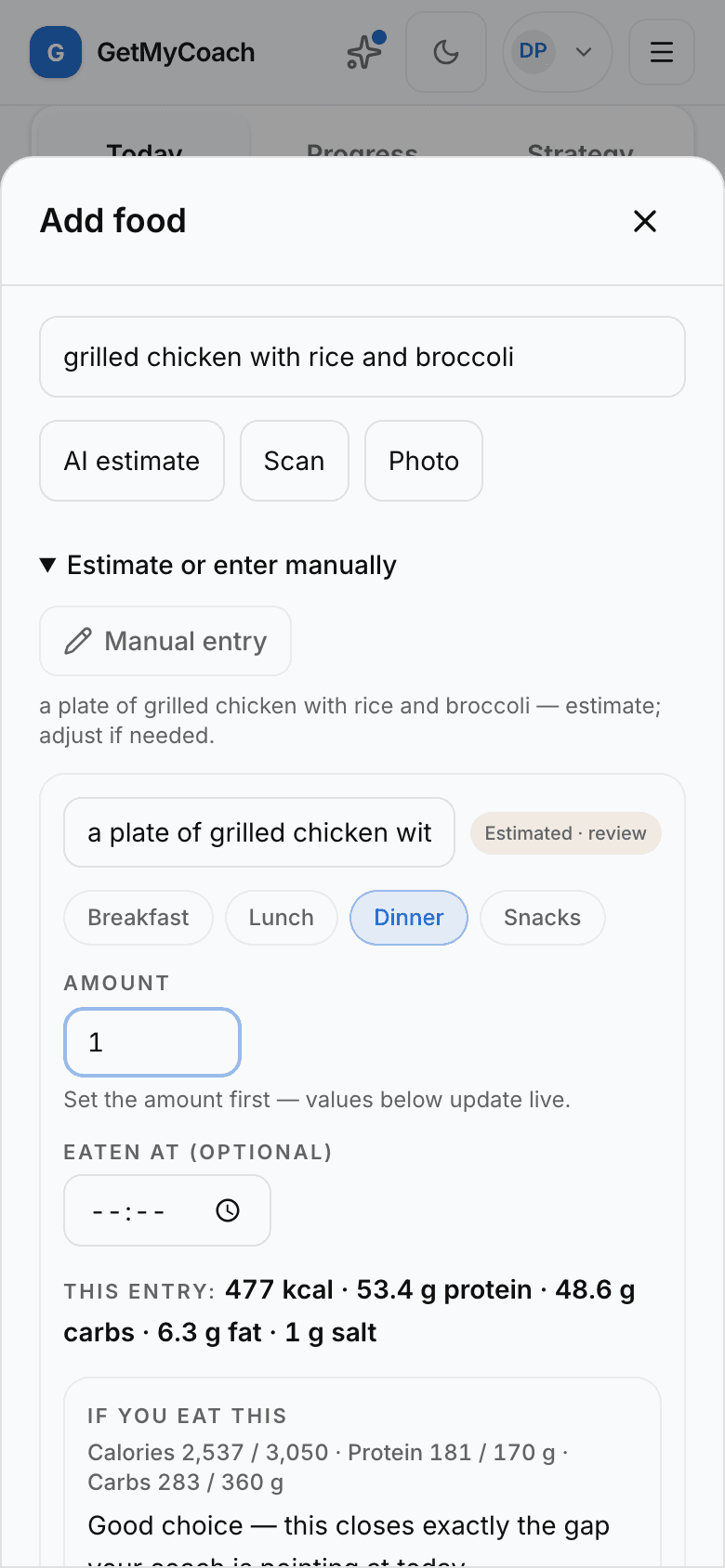
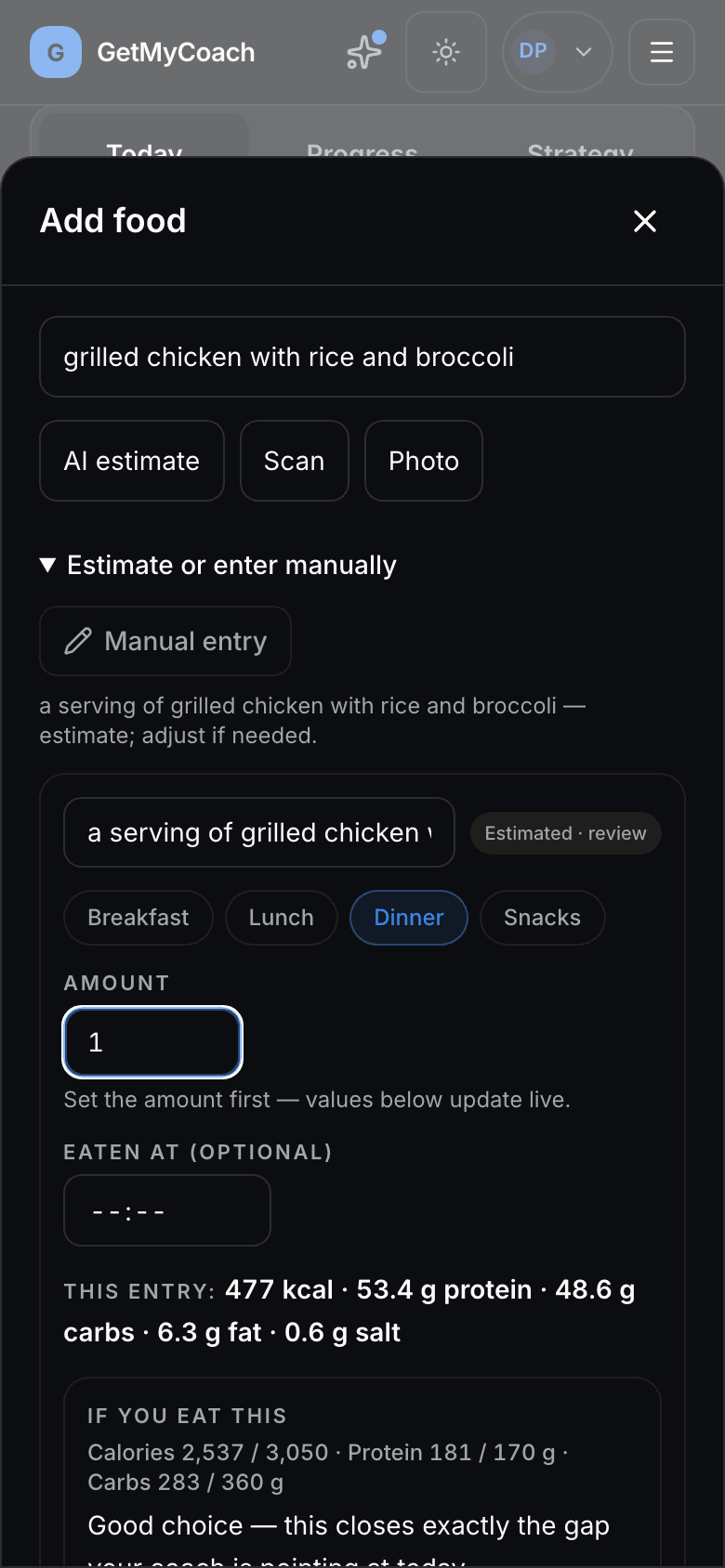
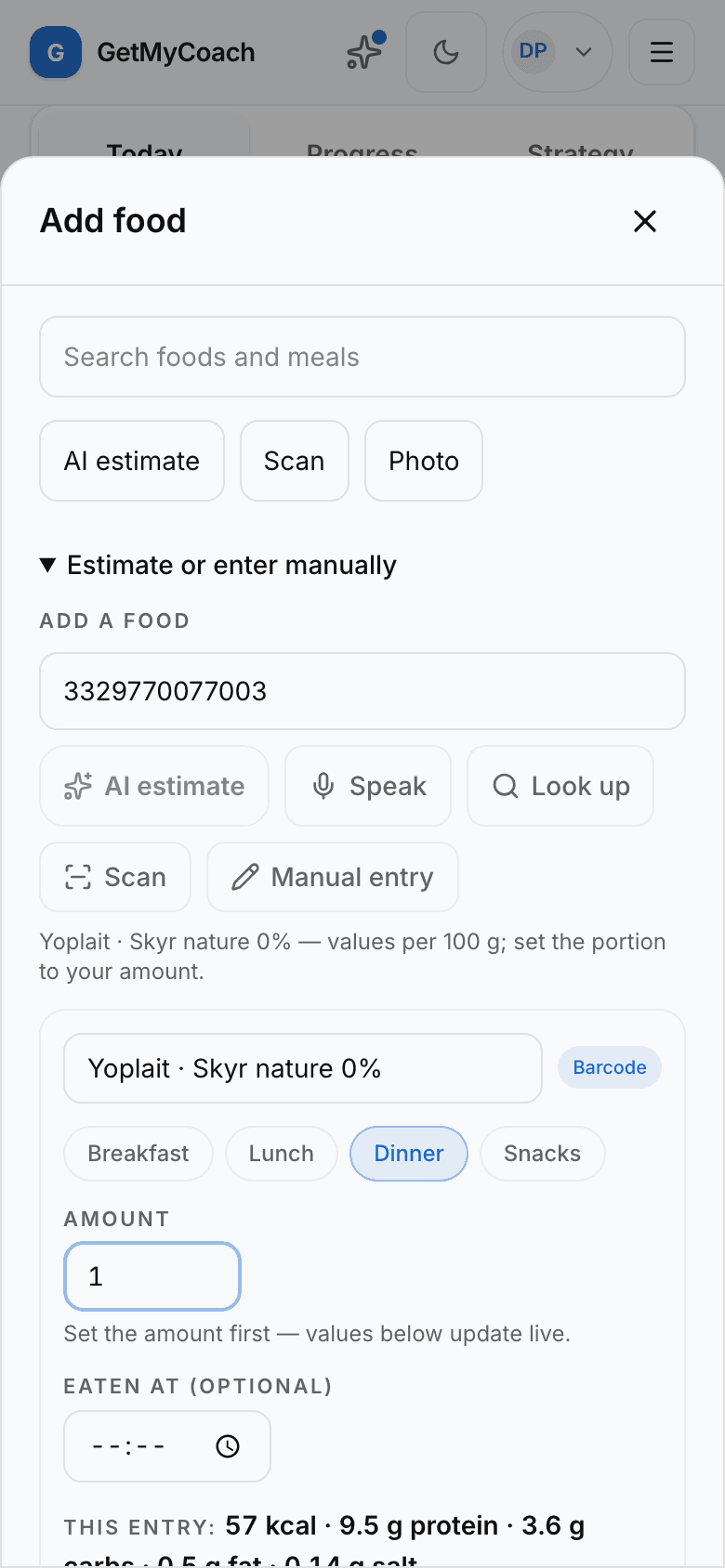
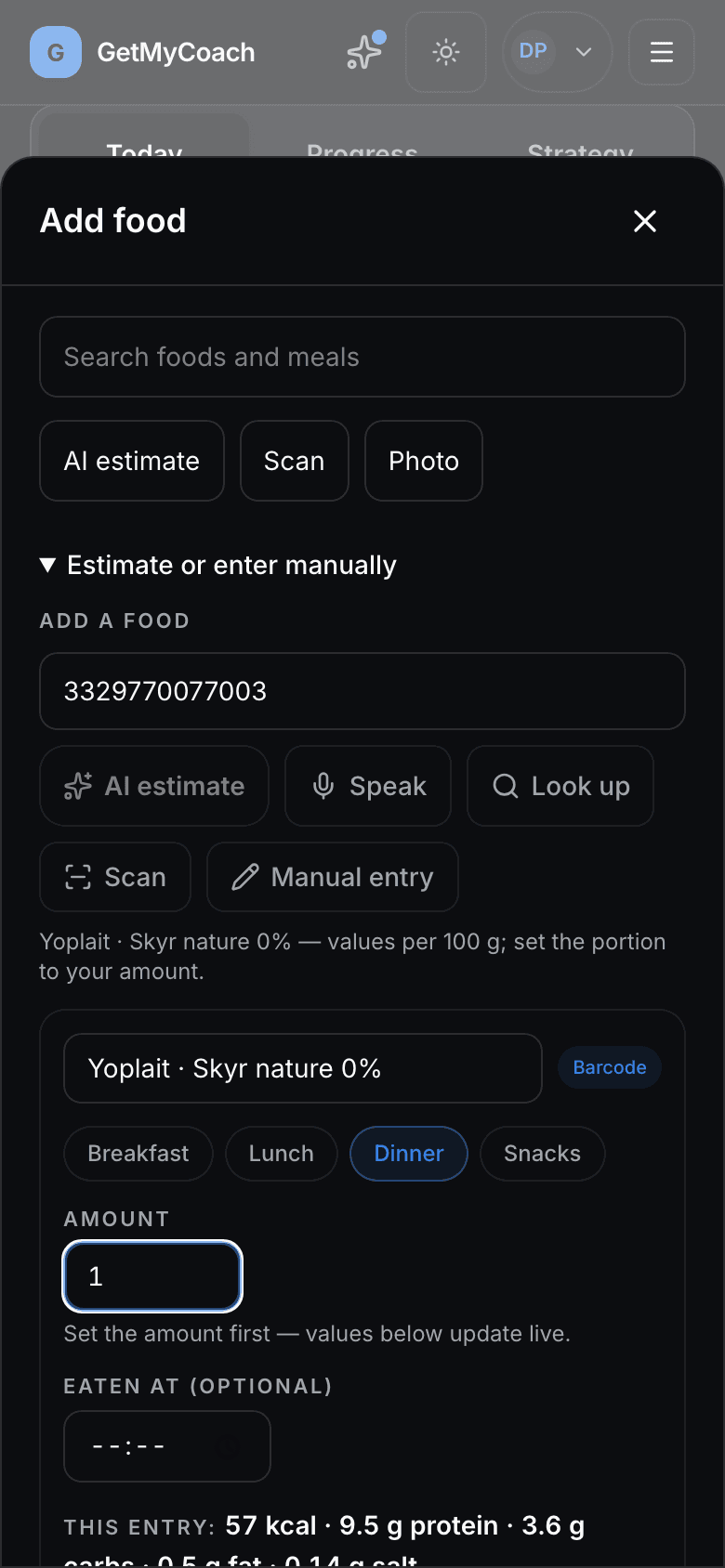
Describe a meal or scan a barcode. Check the values and portion before adding it to your day.
Use your coach’s guidance
See how your logged meals fit your targets and explore suggestions for what to eat next. You choose what works for you.
app.getmycoach.ch
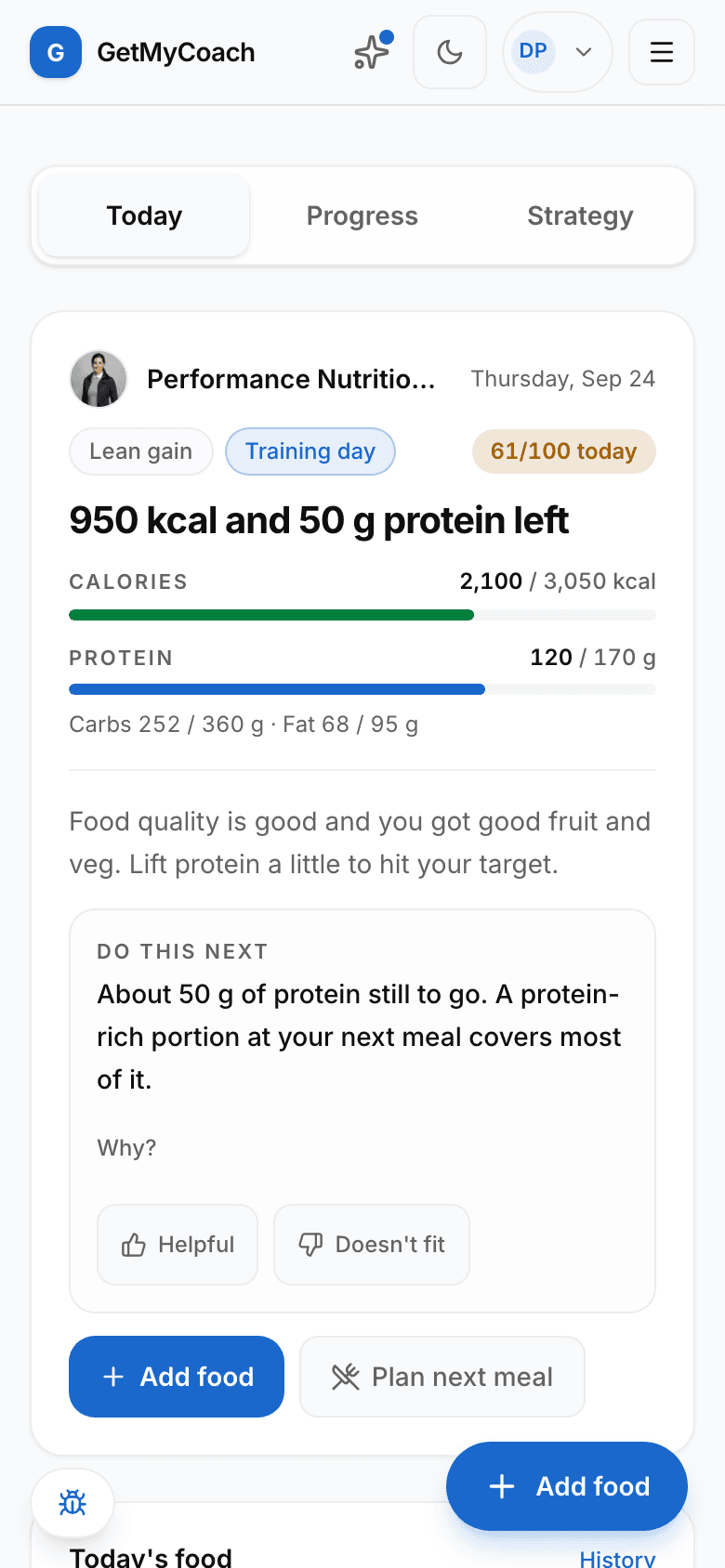
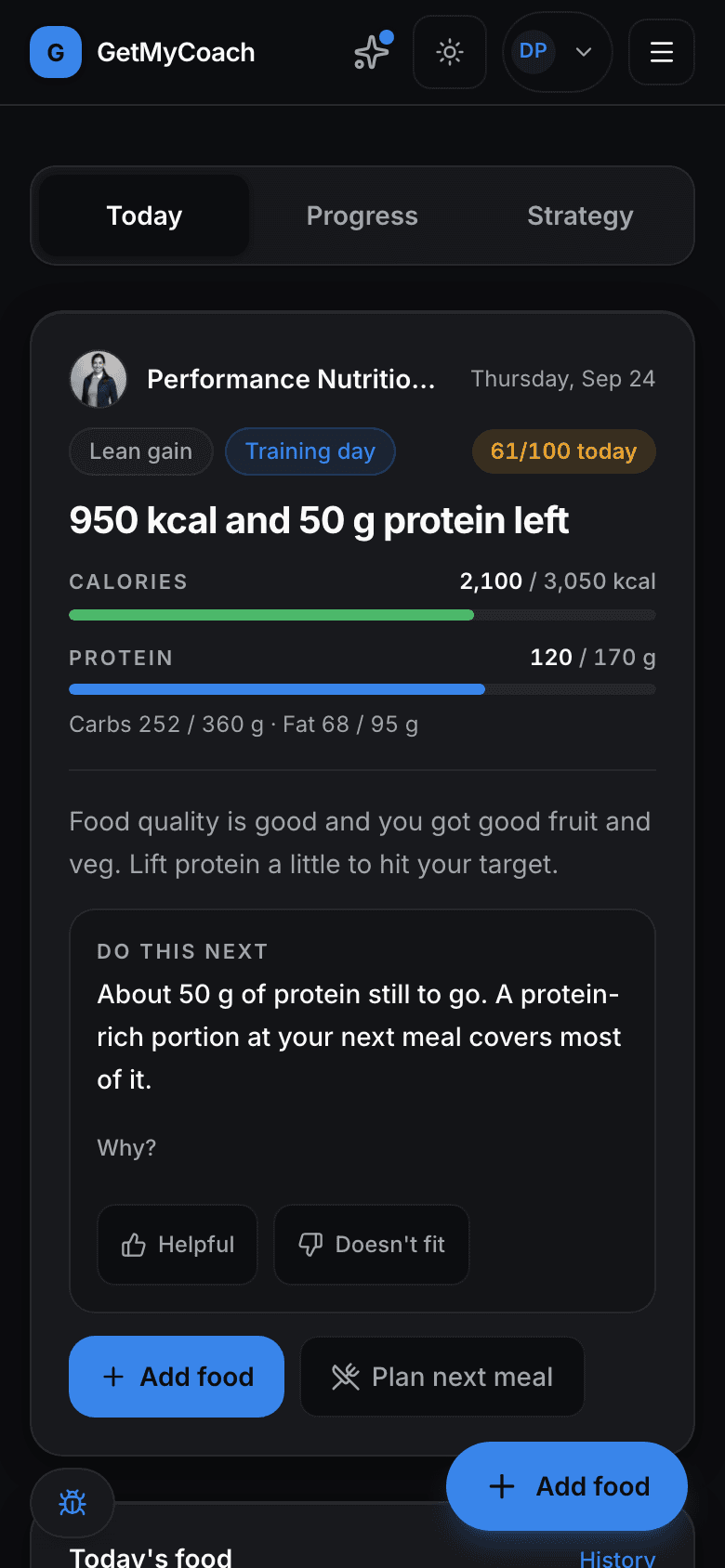
Log food — and know what to eat next
app.getmycoach.ch
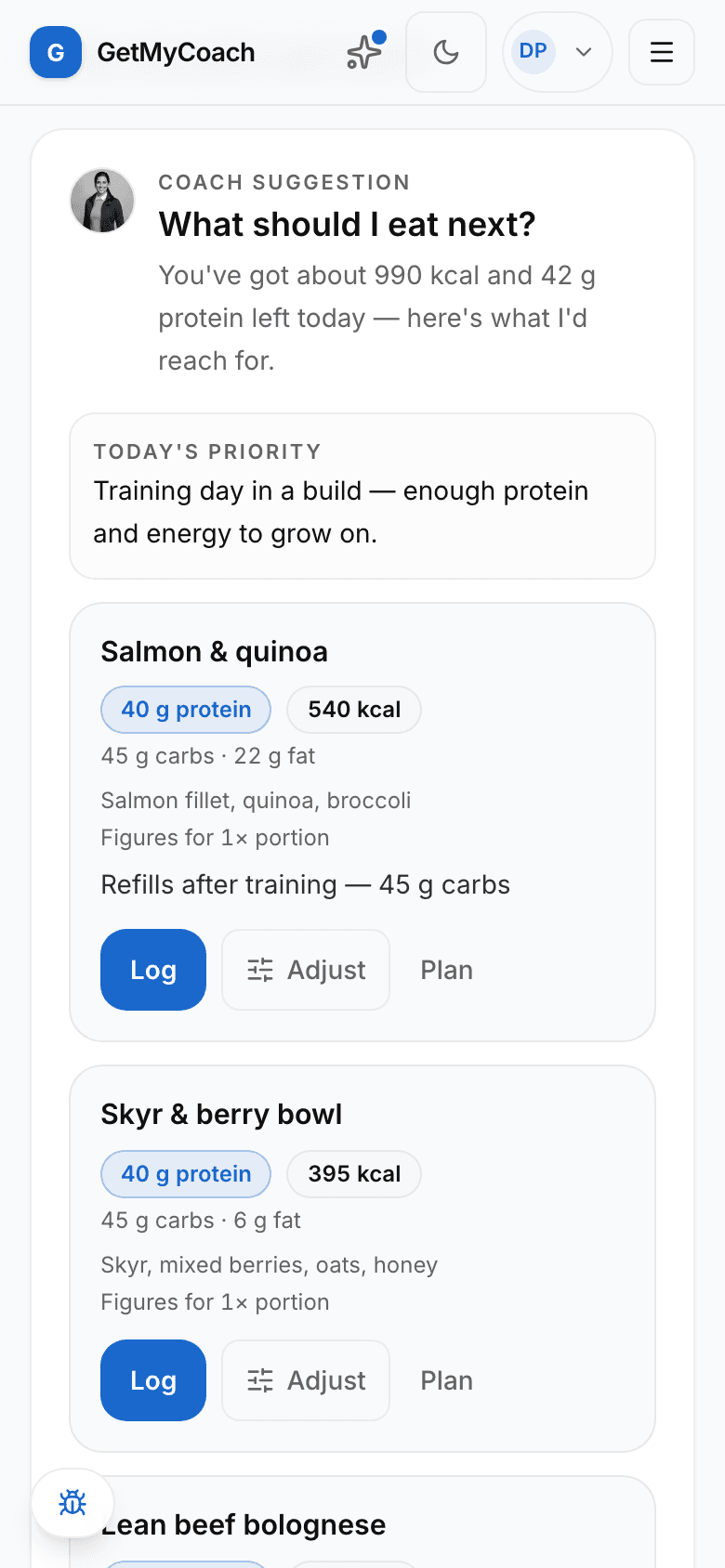
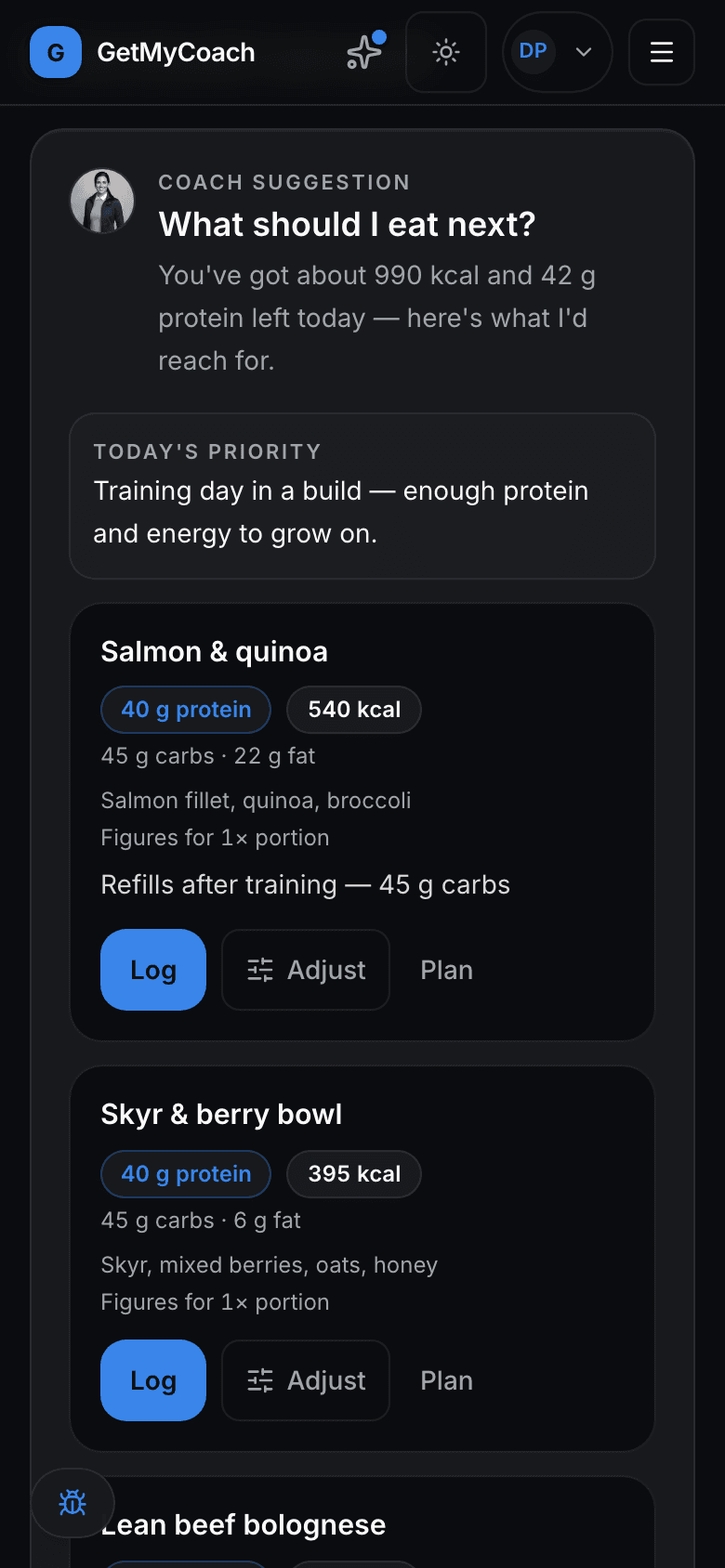
app.getmycoach.ch
app.getmycoach.ch
app.getmycoach.ch
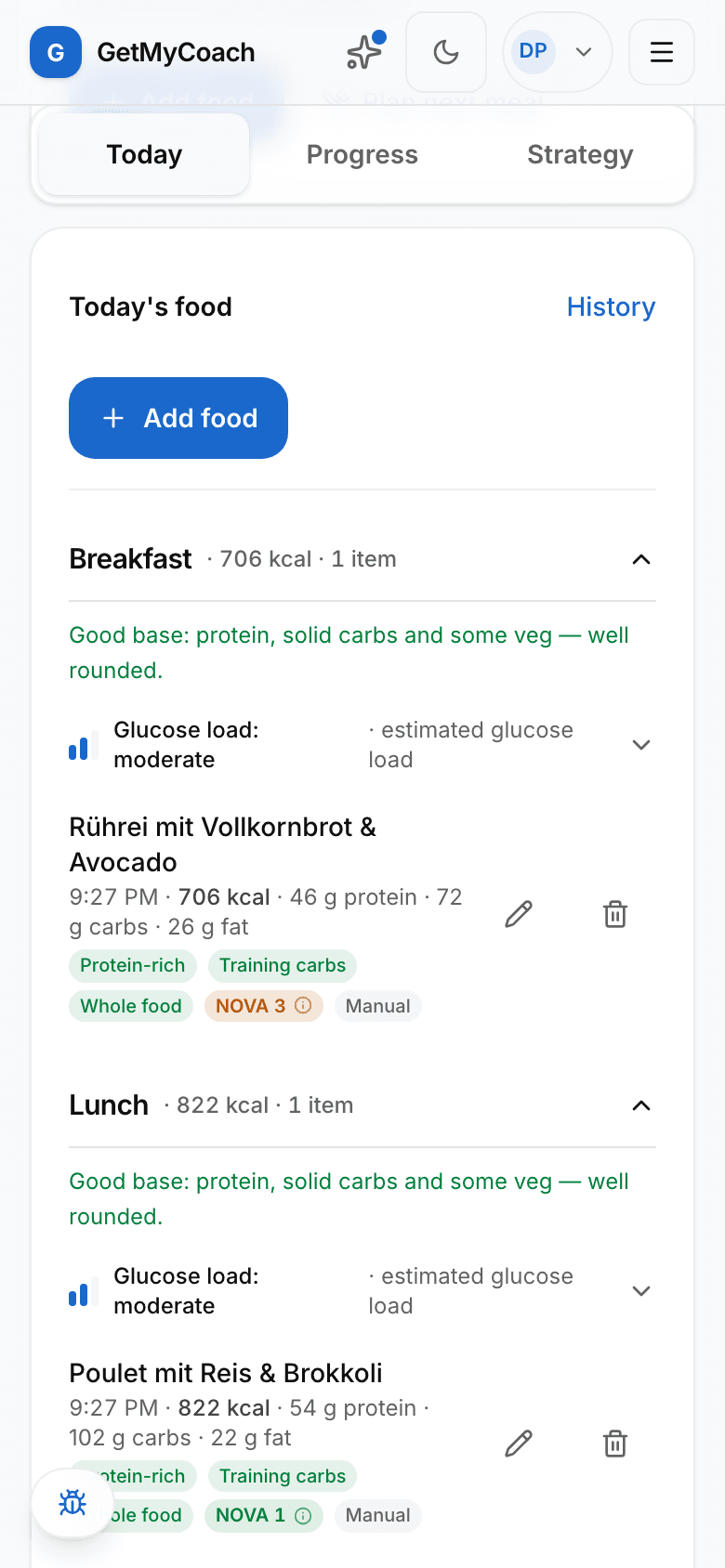
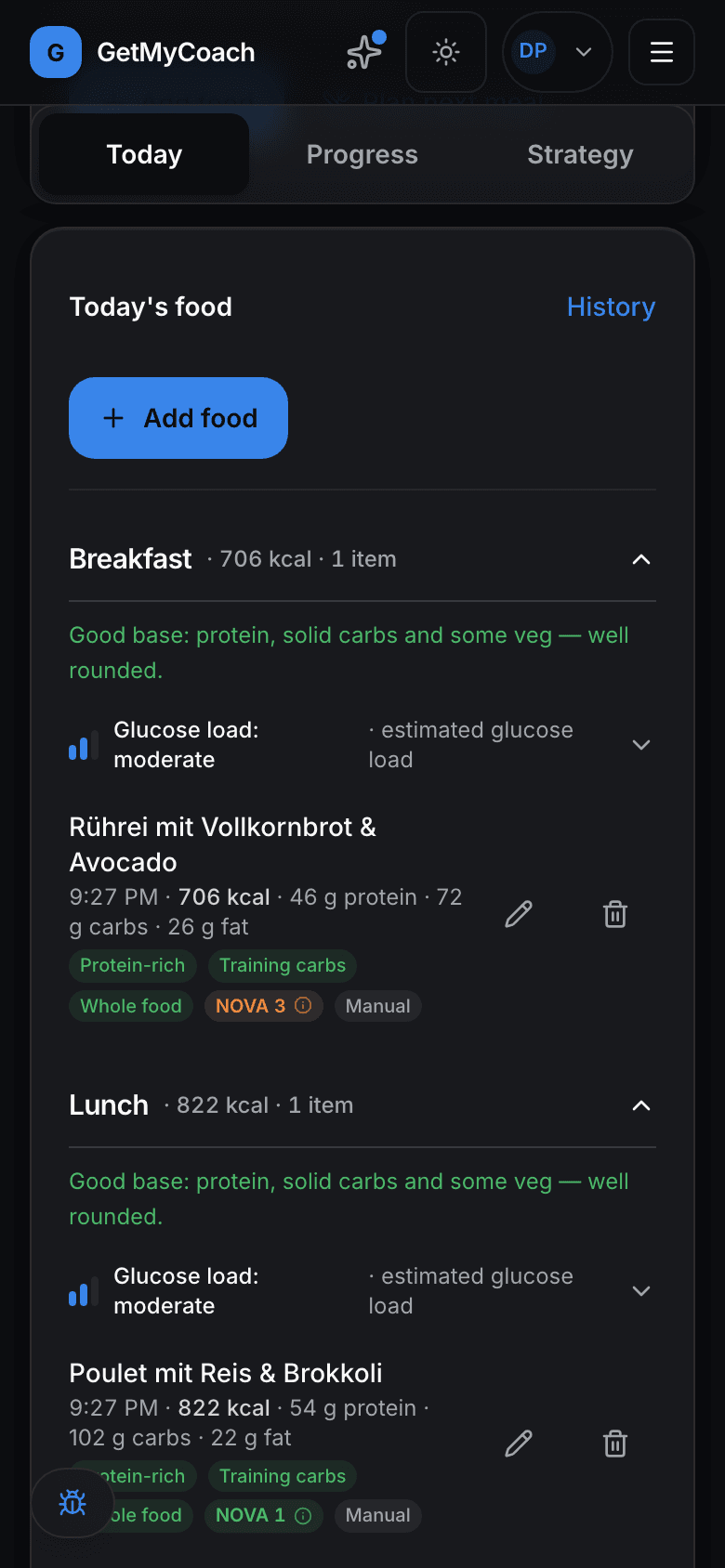
No training plan needed — and nothing here waits for one
Nutrition coaching is its own product here, not a tab that unlocks once you have a plan. Pick a goal, add your body basics, and you have daily targets and a coach the same day. You are never asked to choose a sport, set a training goal or build a training week.
Plenty of people arrive exactly this way: they already train on their own, or they are not training at all right now, and what they want is to get their eating under control. You don't need a training plan for any of what follows — that is a whole use of GetMyCoach, not half of one.
Three different goals, not one
Losing weight, gaining weight and simply getting a handle on how you eat are not the same job, and they don't get the same coaching. Losing weight means a deficit you can hold for months, with enough protein to keep the muscle you have. Gaining weight means a controlled surplus — small and checkable, so more of it arrives as muscle and less as fat.
And wanting neither is a real answer. Choose to hold your weight and the scale stops being the point: your targets sit at maintenance, and the day's read is about protein, food quality and whether your week is broad enough.
You choose which of the three you are doing, and you can change it whenever you want. Nothing on this page decides it for you, and opening the nutrition coach never sets a weight goal on your behalf.
Targets from your body and your goal
Your daily calorie and protein target starts where it should: your height, weight, age and how physical your day is outside training, put through a standard energy estimate, then moved up or down by the goal you chose — by a documented amount, not a mystery number.
You can see what it was built from. And when your body data is missing or implausible, you get a deliberately simpler estimate instead of a precise-looking number with nothing behind it.
A daily Coach Verdict, not just a running total
Log what you eat by name — the app recognises everyday foods in English and German — and your coach gives you a single daily score out of 100, weighing calories, protein, food quality, fuel timing and fibre.
Each item gets quick feedback — including an automatically estimated NOVA 1–4 food-processing score you can tap to understand — and each meal gets a line, so you can see at a glance what helped and what to adjust tomorrow — no spreadsheet, no weighing every gram.
An estimated glucose load per meal
Log a meal and your coach estimates how strongly it loads your glucose — low, moderate or high — from what you actually logged: the absorbable carbohydrate (carbohydrate minus fibre), how much of it is sugar, the kind of carbohydrate source, and the protein and fat sitting in the same meal. The portion comes from the amounts you entered.
You see the band, a relative course over the three hours after eating with the point the rise is expected to peak, and the reasons behind it — plus one or two non-medical things that help: a short walk after eating, a fibre source next time, or eating the carbohydrate last.
It is an estimate from logged food, not a blood-sugar measurement: no measured values, no sensor, and no statement about your health. Individual responses vary a lot. And when a meal’s carbohydrates are missing, you get “not enough data for an estimate” instead of a band.
Logging takes a minute — and the estimate is yours to confirm
You log a meal by typing what you ate, scanning its barcode or photographing it. Typing searches your own foods and the food databases and shows you what matched, with your saved foods, generic entries and branded products kept apart — a named product is never quietly swapped for a generic one. A barcode looks the product up directly.
An AI estimate is there for the times nothing matches, and it is a button you press rather than something that happens to your words. However the food arrived, the portion is put in front of you to adjust and confirm before it counts. Nothing lands in your day behind your back.
So it is much quicker than weighing every gram, and it is not zero effort: the portion is the part you check. Getting portions roughly right, consistently, is worth more here than getting one meal exactly right.
Your own meals, saved once and reused by the portion
The food you actually eat repeats. So you can name a meal — your porridge, the shake after training, the lunch you make every Tuesday — save it with its ingredients, and log it again in a couple of taps. A saved meal is private to you, and it works on both the web app and the Android app: save it on one, use it on the other.
Reusing is not a blind copy. Take what you want from an earlier day or from a saved meal, choose the day and the slot it belongs to, change the amounts that were different this time — less oats, more milk — and see the totals before you confirm. One action records it, and asking twice never writes it twice.
What you logged stays what you logged. Logging a saved meal takes its own snapshot, so editing that meal later, or deleting it, never rewrites a day you already recorded. And saving a meal is not eating it: nothing counts towards your day until you log it.
Tells you what to eat next
The hard part isn't the scoring — it's deciding what to actually eat. So GetMyCoach turns the calories and protein you have left today into two or three concrete meals, each with its macros and a one-line reason it fits your goal — real everyday foods, not a recipe blog.
Log one in a tap, adjust the portion, or hit “plan the rest of the day” and your coach lays out lunch, a snack and dinner that together hit your remaining targets. Suggestions, never a fixed menu: there is no prescribed meal plan to fall off, and every choice stays yours to log, change or ignore.
It tells you what it knows — and what it doesn't
Most tracking apps answer every question, including the ones your data can't answer. This one doesn't. Only the days you actually tracked count towards a read, today is left out until it's done, and when there isn't enough to say something solid your coach says exactly that instead of producing a number that merely looks precise. Behind every read sits a “Why?” that shows what it was based on — how many days, which values, which period.
You also get one prioritised thing to do, not a list of everything that could be better: protein that's already where it should be doesn't get raised again. And when a pattern is established — not one off day — your coach suggests a single way to make tomorrow easier. When there's nothing worth preparing, it says nothing.
A week's read on your nutrients, without the pseudo-precision
Across the days you tracked, your coach takes one nutrient at a time and answers the question you can actually act on: is your week covering it? Where you've logged real values and enough of your day is accounted for, that answer is quantitative. Where it isn't, it's about your food sources — “this barely shows up in your week” — instead of a percentage nobody could stand behind.
It's a read on how broad your eating is, not a lab result: no deficiency claims, no diagnosis, and no nutrient table to manage.
Fibre and sugar, where the numbers are really there
Fibre and sugar are only read as numbers when enough of your day carries a value its source actually declared. Where that holds, your fibre is read against a published adult orientation, and your sugar against a reference derived from your own logged energy rather than one flat gram figure that would be wrong for a 1'600 and a 3'800 kcal day alike.
Where those values are missing, your coach says so rather than adding up whichever of your foods happened to have a barcode. Neither reading is a statement about your health, and an absent value is never treated as a zero.
Supplements: search your product, not type it out
Your coach reads what you log, and suggests a supplement only when a concrete gap shows — never a standard stack everybody gets. A suggestion names a generic type, never a brand or a product, carries the source it rests on, and starts with the food that could close the gap wherever food realistically can. When nothing is missing, that is the answer you get.
Your own supplements are a routine you build by searching a curated library instead of typing every field: by product, brand, category or active ingredient, with German and English spellings both understood — “Kreatin”, “Creapure”, “Cholecalciferol”, “fish oil”. A scanned barcode is resolved against that library first, your own serving is converted from the manufacturer's, and you are told when an active is already planned in another routine. Change the brand later and your history stays with the product you were actually taking at the time. A brand name in the library is a search result, not a recommendation or a verdict on quality, and the library is curated rather than complete — a product that is not in it you enter by hand.
A routine is a plan of what you intend to take, not a daily tick-off: there is no checkbox to miss. GetMyCoach doesn't sell supplements and never gives you a diagnosis.
Food and supplements in one account
For the nutrients where both sides carry real numbers, you see three things rather than one: what comes from your food, what comes from your planned supplements, and the sum. The total never replaces the two it came from, and only the same measure is ever added — an elemental amount and a compound weight are not quietly converted into one another.
When your food side cannot be evaluated, the number is simply missing. That is deliberate: a sum of a real supplement amount and an unknown food side would look exactly like an honest one. And it stays bookkeeping of what you plan to take — not a measurement, not a verdict on whether it is enough, and never compared against a limit, because published maximums apply to what you take as a supplement rather than to the sum.
Targets that adapt to your body over time
Your weight and intake are tracked over a rolling week, so the picture isn't one noisy day. When your trend drifts away from your goal, your coach suggests adjusting your calories — up or down — instead of leaving you to guess. It is a suggestion about your target, not a promise about your weight: how fast a body responds is not something an app can guarantee.
You also see how fast your weight is actually moving: a rate in kilos per week, and whether that is faster, slower or the same as the period before. If it stops moving, that gets named as a plateau together with how long it has lasted — the thing a line that fell and then flattened hides. Without enough weigh-ins to be sure, no rate is reported at all, and the web and the app quote the same number.
How long this has been running — and a pause that keeps your goal
Losing fat has no end condition here: no target weight is required, not before you start and not as a condition for anything. So something has to say how long your current phase has actually run, and that is counted for you. If you never confirmed a phase, it is estimated from your own weigh-ins and labelled as an estimate — a phase only becomes real by you confirming it, never by us guessing.
When a deficit has run a long time and something says it is no longer working — the weight has stopped, it is falling markedly slower, or you yourself recorded cutting sessions short for low energy — your coach brings up a maintenance pause. You set it and you end it. Your goal stays exactly where it was, so after the pause you carry on without re-stating anything. Your coach brings it up; it does not decide about your body, it promises nothing about what a pause will do for you, and it never tells you that a long diet is harmful.
It remembers what it asked — and comes back to it
This is the part that separates a coach from a dashboard. When your coach asks you to change something, it records the ask together with what that change is meant to move, and comes back to it after a time that fits the suggestion. Then it reports what your numbers did. If they moved, you hear that — as something observed, never as proof that the change caused it.
If nothing moved, it does not repeat the same advice: it revises its own read and tries a different angle. Turning an ask down is a valid answer and changes what gets suggested next. It also checks its own planning — if the plan announces a step up, that step has to be in the prescription. Several open points arrive as one prioritised list that does not contradict itself, and “carry on, nothing needs changing right now” is a complete answer rather than a shrug.
When training gets harder, it says what might be contributing
Your weight pace and your eating are described above on their own. The reading that connects them is this one: your coach also reads your logged training against what the plan prescribed, so when the prescribed effort is no longer being reached, or a lift has stopped moving, it can put that next to the week you ate. A macro that has been short for weeks is named as something that can plausibly contribute to the energy you have for training.
It is a reading from your own logs, not a measurement, and it names possible contributions rather than causes. A deliberately lighter week is read as exactly that, not as exhaustion. There is no recovery status, no readiness score and nothing about hormones, metabolism or a deficiency — and nothing here comes from sleep or a sensor, because none of that is collected. You get one prioritised thing, what it rests on, and “not enough data yet” when that is the honest answer.
Training is optional — and this is exactly what it adds
If you also train with GetMyCoach, the training your plan prescribes is folded into your maintenance as a weekly average, which raises your daily target. It stays one number for the week: it does not swing between a hard day and a rest day.
What does know the difference is your coach. The day's guidance, how your verdict reads your intake and which meals it suggests all take today's session into account. And because both live in one app, your coach can look at them side by side — how you ate before the sessions you finished, and before the ones you didn't. That is reported as two things observed together, never as cause and effect.
None of it is a precondition. Add a plan later and your targets simply start accounting for it; never add one, and nothing here is missing.
Frequently asked questions
- Do I need a training plan to use it?
- No. The nutrition coach works entirely on its own: set a goal like losing weight, get daily calorie and protein targets, and a daily verdict on how you ate. You are not asked for a sport or a training week. A training plan makes the targets account for your training, but it is optional and you can add one at any time.
- What do I have to enter before I get a target?
- Your goal, and the body basics an energy estimate needs: height, weight, age, sex and how physical your day is outside training. That is all — no sport, no training days, no plan. You can change any of it later and the targets follow.
- Do I need an account?
- Yes. Starting nutrition coaching creates your GetMyCoach account, because your targets, your food log and your coach's read have to persist and belong to you. It is free during early access and no card is asked for.
- Do I have to weigh and count everything?
- No. You log what you eat by name, by barcode or from a photo, and the app handles the rest — then your coach gives you one daily verdict instead of a column of numbers. A described or photographed meal comes back as an estimate you confirm or adjust, so the portion is the part that still needs a moment of your attention.
- Does it suggest what to eat, or create a meal plan?
- It suggests, it doesn't prescribe. Your coach turns the calories and protein you have left into two or three concrete meals — and can plan your whole remaining day to hit your targets — but every choice stays yours to log, adjust or ignore. There is no fixed menu to follow and none to fall off.
- Will it make me lose a certain amount of weight?
- No, and it never claims a number. It sets a target you can eat to, shows you what your weight is actually doing as a trend, and suggests adjusting the target when the trend drifts from your goal. What your body does with that is not something any app can guarantee.
- Does it estimate a meal’s glucose response?
- Yes — as an estimate, from the food you logged. Your coach reads the absorbable carbohydrate, the sugar share, the type of carbohydrate source and the protein and fat in the same meal, then shows a low, moderate or high band, a relative course with the expected peak, and the reasons behind it. It is not a blood-sugar measurement: no measured values, no sensor, and no statement about your health. If a meal’s carbohydrates are missing it says there is not enough data for an estimate, rather than showing a band.
- Does it tell me if I'm deficient in something?
- No — that's a medical question, and it isn't one this app answers. What your coach does is look across the days you tracked and say whether your week covers a nutrient through your food, one nutrient at a time. It's a read on how broad your eating is, not a diagnosis.
- Does it recommend supplements?
- Only where a real gap shows in your logged food. A suggestion names a generic type with the source behind it — never a brand, and never a product we sell. Food comes first wherever food can close the gap, and “you don't need anything extra right now” is a normal answer.
- Is the nutrition coach free?
- Yes — it's included free during GetMyCoach's early access, whether or not you ever create a training plan.
- Does it work in German?
- Yes. The whole experience, including the food recognition and meal suggestions, works in both English and German.
- How long have I been dieting — does it keep track?
- Yes. Your current nutrition phase is counted, so you can see how long a deficit has actually run — and if you never confirmed a phase, it is estimated from your own weigh-ins and marked as an estimate. No target weight is required for any of it. When a deficit has run long and something says it is no longer working, your coach brings up a maintenance pause you set and end yourself. Your goal stays where it is, so you carry on afterwards without re-stating it. What a pause will do for you is not something we promise.
- Do I have to type my supplements in by hand?
- Usually not. You search a curated library by product, brand, category or active ingredient — German and English spellings both work — and a scanned barcode is checked against that library first. Your own serving is converted from the manufacturer's, and you are told when an active is already planned in another routine. The library is curated rather than complete, so a product that is not in it you still enter by hand. Brand names there are search results, not recommendations.
- Does my coach follow up on its own suggestions?
- Yes — that is the point of it. An ask is recorded with what it should move, and your coach comes back to it after a time that fits. If your numbers moved, it reports that as something observed, never as proof the change caused it. If nothing moved, it revises its read instead of repeating the same advice. Saying no is a valid answer, and “carry on, nothing needs changing right now” is a complete one.
Start with your nutrition goal
Create your account, set your nutrition goal and log your first meal. Your coach helps you understand your targets and choose your next step. Free during early access; no training plan required.
Create your account, choose your nutrition goal and log your first meal. No training plan required.