Loading…
An AI nutrition tracker for calories, macros and meals
GetMyCoach's nutrition tracker is a food log with a coach attached. You log a meal by describing it, photographing it or scanning its barcode; you see what is left of today's calories and protein; and your coach turns that remainder into two to four real meals. It works with no training plan at all — and it tells you when it does not know something instead of inventing a number.
Creates your free GetMyCoach account and opens the nutrition coach. No training plan, and no sport to choose.
app.getmycoach.ch
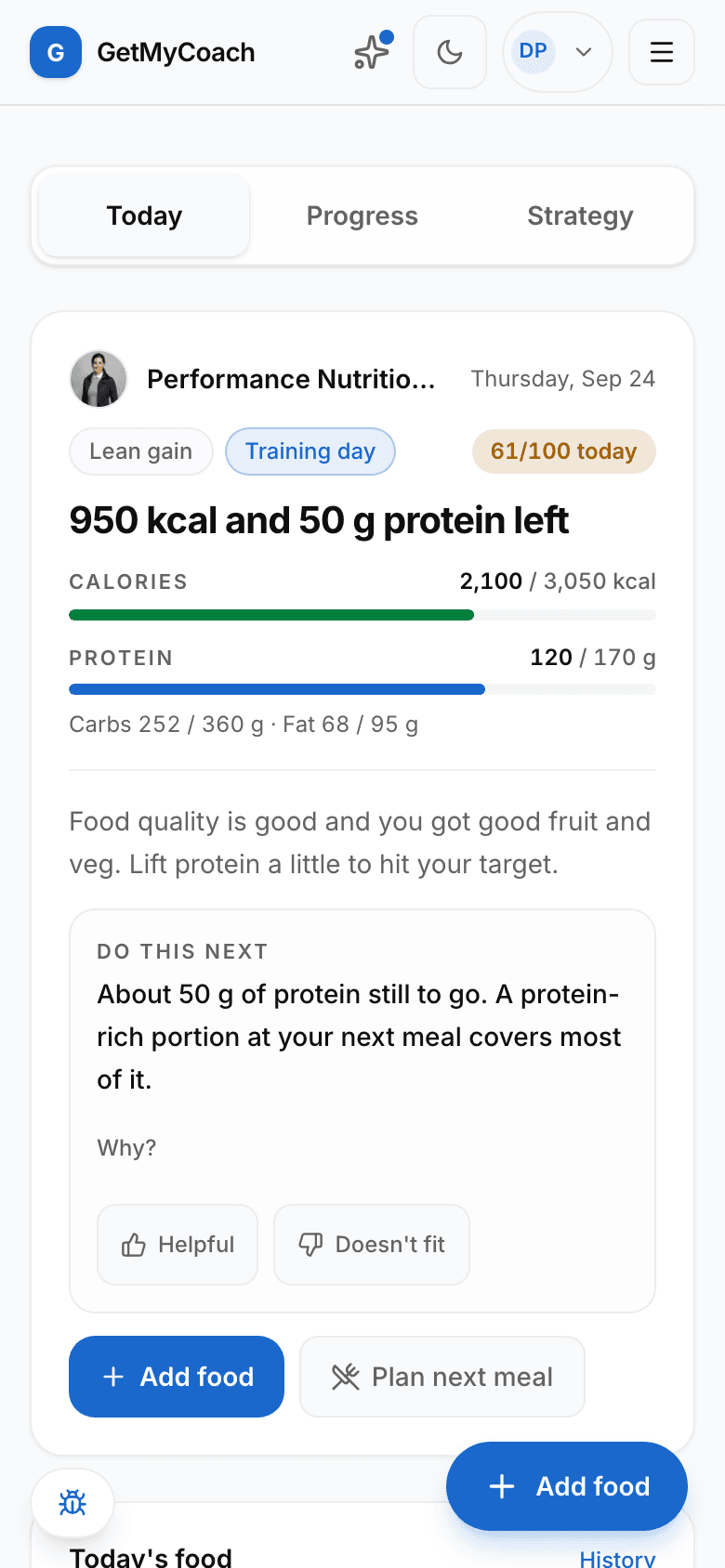
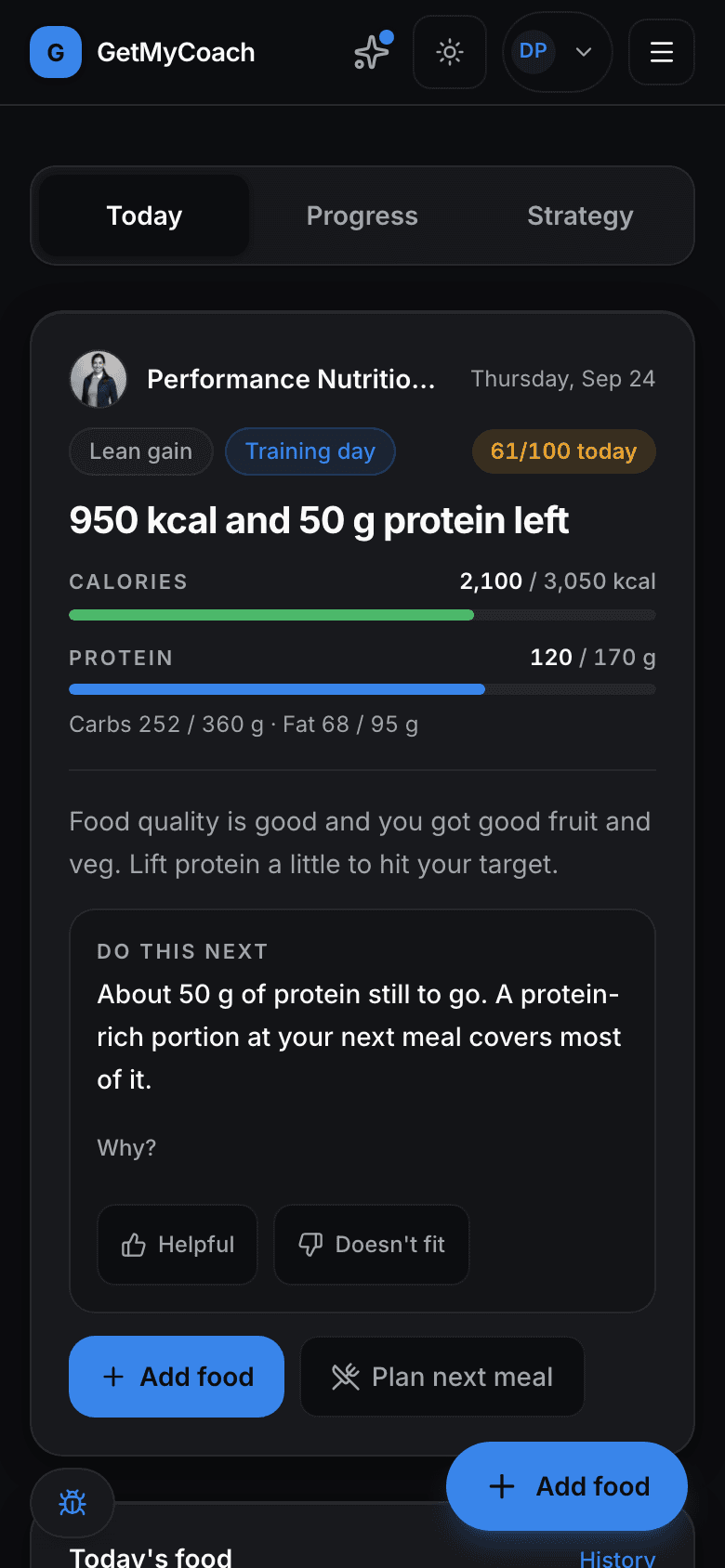
The whole loop: log it, read it, decide what's next
app.getmycoach.ch
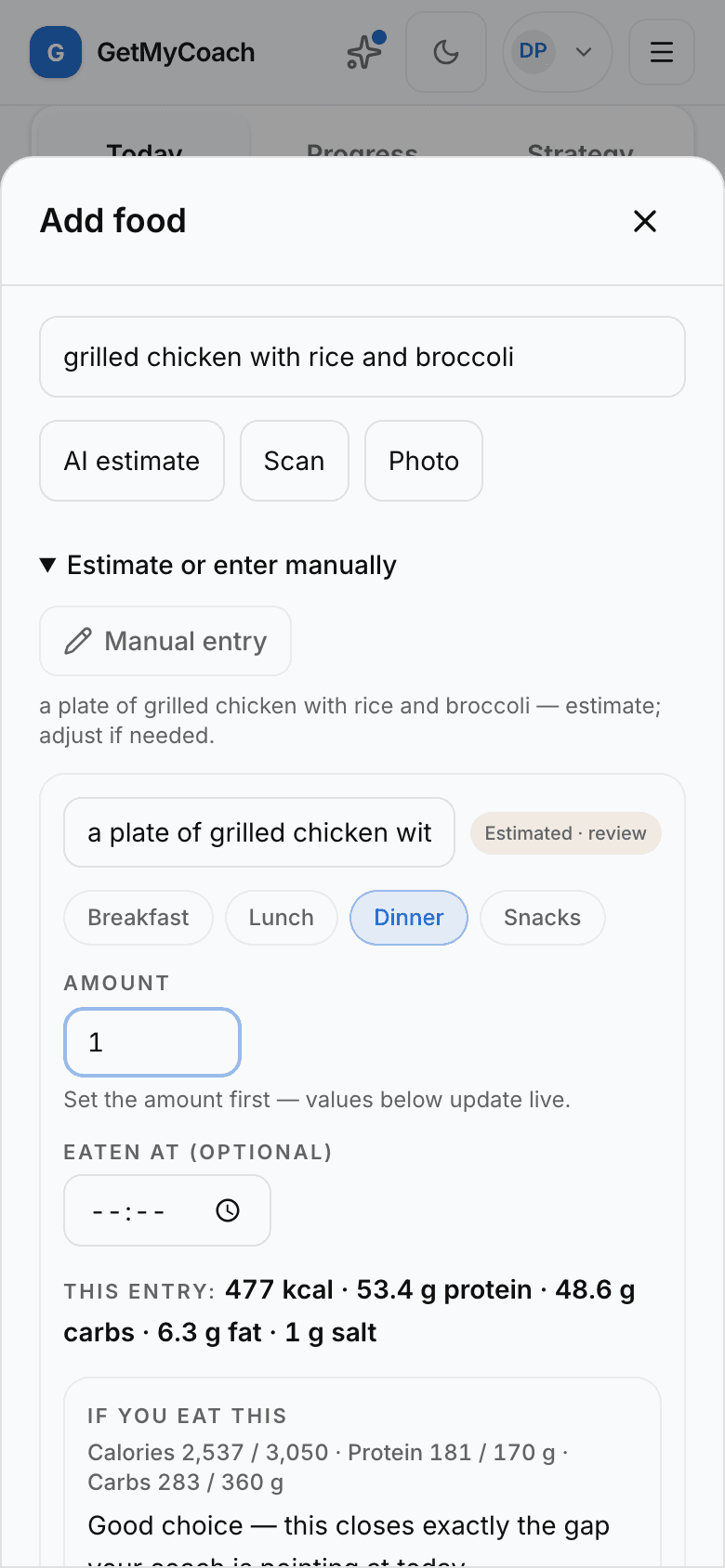
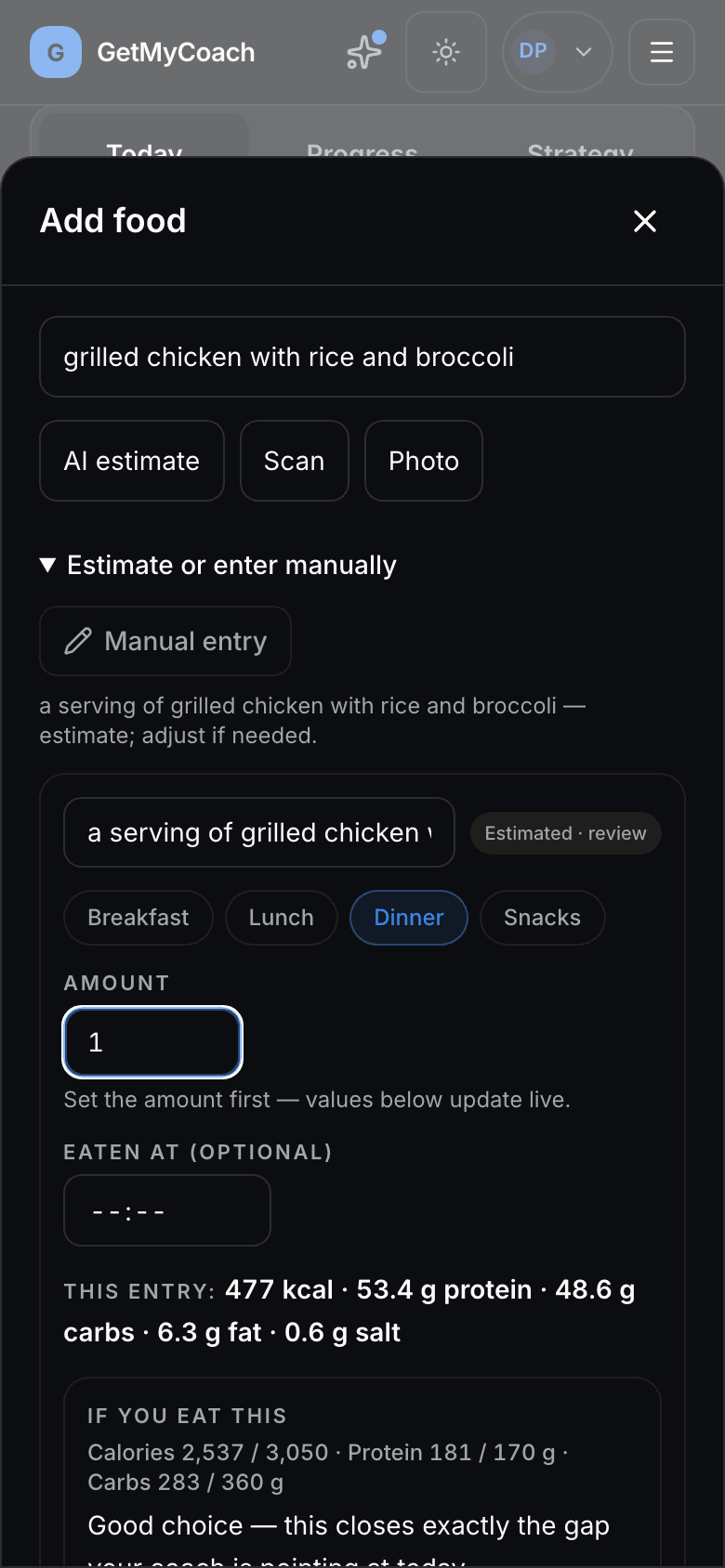
app.getmycoach.ch
app.getmycoach.ch
app.getmycoach.ch
Logging a meal: five ways in, and none of them a spreadsheet
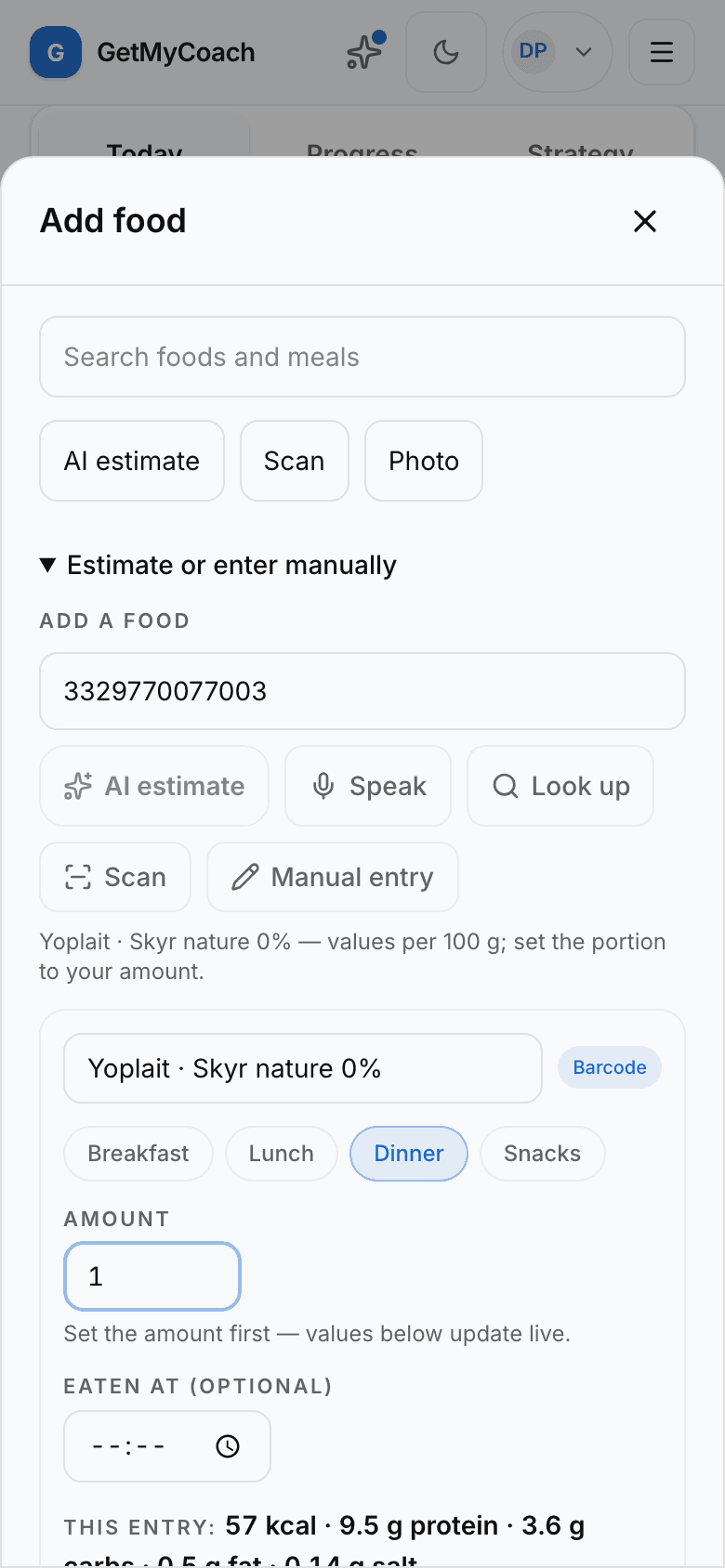
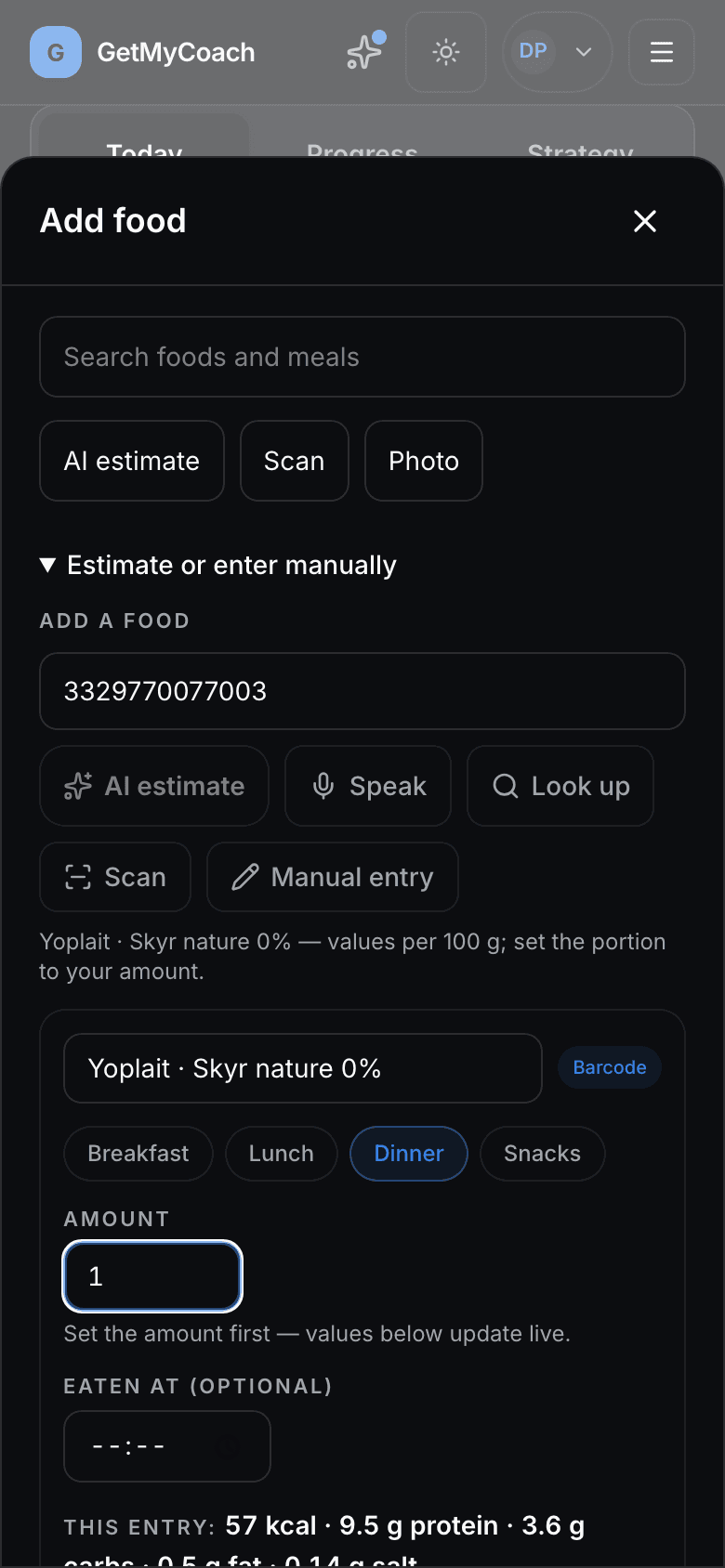
The reason most food logs get abandoned is not the maths — it is the twelve taps it takes to record a sandwich. So there are five ways to get a meal in, and you use whichever is fastest at that moment: describe it in plain language (in English or German), photograph the plate, scan the product barcode, search the food database by name, or type the numbers in yourself.
Typing and searching lead to the same place: your own saved foods and the food databases, with personal, generic and branded results kept apart so a named product is never quietly swapped for a generic one. A barcode goes straight to the product. Those carry the source's own stated values, and the source and its preparation — raw or cooked rice are not the same row — stay visible.
A photo, or an AI estimate you ask for by name, is a good guess and nothing more — so it arrives in editable fields, with every number, the portion multiplier and the name open for you to correct before you save it. The tracker never blurs the difference, and nothing is estimated on your behalf because you typed something.
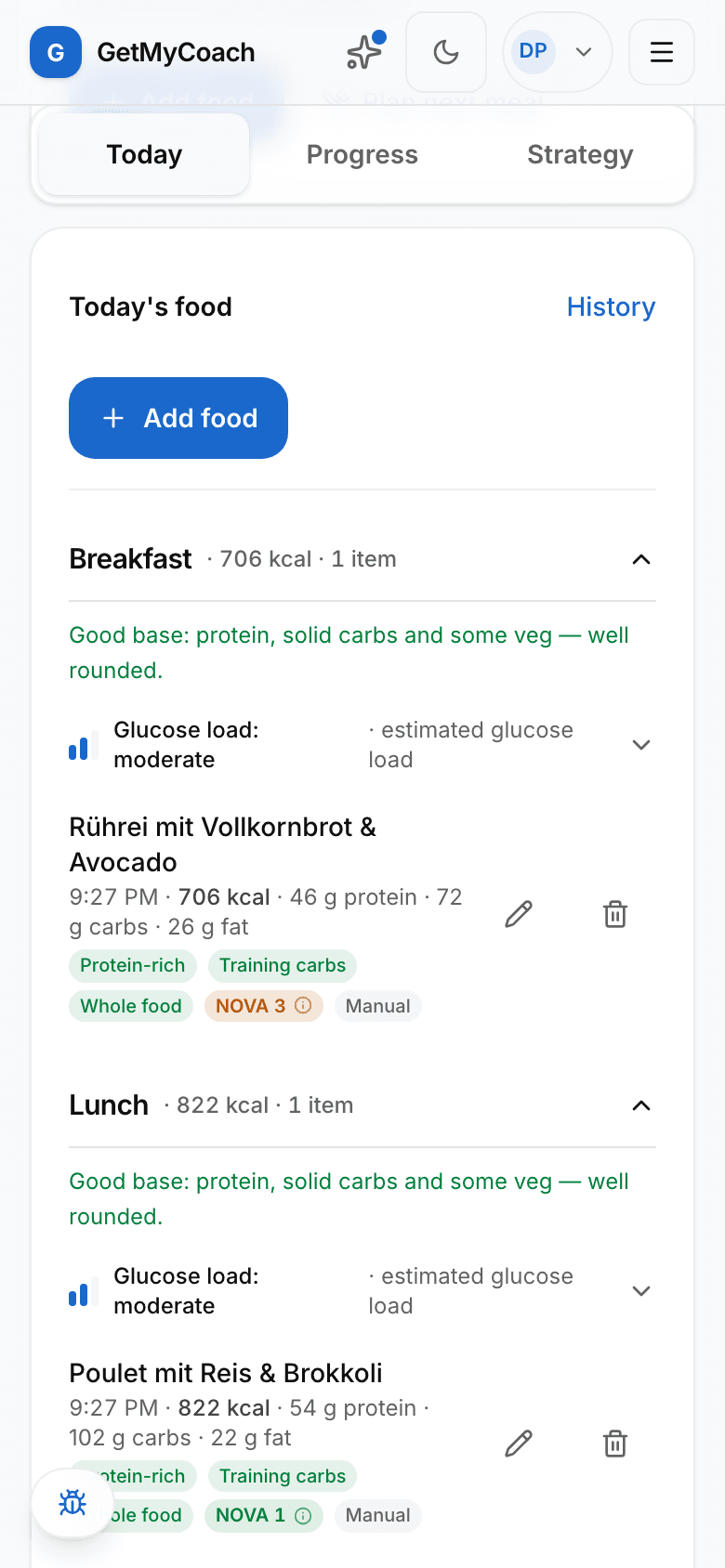
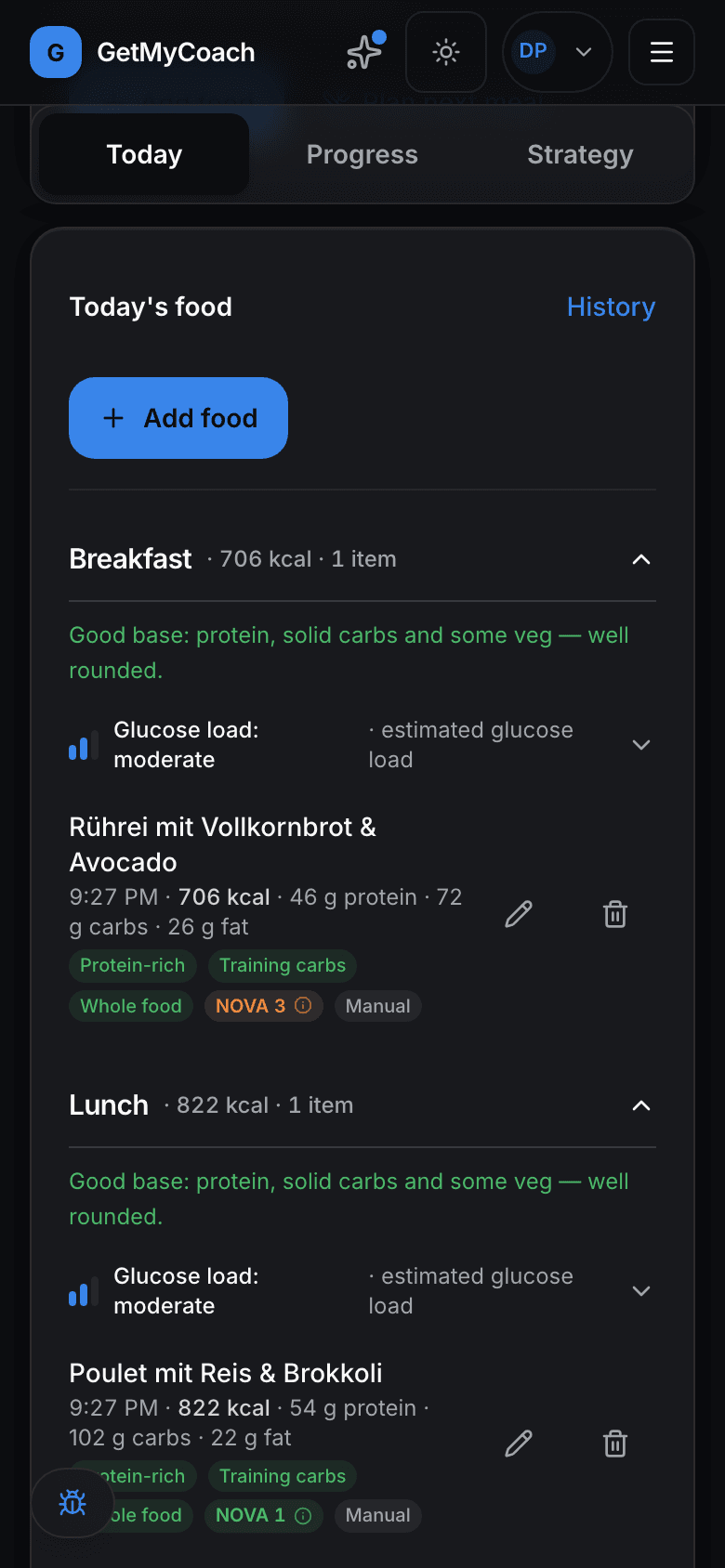
After saving, a logged item is still yours: each row shows a badge for where it came from — database, photo, estimate or entered by hand — and can be edited or deleted, with a window to undo the deletion. An estimate-heavy day therefore looks like an estimate-heavy day rather than passing itself off as measured.
The sixth way in: a meal you already saved
Most people eat the same twenty things. So once a meal is right, name it and save it with its ingredients — and from then on it is two taps, on the web app or the Android app, whichever you have in your hand.
Reuse keeps the review step. Pick the items you want from a saved meal or from any earlier day, choose the day and slot, adjust the amounts that were different this time, and check the totals before you confirm. Confirming twice does not log it twice.
A logged meal is a snapshot of itself: editing or deleting the saved version later leaves every day you already recorded exactly as it was. And saving a meal records nothing — it counts when you log it, not before.
More than a calorie counter
Calories are one number out of several that decide whether a day supported your goal. So the tracker gives you a daily calorie target and a daily protein target — plus carbohydrate and fat — computed from your body data and the goal you chose, and shows what is left of each as the day goes on.
At the end of the day you get one Coach Verdict out of 100. It weighs five things, not one: how your calories sat against your goal, your protein, the quality of the food you ate, whether you fuelled around training, and your fibre, fruit and vegetables — with an honest deduction when the day's salt ran over the daily reference. Every logged item also carries an automatically estimated NOVA 1 to 4 food-processing group, so “400 kcal of oats” and “400 kcal of biscuits” are not filed as the same day.
What comes back is coaching, not a leaderboard: up to two things that actually went well, and exactly one prioritised thing to change tomorrow. Protein that is already where it should be does not get raised again, and a genuinely good day is allowed to be a good day.
“What should I eat next?”
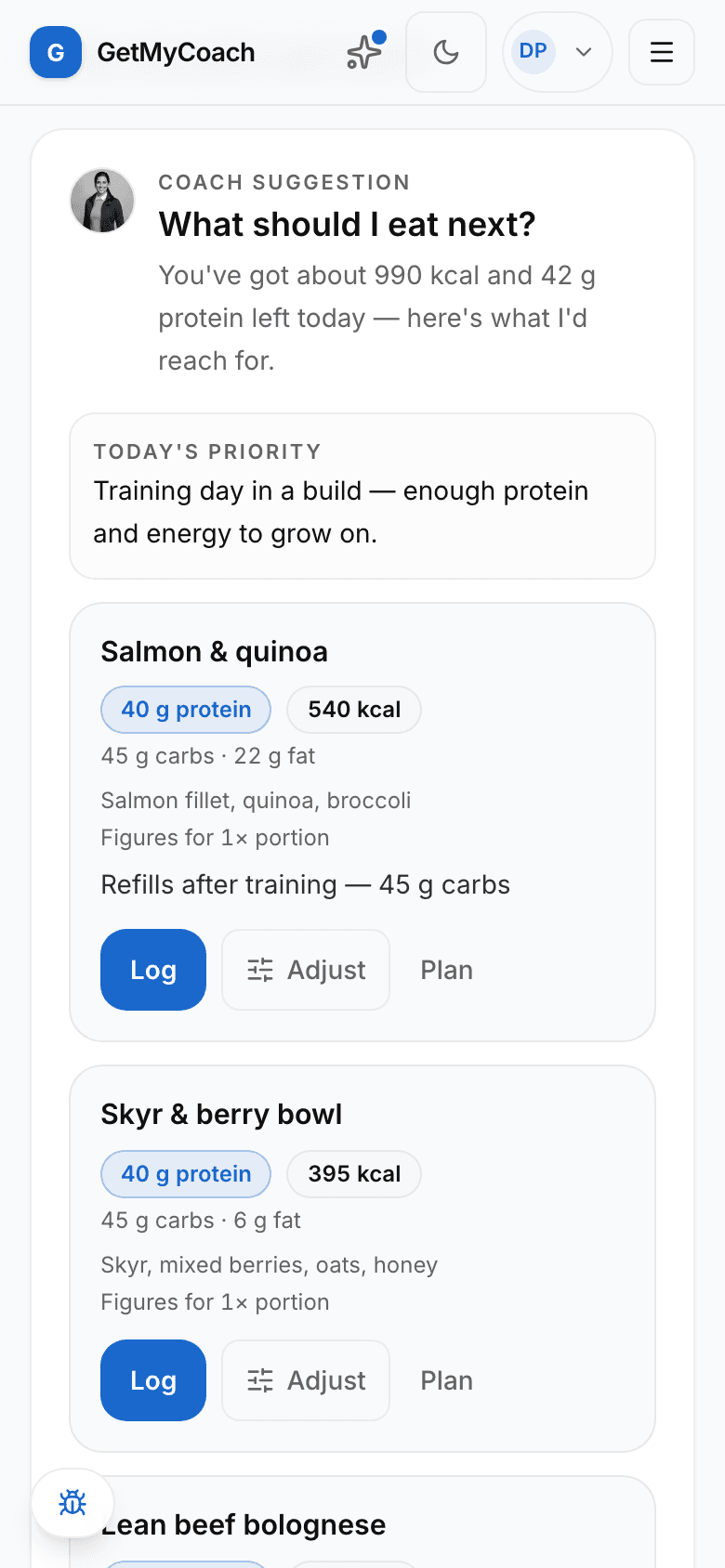
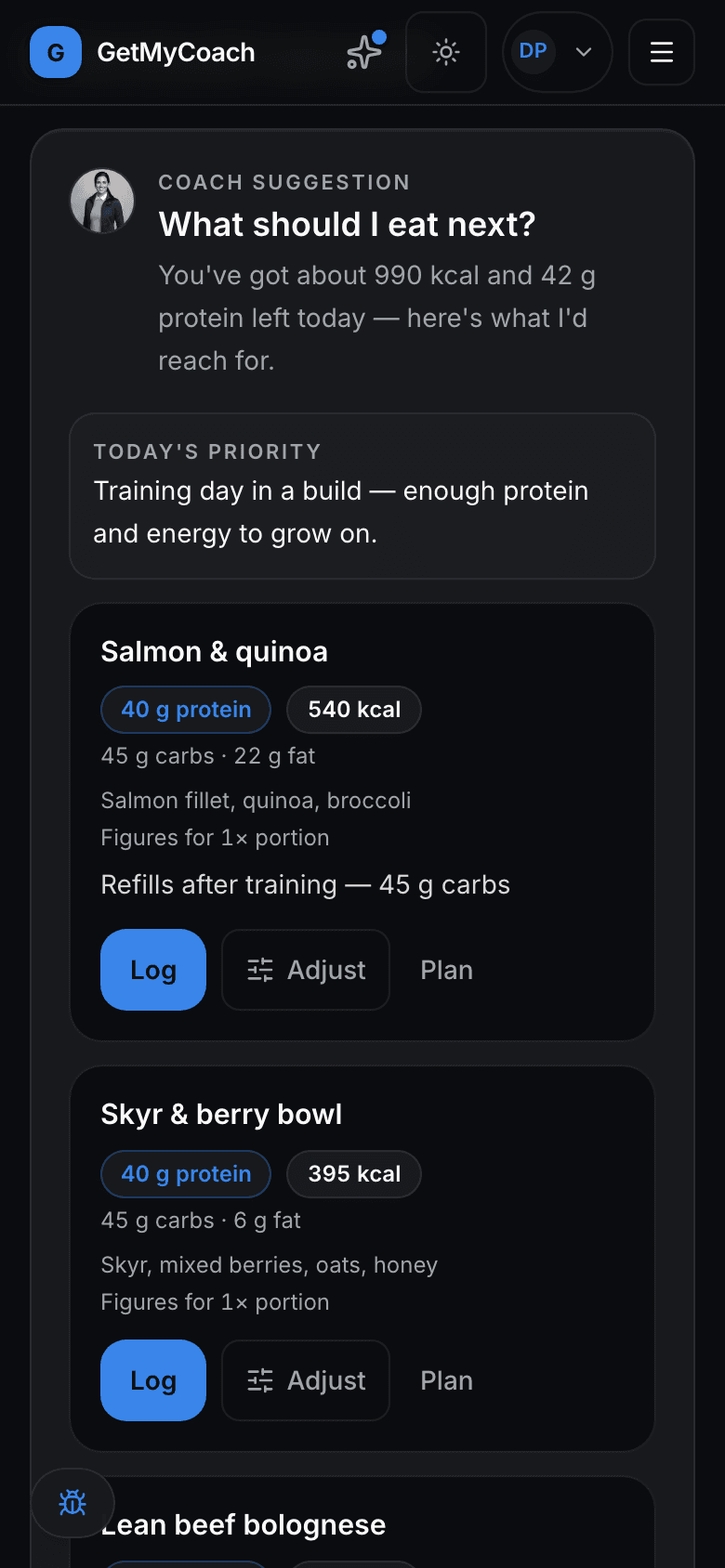
Every tracker can tell you that you have 700 calories and 60 grams of protein left. The hard part is the next sentence, and that is the one this tracker answers: it turns the remainder into two to four concrete meals, each with its macros and a one-line reason it fits — and you log one with a tap, adjust the portion first, or ignore all of them.
Ask it to plan the rest of the day and it lays out the remaining meals as a coherent set rather than three unrelated suggestions. Over a week, it can anchor a handful of meals against the shortfalls that keep recurring and hand you the shopping list for them, with the rest of the days left deliberately free.
All of it comes from curated meal templates and our own recipe library, so a suggestion is always real, cookable food — never an invented dish, and never a rigid menu. Quantities on the shopping list are merged and counted, never summed out of free text, because a list that guesses at grams is worse than one that says “rolled oats ×3”.
Losing weight, holding it, or gaining
The same log serves all three, because what changes is the target and not the tracker. You pick the goal — fat loss, lean gain, maintenance, performance, or a deliberate mass gain — and your calorie target moves with it while your protein target is set from the band that goal needs.
If you want the reasoning behind the two goals people search for most, each has its own page: how a deficit is sized and how to read the scale when you are losing weight, and why energy decides whether you gain but training decides what the gain is made of when you are going the other way.
You can change the goal whenever your plans change, and a goal you have stated yourself is never quietly overwritten later — including by a training plan you add afterwards. A cut alongside a strength block is a coherent decision, and it stays your decision.
With a training plan, or without one
Nutrition-only is a complete path here, not a trial version. Enter your body basics, pick a goal, and you have targets, the day's guidance, logging and your coach's read — with no training plan, and none created for you in the background. That last part is enforced in the code rather than promised in marketing copy: nothing on the nutrition side is allowed to reach the plan generator, and a test fails the build if that ever changes.
If you do train with a plan here, the targets get more informed rather than more complicated: the energy your sessions demand is added on top, so a hard training day and a rest day stop carrying the same number, and your coach can read how you ate before the sessions you finished — reported as something observed alongside each other, never as cause and effect.
How accurate is it, and where it stops
Honestly: an AI estimate from a description or a photo is an approximation of a portion it cannot weigh. It is usually close enough to steer a week, and it will sometimes be wrong by a meaningful margin — most often on portion size, on oil and dressings, and on composite home-cooked dishes. Where the number matters, scan the barcode or pick the product from the database and the value is the product's own. Where it does not, a fast approximation you actually log beats a precise one you skip.
The tracker is also honest about your log rather than your food. Only the days you actually tracked count towards a read, today is left out until it is over, and behind every read sits a “Why?” that shows what it was based on — how many days, which values, which period. When there is not enough to say something solid, it says that instead of producing a number that merely looks precise. A partly logged day is read as a partly logged day, not as a disciplined one.
And it stops where medicine starts. Micronutrients are answered one at a time, as whether your week's food covers them — never as a deficiency, and never as a lab result. Supplements are kept as a routine you planned, with generic types and their sources rather than brands. The tracker does not diagnose anything and is not a substitute for a doctor or a registered dietitian, particularly if you are pregnant, managing a condition such as diabetes or an eating disorder, taking medication affected by what you eat, or under 18.
On your data: we do not sell it. Product analytics only runs if you accept it in the cookie banner, our events are limited to category-level properties and never carry your food entries, free text or health notes, and you can download a copy of your data or delete your account and everything in it yourself from your account settings. Estimating a meal from text or a photo sends it to the large-language-model provider named in our privacy policy; a barcode lookup goes to the Open Food Facts database.
This tracker, a food diary, and a plain calorie counter
Three ways to keep track of what you eat, and what each one actually gives you back. The columns are kinds of tool, not products — every cell follows from what that kind of tool does by definition, so there is nothing here we could not stand behind.
Scroll sideways for the other two columns →
| What you get back | GetMyCoach nutrition tracker | A written food diary | A plain calorie counter |
|---|---|---|---|
| How a meal gets in | Describe it, photograph it, scan the barcode, search the database, or type it in. | You write it down by hand. | You look the food up and add it to the day. |
| Where the numbers come from | Every item is labelled: a database value, or an AI estimate you can correct. | Whatever you wrote down. | The entry you picked from the list. |
| A daily calorie and protein target | Calories, protein, carbs and fat from your body data and your chosen goal. | You decide it yourself. | A calorie number from a formula. |
| The target moves with your training | With a training plan, a hard day and a rest day carry different energy. | No — a diary does not know your week. | No — the target is the same on every day. |
| What you get at the end of the day | One score out of 100 across five areas, and one prioritised thing to change. | Pages to read back through. | A total and a progress bar. |
| Help deciding what to eat next | Two to four real meals built from the calories and protein you have left. | None — a diary records, it does not suggest. | None — it counts what you already ate. |
| Food processing, not only calories | An estimated NOVA 1-4 group on every item, authoritative from a barcode. | Only what you noted down. | Calories and macros are the unit of account. |
| Reading the scale | A smoothed trend, a rate in kg per week, and a plateau named when it flattens. | Your weigh-ins, compared by you. | Your weigh-ins as you entered them. |
| When there is not enough data | It says “not enough data” instead of a number that only looks precise. | You judge it yourself. | The total is the total, however little you logged. |
| Works without a training plan | Yes — nutrition-only is a complete path, and no plan is created for you. | Yes. | Yes. |
Free during early access, in the browser and in the Android app, in English and German. What a written diary and a calorie counter are genuinely better at: a diary needs nothing but paper, and a plain counter is the fewest moving parts there is.
Frequently asked questions
- What is a nutrition tracker?
- A nutrition tracker records what you eat and adds it up — calories, and usually protein, carbohydrate and fat. A calorie counter is the narrowest version of one: it tracks energy only. GetMyCoach's tracker records the food, sets your daily calorie and protein targets from your body data and your goal, scores the day, and tells you what to eat with what is left.
- Can I log a meal by describing it?
- Yes — describe it in plain language, in English or German, and an AI model estimates the calories, protein, carbohydrate, fat and salt. The estimate arrives in editable fields, so you confirm or correct it before it is saved. Dictating the description instead of typing it works wherever your browser supports speech input.
- Is there barcode scanning?
- Yes, in the browser and in the Android app. A scan looks the product up in the Open Food Facts database and fills in its stated macros — and, where the product states them, some micronutrients too. A barcode value is marked as a database value rather than an estimate, so you can tell the two apart in your log.
- How accurate are the AI estimates?
- They are estimates, and the tracker labels them as such. From a description or a photo the model cannot weigh your portion, so it assumes a standard serving — which makes portion size, cooking oil and dressings, and composite home-cooked dishes the usual sources of error. It is generally close enough to steer a week. When a number really matters, scan the barcode or pick the product from the database instead.
- Can I correct the values?
- Every one of them, before and after saving. An estimate lands in editable fields — each macro, the portion multiplier and the name — and a logged item can still be edited or deleted afterwards, with a window to undo the deletion. Its source badge stays with it, so a corrected estimate never quietly becomes a measured value.
- Does GetMyCoach track protein and macros?
- Yes. You get a daily protein target alongside the calorie one — both computed from your bodyweight and your goal — plus carbohydrate and fat targets that add back up to your calories. Protein is its own scored area in the daily verdict, weighted second only to calories, because it is the macro that decides most of what a deficit or a surplus is made of.
- Does the tracker work for losing weight and for gaining?
- Both, and for holding your weight. You choose the goal — fat loss, lean gain, maintenance, performance or a deliberate mass gain — and the calorie target shifts while the protein target is set from the band that goal needs. You can change it whenever your plans change, and a goal you have stated is never overwritten later, not even by a training plan you add afterwards.
- Do I need a training plan to use it?
- No. Nutrition-only is a complete path: your targets, the day's guidance, your logging and your coach's read all come from your body data and the goal you chose. Nothing on the nutrition side can create a training plan for you — that is enforced by a test, not just a policy. A plan only makes the targets training-aware if you choose to add one.
- Does it work on the web and on Android?
- Yes — both, on the same data, including barcode scanning and photo logging. Log a meal on your phone at lunch and it is there in the browser in the evening.
- What does it cost during early access?
- Nothing. The nutrition tracker is included free during GetMyCoach's early access, with no invite needed.
- How is my data protected?
- We do not sell your data. Product analytics only runs if you accept it in the cookie banner, and our events are limited to category-level properties — never your food entries, free text or health notes. From your account settings you can download a copy of your data, or permanently delete your account and everything in it. Estimating a meal from text or a photo sends it to the large-language-model provider named in our privacy policy, and a barcode lookup goes to Open Food Facts.
Start tracking in the next two minutes
Add your body basics, pick a goal, and log your first meal — free during early access, no training plan required.
Creates your free GetMyCoach account and opens the nutrition coach. No training plan, and no sport to choose.