How to Read a Food Label: Ingredients, Hidden Sugar, E-Numbers and the Nutrition Table
Learn to read ingredient lists and nutrition tables properly. How to spot hidden sugar, hidden and hydrogenated fats and what E-numbers actually mean — and what claims like sugar-free, light and high protein legally require.
The front of a pack is designed to sell. The back is where you can check the promise.
"Rich in protein." "No added sugar." "Natural ingredients." "Wholegrain goodness." The front of a package is designed by a marketing team and is legally allowed to say a great deal while telling you almost nothing.
Turn the pack over and the rules change. The ingredient list and the nutrition table are regulated: what goes in them, in what order, and per what quantity is defined by law — in Switzerland by the food information ordinance (LIV), in the EU by Regulation 1169/2011. Once you know how those two blocks are built, you can read almost any product in about half a minute.
In short: The ingredient list is a ranking by weight — the first three entries are most of the product. The nutrition table is the honest arbiter, and only the per-100-g column lets you compare two products. Sugar has dozens of names and can be split across several of them; the "of which sugars" line catches all of them at once. E-numbers are identification codes for approved additives, not a danger rating. And front-of-pack claims like "high protein" or "light" have precise legal thresholds that are lower than most people assume.
Last updated: August 2026.
Turn the pack over
On the front, the manufacturer decides what to highlight. On the back you get the standardised information you can check that promise against.

Front-of-pack claims are regulated too — "sugar-free" and "high protein" may only be used under defined conditions, and no label may mislead. But which true thing goes on the front, and how big, is still a marketing decision. The line in the nutrition table saying how much sugar is in 100 grams is a standardised obligation, and it is what the cantonal laboratories check against.
So build the habit in that order:
- Ingredient list — what is this actually made of, and in what proportion?
- Nutrition table per 100 g — how does it compare with the alternative on the shelf?
- Front of pack — last, and only to check whether the claim survives what you just read.
Most people do it in exactly the reverse order. That is why the front works.
The ingredient list is a ranking, not a list
Ingredients are listed by weight, heaviest first, measured at the time of manufacture — that is the rule the labelling law sets, and it carries most of the information.
It means the first two or three entries are the largest single ingredients by weight. They tell you quickly what characterises the product — even though you cannot always derive an exact total share from them. If sugar or a syrup already sits in second place, that is a clear warning sign; how sweet the product really is, the "of which sugars" line tells you next. And if water is first in a "protein drink", you are mostly buying water.
Four more things worth knowing:
- Percentages appear when the ingredient is advertised. If an ingredient is named in the product name, shown in a picture or emphasised on the front, its quantity has to be declared — usually as a percentage right in the list. A "raspberry yogurt" showing raspberries has to tell you it contains 4 percent raspberries.
- Allergens are emphasised. The 14 declarable allergens (milk, gluten-containing cereals, soy, egg, nuts, and so on) must stand out in the list — bold, capitals or a different typeface — so you can find them without reading every word.
- Compound ingredients get broken out. A "chocolate coating" in a bar is followed by its own sub-list in brackets: sugar, cocoa butter, cocoa mass, emulsifier. That bracket is often where the sugar you were looking for is hiding.
- Length alone means nothing. A curry paste with twenty herbs and spices has a long list and is fine. What matters is what the entries are, and how far up the list the sugar and fat sit.
The three-ingredient test: Read only the first three entries and say out loud what the product mostly is. If that sentence surprises you, the front of the pack did its job.
How to spot hidden sugar in the ingredient list
Sugar is the most renamed ingredient in the supermarket. All of the following are, functionally, sugar:
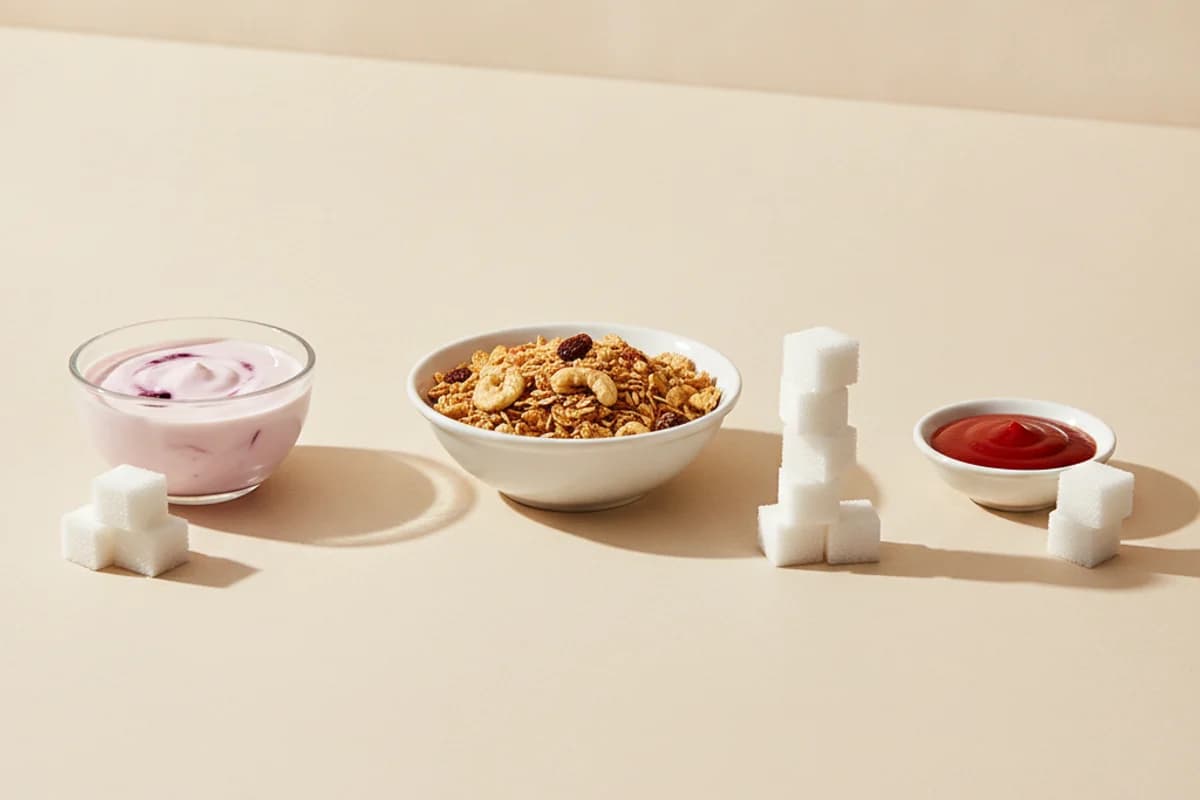
- Syrups: glucose syrup, glucose-fructose syrup, fructose-glucose syrup, invert sugar syrup, caramel syrup, rice syrup, agave syrup, date syrup, maple syrup
- -ose names: dextrose, sucrose, fructose, glucose, maltose, lactose
- "Natural-sounding" sugars: honey, molasses, cane juice, raw cane sugar, coconut blossom sugar, malt extract, barley malt
- Fruit-derived: fruit juice concentrate, apple or grape juice concentrate, fruit sweetness, fruit purée concentrate
Because these count as separate ingredients, a manufacturer can use three or four of them instead of one. Each individual name then sits lower in the ranking — and the ingredient list stops looking sugar-heavy even though nothing changed. This is legal and common.
There is one clean way around it, and it takes five seconds: the nutrition table adds them all up in the line "of which sugars". That number cannot be split.
Two caveats so you read that line correctly:
- "Of which sugars" includes natural sugars. Plain milk shows about 4.8 g of sugar per 100 ml — that is lactose, not something a factory added. Plain yogurt and fruit behave the same way. For those foods, judge the number against the plain version, not against zero.
- Maltodextrin is not counted as sugar. It is made from starch, is only faintly sweet, and lands in "carbohydrates" rather than "of which sugars" — but it is rapidly digested and adds energy. If maltodextrin sits high in the list of a product marketed as low in sugar, the low-sugar claim is technically true and practically misleading.
"No added sugar" is a real, defined claim — but it does not mean "not sweet". It means no sugars and no sweetening ingredients were added; naturally occurring sugars can still be substantial, and the label has to say so. A "no added sugar" fruit juice is still concentrated fruit sugar. We wrote about what that does to an energy budget in the guide to empty calories.
How to spot hidden and hydrogenated fats
Fat has fewer aliases than sugar, but it hides better — mostly inside other ingredients.
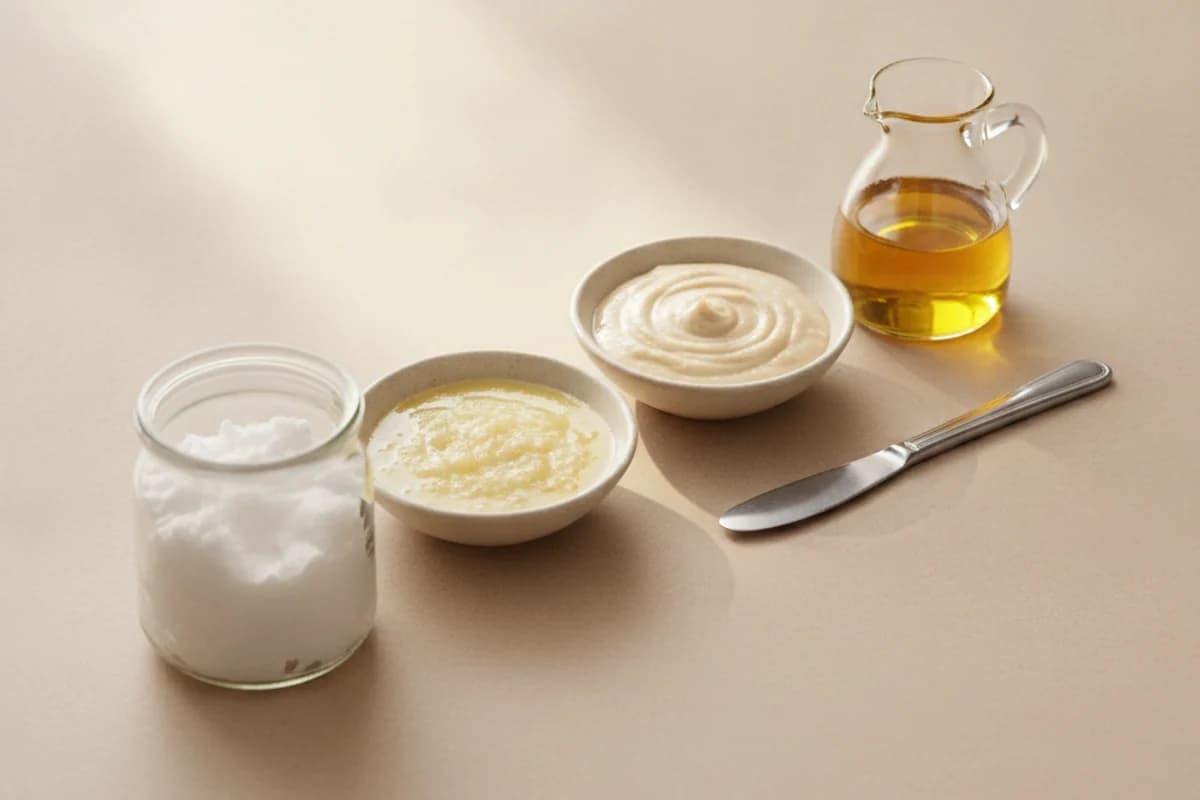
Names to recognise in the list:
- Palm oil and palm fat, coconut fat, palm kernel fat — cheap, solid at room temperature, high in saturates, extremely common in spreads, coatings and baked goods.
- Partially hydrogenated fat — this is the one that can carry industrial trans fats, and a reason to look twice. Fully hydrogenated fat is a different thing: it is high in saturates but not automatically a relevant trans-fat source. Either way the amounts are far smaller than they used to be, because non-naturally-occurring trans fats are capped at 2 grams per 100 grams of fat in Switzerland and in the EU.
- Cream powder, whole milk powder, butterfat, cocoa butter, cocoa mass — carriers that bring fat in through the back door of a sub-list.
One rule genuinely helps here: a label may no longer just say "vegetable oil". It has to name the source — "vegetable oils (palm, rapeseed)". If you still see an unspecific fat on a pack, the pack is old or the label is wrong.
And watch the mirror-image trick: low-fat products often carry more sugar, because fat carries flavour and something has to replace it. A 0.1 percent fat fruit yogurt can have more sugar per 100 g than the full-fat plain one. Read both lines, not one.
What do E-numbers actually mean?
An E-number is an identification code, not a risk score. It means the substance has been safety-assessed and approved for defined uses. For many additives there are maximum levels or an acceptable daily intake; for others the assessment concludes that no numerical daily limit is needed. In Switzerland the permitted list sits in the additives ordinance; in the EU, in the relevant additive regulations.
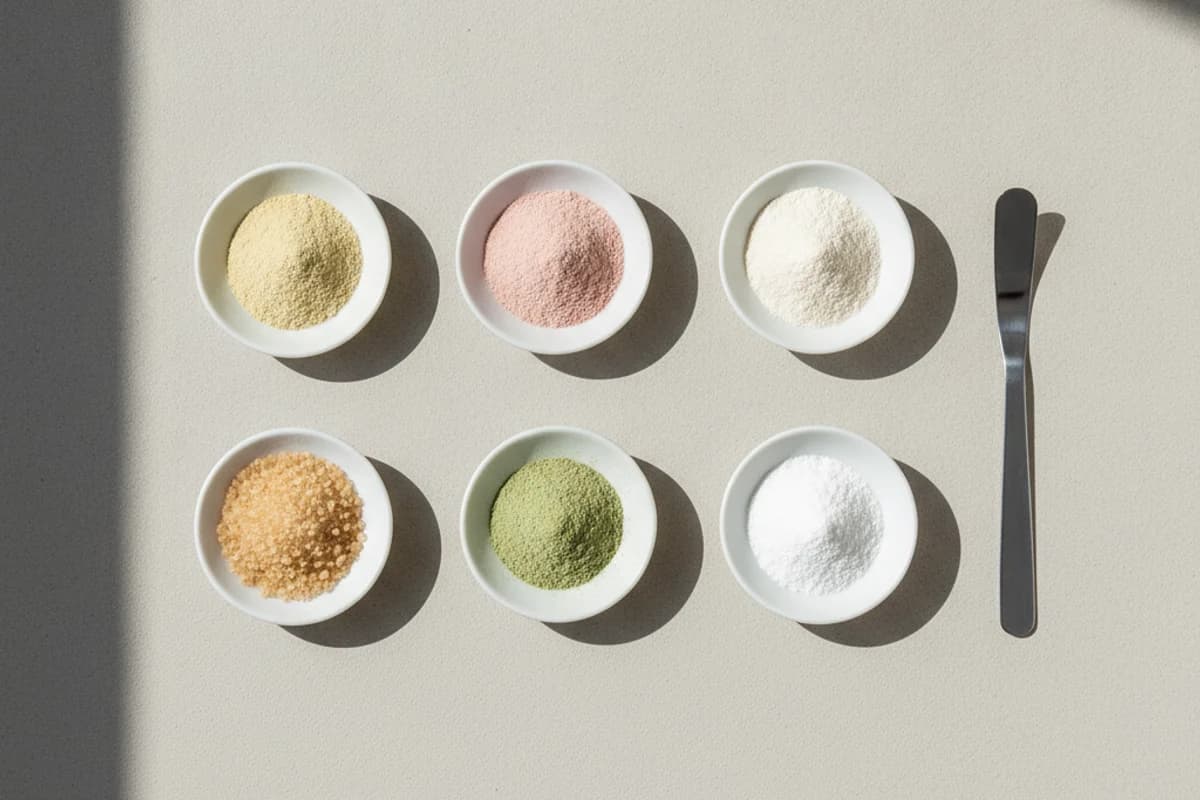
The number range gives you a rough grouping — a historical one, not a reliable function key. Lecithin is an emulsifier but carries E322, in the 300s:
| Range | Rough grouping | Examples that sit there |
|---|---|---|
| E100–E199 | Mostly colours | Curcumin (E100), beta-carotene (E160a) |
| E200–E299 | Mostly preservatives | Sorbic acid (E200), sulphites (E220–E228) |
| E300–E399 | Mixed: antioxidants, acidity regulators and others | Ascorbic acid / vitamin C (E300), lecithin (E322), citric acid (E330), phosphates (E338–E341) |
| E400–E499 | Thickeners, gelling agents, stabilisers, emulsifiers | Alginate (E401), xanthan gum (E415), pectin (E440) |
| E500–E599 | Acidity regulators, raising agents, anti-caking agents | Sodium carbonates (E500), silicon dioxide (E551) |
| E600–E699 | Mostly flavour enhancers | Monosodium glutamate (E621) |
| E900–E999 | Sweeteners, glazing agents and others | Aspartame (E951), sucralose (E955), steviol glycosides (E960) |
| E1000+ | Further additives | Modified starches (E14xx) |
So "E330" is citric acid, a substance that also occurs naturally in citrus fruit. "E300" is vitamin C. Neither is a reason for alarm, and a product with zero E-numbers is not automatically better than one with two.
What the list is useful for is a different question: how heavily formulated is this? Several emulsifiers, modified starches, flavourings, colourings and sweeteners together can indicate a strongly formulated, industrially processed product. The additive list alone is not enough to judge its overall nutritional quality — but it points at the same thing the NOVA classification of processing levels describes, which we cover in the guide to ultra-processed foods. NOVA describes the degree of processing; it does not by itself decide whether a single food is healthy or unhealthy.
A few entries are worth actually noticing, not because they are dangerous but because they are informative:
- Sweeteners (E9xx) tell you the product is engineered for sweetness without sugar — useful in a diet phase, not a health food in itself.
- Phosphates (E338–E341, E450–E452) are common in processed meat and cola drinks; relevant if you have kidney problems, in which case that is a conversation with your doctor.
- Sulphites (E220–E228) and a handful of colours carry mandatory warning notes on the label — if a warning is printed, read it.
- Polyols — sorbitol (E420), xylitol (E967), maltitol (E965) — must carry the note "excessive consumption may produce laxative effects". Take that literally, especially in "sugar-free" sweets.
The nutrition table, line by line
For most prepacked foods, the mandatory block — often called the "Big 7" — gives, per 100 g or 100 ml: energy in kJ and kcal, fat, of which saturates, carbohydrate, of which sugars, protein and salt. Exceptions apply to certain product groups. Fibre is voluntary, along with vitamins and minerals.
Here is what each line is actually telling you.
Energy (kJ / kcal). Two units for the same thing: 1 kcal is about 4.2 kJ. Read the kcal column and ignore the kJ unless you like the bigger number.
Fat, of which saturates. The total matters for the energy density; the saturates line matters for the type. Nine kilocalories per gram makes fat the densest macronutrient, which is why "only 200 g" of a fatty snack is rarely only 200 kcal.
Carbohydrate, of which sugars. In Switzerland and the EU, "carbohydrate" already excludes fibre — so you do not subtract it yourself the way US labels require. "Of which sugars" is the sub-total described above.
Protein. The number to compare when you are training. A useful frame that no label gives you — our own GetMyCoach rule of thumb, not a legal or official threshold: protein per 100 kcal. Quark at roughly 12 g protein and 70 kcal per 100 g gives about 17 g per 100 kcal. A "high protein" chocolate pudding at 6 g protein and 150 kcal gives 4. Both may legally carry a protein claim; only one has protein as its defining property. How much you need overall is in our protein guide.
Salt. Given as salt, not sodium. If you meet an older label or a non-European one showing sodium, multiply by 2.5 to get salt.
Fibre, when it is there. A voluntary declaration. If the value is missing, the label alone does not tell you how much fibre the product has — you simply cannot compare it. Where the value is given, under 3 g per 100 g means a bread is not doing much fibre work regardless of what the front says.
Then there is the column that causes the most confusion.
Per 100 g versus per portion: The per-100-g column is legally required and standardised, so it is the only one that lets you compare two products. The per-portion column is optional and the manufacturer picks the portion. A 30 g cereal serving, a 25 g crisp serving or "per 2 squares" of chocolate are chosen to make the numbers look calm. Compare on 100 g; plan on the portion you will actually eat.
Rules of thumb per 100 g
For a quick read at the shelf, the UK front-of-pack traffic-light thresholds are the most useful public benchmark. They are guidance for solid foods, not law here, but they are well calibrated and easy to remember:
| Per 100 g | Low | Medium | High |
|---|---|---|---|
| Sugars | 5 g or less | 5–22.5 g | more than 22.5 g |
| Fat | 3 g or less | 3–17.5 g | more than 17.5 g |
| Saturates | 1.5 g or less | 1.5–5 g | more than 5 g |
| Salt | 0.3 g or less | 0.3–1.5 g | more than 1.5 g |
The rating describes the amount of that one nutrient and nothing else. "High" does not automatically mean unhealthy, and "low" does not automatically mean healthy. The criteria come from the voluntary UK traffic-light scheme and serve here purely as orientation; that scheme also adds separate per-portion thresholds for portions above 100 g.
Two more thresholds worth carrying around, this time from the claims rules:
- Fibre: 3 g per 100 g is a "source of fibre", 6 g per 100 g is "high in fibre".
- Protein: a food is a genuine protein source when a meaningful share of its energy comes from protein — see the table below.
These are orientation, not a verdict. Olive oil is "high fat" and still a good thing to cook with. Nuts are high in fat too, but mostly unsaturated fat — judging them on the fat figure per 100 g alone would misrepresent the rest of their composition. The thresholds are most useful on the products that are pretending not to be treats.
What do "sugar-free", "light" and "high protein" actually mean?
Nutrition claims are not free text. In Switzerland only the claims listed in Annex 13 of the LIV are permitted, with defined conditions; the EU list under Regulation 1924/2006 matches it. Here is what the common ones actually require:
| Claim on the front | What the product must meet |
|---|---|
| Sugar-free | No more than 0.5 g sugars per 100 g or 100 ml |
| Low in sugar | No more than 5 g per 100 g (solids) or 2.5 g per 100 ml (liquids) |
| No added sugars | No added sugars or sweetening ingredients; naturally present sugars must be flagged |
| Fat-free | No more than 0.5 g fat per 100 g or 100 ml |
| Low fat | No more than 3 g per 100 g, or 1.5 g per 100 ml |
| Source of protein | At least 12 percent of the energy comes from protein |
| High protein | At least 20 percent of the energy comes from protein |
| Source of fibre | At least 3 g fibre per 100 g |
| High fibre | At least 6 g fibre per 100 g |
| Low salt / low sodium | No more than 0.12 g sodium (0.3 g salt) per 100 g |
| Light / reduced | At least 30 percent less of the named nutrient than a comparable product, and the pack must state what makes it "light" |
| Reduced energy | At least 30 percent fewer calories than a comparable product |
On top of the thresholds in the table, general conditions apply to every nutrition claim: the ready-to-eat product must deliver a relevant amount of the advertised nutrient in a quantity that can reasonably be expected to be consumed. That condition does a lot of work, as the next paragraph shows.
Three things fall out of that table.
"High protein" is a lower bar than it sounds. Twenty percent of energy from protein is easy to reach in a product that is also 25 percent sugar. In 2025 the Zurich cantonal laboratory sampled 15 high-protein products bought from online shops and objected to roughly 80 percent of them, for a range of reasons: in two products the measured protein was below what was declared; others advertised the protein of a whole multi-serving pack, or per 100 g rather than per realistic portion; and there were missing warning notes on high polyol contents and an insufficiently substantiated "soy free" claim. If a claim quotes grams, check what quantity those grams refer to.
"Light" is relative, not low. It only promises 30 percent less than a comparison product — 30 percent less than something very sweet is still sweet. Light mayonnaise is still a fatty condiment.
"Natural flavouring" is narrower than "natural". If a label says "natural strawberry flavouring", at least 95 percent by weight of the flavouring component has to come from strawberries. If it says only "natural flavouring", the flavouring does come from natural source materials — but those need not be strawberries, or whatever fruit is pictured on the front.
And two words that carry no legal threshold at all in this context: "multi-grain" tells you there is more than one cereal, not that any of it is wholegrain, and "with wholegrain" does not tell you how much. The ingredient list settles both: look for wholegrain flour or wholemeal as the first entry. Our bread and flour guide goes deeper on that one.
Three examples: how to compare two products
The numbers below are typical values for the category, put here to show the reading method — always check the actual pack in your hand.
A "wholegrain" breakfast cereal. Front: fibre claim, wholegrain claim, a cheerful vitamin list. Ingredient list: wholegrain wheat, sugar, glucose syrup, honey, salt. Two separate sweeteners plus honey in positions two to four means the sugars together may well outweigh anything but the wheat. Table: 22 g sugar and 6 g fibre per 100 g. The fibre claim is true; the product is also close to the "high sugar" threshold. Verdict: it is a sweetened cereal with a decent fibre content, not a health food — and plain oats at about 1 g sugar per 100 g do the fibre job without the rest.
A high-protein bar. Front: "20 g protein". Table: 30 g protein, 20 g sugar, 18 g fat, 450 kcal per 100 g — but the bar weighs 65 g, so the honest per-bar numbers are roughly 20 g protein, 13 g sugar, 12 g fat and 290 kcal. Protein per 100 kcal: about 6.7. Verdict: a real protein source and also a genuine confectionery item. Fine as a solution to a specific problem — travel, no fridge, a long gap between meals — and a poor default. We compared what is actually worth buying in the protein bars and drinks guide.
A fruit yogurt versus plain yogurt. Fruit yogurt: 13 g sugar and 4 g protein per 100 g, with sugar and fruit preparation high in the list. Plain yogurt: 4.7 g sugar (all lactose) and 4 g protein. Add your own fruit and you land near 8 g sugar with more fibre and more actual fruit. Verdict: the same product category, roughly 40 percent less sugar, and no claim on the front was needed to get there.
Your 30-second check at the shelf
A repeatable routine, in the order that gives you the most information the fastest:
- Read the first three ingredients. Say what the product mostly is.
- Scan for sugar aliases and count them. Three syrups instead of one is a deliberate choice.
- Check "of which sugars" per 100 g against the traffic-light thresholds above.
- Check saturates and salt per 100 g if it is a savoury or a ready meal.
- Check protein per 100 kcal if you bought it for protein. Our practical GetMyCoach rule of thumb: below about 8 g per 100 kcal, protein is usually not the defining property of the product.
- Look at the portion the numbers refer to before you believe any per-portion figure.
- Now read the front — and see whether the claim still means anything.
That is the whole method. It gets faster with practice, and after a few weeks you mostly stop needing it: you will know the ten products you buy regularly and only check the new ones.
Frequently asked questions
In what order are ingredients listed on a food label?
By weight, heaviest first, measured at the time of manufacture. So the first two or three entries are the largest single ingredients — they show you what characterises the product, even though you cannot always derive an exact total share from them. If sugar, a syrup or a fat appears near the front, that is a clear signal to check the nutrition table.
How do I spot hidden sugar in an ingredient list?
Look for the aliases: glucose syrup, glucose-fructose syrup, invert sugar syrup, dextrose, sucrose, maltose, molasses, malt extract, honey, agave or rice syrup and fruit juice concentrate. Manufacturers can also split the sugar across several of these so each one sits lower in the list. The nutrition table settles it: read the "of which sugars" line per 100 g.
Are E-numbers dangerous?
An E-number is an identification code for an additive that has been safety-assessed and approved for defined uses — it is not a danger rating. The number range gives a rough grouping only: E100s are mostly colours, E200s preservatives, E300s a mixed group of antioxidants and acidity regulators, E400s thickeners and emulsifiers, E600s flavour enhancers, E900s sweeteners and glazing agents. The grouping is historical, not a reliable function key — lecithin is an emulsifier but carries E322. A long additive list mainly signals a heavily formulated product, not proof that it is harmful.
Should I read the values per 100 g or per portion?
Per 100 g when you are comparing two products, because the manufacturer chooses the portion size and a small one flatters the numbers. Per portion only when the stated portion matches what you actually eat.
What does "high protein" legally mean?
In Switzerland and the EU, at least 20 percent of the product's energy has to come from protein; "source of protein" needs at least 12 percent. General conditions apply on top: the product has to deliver a relevant amount in a quantity you would realistically eat. The claim says nothing about the sugar and fat alongside it — in a 2025 sample of 15 high-protein products bought online, the Zurich cantonal laboratory objected to roughly 80 percent, for reasons ranging from protein below the declared value to claims stated per pack or per 100 g rather than per realistic portion.
The bottom line
Label reading is not about memorising additives. It is about knowing which two blocks on the pack are obliged to be honest, and reading them in the right order.
- The ingredient list is a ranking by weight — the first three entries are the largest single ingredients.
- Sugar has many names and can be split across them; "of which sugars" per 100 g cannot be split.
- Fat mostly hides inside other ingredients and inside low-fat products' sugar content.
- E-numbers are codes, not warnings — but a long additive list tells you how heavily formulated the product is.
- Compare on 100 g, plan on the portion you will really eat.
- Front-of-pack claims are legally defined and the thresholds are lower than they sound.
None of this requires you to eat perfectly, and it is not an argument for cutting out convenience food. It is an argument for knowing what you are choosing — which is what turns "I'm eating pretty well" into something you can actually steer.
See what your week actually looks like
Log your meals in GetMyCoach and you get calories, protein, energy balance and the processing level of each food in one place, next to your training plan. The point isn't the numbers — it's seeing the pattern you'd otherwise have to guess at.
Note: This article is general information and does not replace individual medical or dietetic advice. If you have a health condition, an allergy, are pregnant, have a history of disordered eating or special nutritional needs, please consult a qualified professional.
Sources
- FSVO: Nutrition and health claims (Switzerland)
- Ordinance of the FDHA on food information (LIV, SR 817.022.16)
- EU Regulation 1169/2011 on the provision of food information to consumers
- EU Regulation 1924/2006 on nutrition and health claims made on foods
- Canton of Zurich cantonal laboratory: sampling campaign on high-protein foods (2025)
- UK FSA / DHSC: front-of-pack nutrition labelling guidance (traffic-light criteria)
- EFSA: Food additives