Ultra-Processed Foods: NOVA 4, Hyper-Palatable Foods and the WHO
What are ultra-processed and hyper-palatable foods? How the NOVA classification works, what the WHO actually says, and what role these foods play in nutrition, building muscle and losing weight.

How processed a food is tells you one thing about it — but it isn't the only basis for judging its nutritional quality.
Protein bars, breakfast cereals, ready meals, soft drinks and flavoured yogurts: many products we eat every day count as ultra-processed. In the NOVA classification they sit in group 4.
But does ultra-processed automatically mean unhealthy? What are hyper-palatable foods? And how does the World Health Organization (WHO) frame the topic?
In short: Ultra-processed foods belong to group 4 of the NOVA classification. Many are easy to eat, energy-dense and partly hyper-palatable. That does not mean every NOVA 4 product is automatically unhealthy. What matters is the amount, the frequency, the nutrient quality and your overall diet.
Last updated: July 2026.
What is the NOVA classification?
The NOVA classification groups foods by how, how much and for what purpose they were processed.
The system was developed by researchers at the University of São Paulo. NOVA is not an acronym; it comes from the Portuguese expression for a "new classification".
It distinguishes four groups.
NOVA 1: Unprocessed or minimally processed
Vegetables, fruit, eggs, milk, oats, rice, meat, fish and legumes.
NOVA 2: Processed culinary ingredients
Oil, butter, sugar, salt and starch.
NOVA 3: Processed foods
Cheese, simple bread, salted nuts, canned vegetables and smoked fish.
NOVA 4: Ultra-processed foods
Soft drinks, many ready meals, crisps, packaged sweets, heavily sweetened cereals and some protein bars.
Further overview: NOVA classification on Wikipedia
NOVA 1: Unprocessed or minimally processed foods
Foods that are close to their natural state.
Examples:
- Vegetables and fruit
- Eggs
- Meat and fish
- Milk
- Oats
- Rice
- Legumes
- Nuts
- Frozen vegetables with no added ingredients
Washing, cutting, chilling, grinding, pasteurising, drying or freezing does not automatically turn a food into a heavily processed product.
NOVA 2: Processed culinary ingredients
Ingredients drawn from foods or natural raw materials, used mainly for cooking.
Examples:
- Oil
- Butter
- Sugar
- Salt
- Starch
They are normally combined with group 1 foods and not eaten as a complete meal.
NOVA 3: Processed foods
These products are usually made by adding salt, sugar, oil or other simple culinary ingredients to NOVA 1 foods.
Examples:
- Cheese
- Canned vegetables
- Smoked fish
- Simple bread made from flour, water, yeast and salt
- Salted nuts
Processed foods can be part of a balanced diet without any problem.
NOVA 4: Ultra-processed foods
Ultra-processed foods are mostly industrially designed products assembled from several processed components.
They often contain ingredients rarely used in a normal kitchen — flavourings, colourings, emulsifiers, sweeteners, modified starch, protein isolates, glucose-fructose syrup, flavour enhancers, thickeners or industrially altered fats.
Typical examples include:
- Soft drinks and energy drinks
- Sweets and packaged baked goods
- Crisps and many salty snacks
- Instant noodles
- Chicken nuggets
- Heavily sweetened breakfast cereals
- Some protein bars
- Flavoured milk drinks
- Many ready meals
- Some meat-substitute products
- Packaged desserts
What does hyper-palatable mean?
"Hyper-palatable" describes foods whose combination of fat, sugar, refined carbohydrates and salt makes them especially appealing.
It's not just that a food tastes good. Certain nutrient combinations can raise a product's reward value and make it easier to keep eating quickly, or beyond immediate energy needs.
- Fat and salt
- Fat and sugar
- Refined carbohydrates and salt
High reward value and easy to keep eating
Typical examples: Crisps, cookies, ice cream, pizza and sweetened cereals.
Researchers have developed quantitative criteria to classify hyper-palatable foods based on specific combinations and proportions of fat, sugar, carbohydrate and sodium.
Ultra-processed and hyper-palatable are not the same
The terms overlap, but they are not synonyms.
A food can be:
- ultra-processed and hyper-palatable
- ultra-processed but not especially hyper-palatable
- hyper-palatable but not necessarily NOVA 4
A soft drink can be NOVA 4 without containing a fat-and-salt combination. A home-baked cake, on the other hand, can be very energy-dense and hyper-palatable without automatically being NOVA 4 through industrial additives.
NOVA describes mainly the type and purpose of processing. Hyper-palatability describes more the composition and the possible effect on eating behaviour.
Why are these foods easy to overeat?
Many hyper-palatable and ultra-processed foods combine several properties:
- high energy density
- intense flavour combinations
- soft or crunchy, easy-to-eat texture
- little chewing required
- fast eating speed
- sometimes low satiety per calorie
- immediate availability
As a result, a lot of energy can be taken in over a short time before a clear feeling of fullness sets in.
What did the controlled diet study show?
In a controlled study, 20 adults were given an ultra-processed diet and an unprocessed diet in turn.
During the ultra-processed phase, participants consumed on average about 500 kilocalories more per day and gained weight. During the less-processed phase, weight fell.
The diets on offer were matched for things like the calories presented, macronutrients, sugar, salt and fibre.
What did the controlled study show?
20
adults
2 weeks
per diet
~500 kcal
more per day on the ultra-processed diet
This study looked at whole diets under controlled conditions. It does not prove that every single NOVA 4 food automatically leads to weight gain.
Source: Hall et al., Cell Metabolism, 2019
The study is important, but it needs to be read correctly:
- Only 20 people took part.
- Each diet phase lasted two weeks.
- Whole diets were studied.
- The result does not prove that every single NOVA 4 product leads to weight gain.
- Properties such as eating speed, texture, energy density and satiety may also play a role.
What does the WHO say?
In 2024, the WHO Regional Office for Europe published the report "Commercial determinants of noncommunicable diseases in the WHO European Region".
The report examines how commercial products and business practices contribute to noncommunicable diseases — including marketing, lobbying, pricing, product development and influence on policy decisions.
The WHO stated that four areas or product groups — tobacco, alcohol, fossil fuels and ultra-processed foods — together are fully or partly responsible for around 2.7 million deaths per year in the WHO European Region.
Read this carefully: That figure refers jointly to all four areas. It must not be presented as if ultra-processed foods alone caused 2.7 million deaths.
The WHO looks not only at individual choices but also at structural influences such as:
- advertising and marketing
- marketing to children and adolescents
- political influence
- product design
- price and availability
- especially easy-to-consume products
- the displacement of traditional, less-processed meals
Is there an official WHO limit for NOVA 4?
The WHO has convened an international expert group to develop an evidence-based guideline on the consumption of ultra-processed foods.
Until a final WHO guideline with a concrete percentage limit is published, no invented limit should be quoted. In particular, there is no official statement such as "at most ten percent NOVA 4", no WHO "80/20 rule" and no blanket WHO ban on NOVA 4.
The 80/20 rule is only a practical orientation, not an official WHO recommendation.
Which health associations are being studied?
In observational studies, a high intake of ultra-processed foods is linked with an increased risk of outcomes such as:
- weight gain and obesity
- cardiovascular disease
- type 2 diabetes
- certain cancers
- several co-occurring chronic conditions
The wording matters: a high intake is associated with an increased risk. Observational studies can show associations but do not automatically prove a direct cause-and-effect mechanism. People with a high intake of ultra-processed foods may also differ in exercise, income, sleep, smoking and the rest of their diet.
Is every NOVA 4 food automatically unhealthy?
No.
NOVA describes first and foremost the type and purpose of processing, not automatically the full quality of a food.
A protein powder, protein bar, carbohydrate gel or sports drink can count as ultra-processed and still be useful in a particular situation.
Examples:
- Protein powder can help top up your protein intake.
- A carbohydrate gel can make sense during a long endurance race.
- An electrolyte drink can be handy during long, intense efforts.
- A chosen ready meal can be better than regularly skipping full meals.
Conversely, a food is not automatically healthy just because it was made at home. A home-baked cake can also contain a great deal of sugar, fat and energy.
What matters is the amount, the frequency, the nutrient composition, the satiety effect, your personal context and your overall diet.
Criticism and limits of the NOVA classification
NOVA is a useful communication model, but not a perfect health verdict on every single food.
Classification can differ for some products. One criticism is that very different products can end up in the same group, and that NOVA does not capture every aspect of nutrient quality.
So it's worth also considering:
- calories and a realistic portion size
- protein
- fibre
- sugar
- saturated fat
- salt
- vitamins and minerals
- satiety effect
- the product's role in the overall diet
Note: NOVA is an orientation on the degree of processing, not a complete rating system for health or athletic performance.
You do not have to classify anything by hand
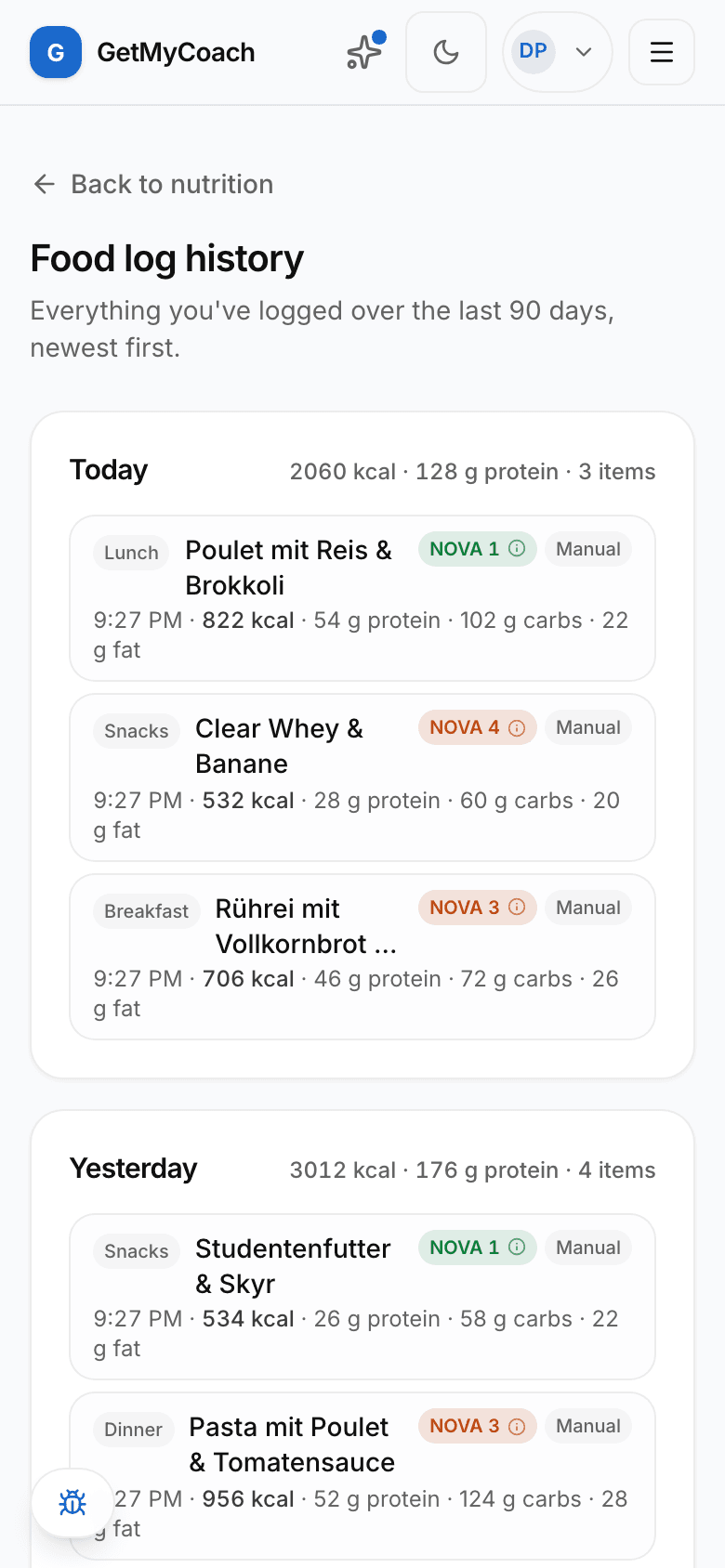
Reading every ingredient list is the part nobody keeps up. GetMyCoach labels what you log by its NOVA group and scores the day against your goal, so the rule above survives a normal week.
How to spot ultra-processed products
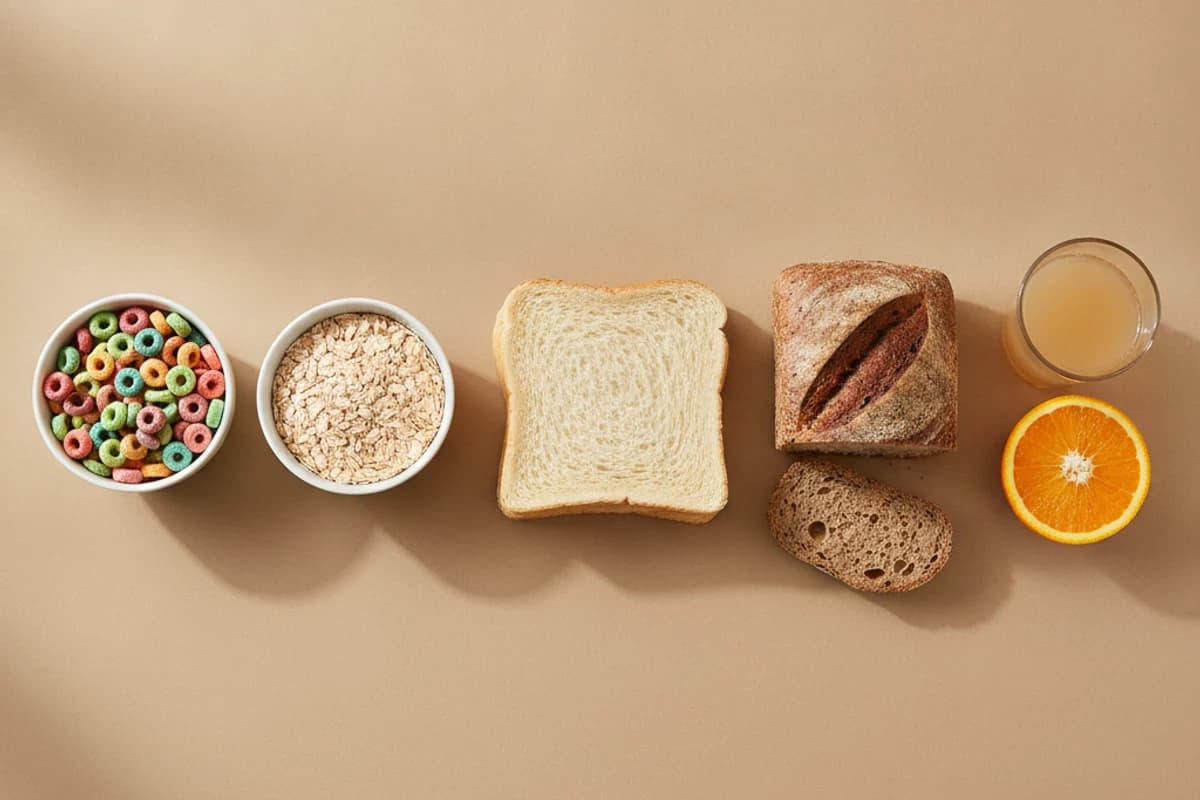
The ingredient list gives clues. Look for things like:
- flavourings and colourings
- emulsifiers
- several types of sugar or syrup
- isolated proteins
- modified starch
- hydrogenated or heavily altered fats
- flavour enhancers
- ingredients rarely used in a normal kitchen
A long ingredient list does not automatically mean a product is bad, though. A dish with many spices, herbs and vegetables can also contain many ingredients.
Bread, yogurt and protein products compared
Bread
A simple bread made from flour, water, yeast and salt is usually a processed food. With many emulsifiers, flavourings, colourings or other industrial components, it can be classified as ultra-processed.
Yogurt
Plain yogurt is a comparatively simply processed food. A dessert yogurt with sugar, flavouring, sweeteners, colourings and thickeners, by contrast, can be NOVA 4.
Protein bars and protein shakes
Many protein bars and ready-made protein shakes count as ultra-processed because of protein isolates, sweeteners, flavourings and emulsifiers. They can still be a practical addition — but they should not permanently replace fruit, vegetables, whole grains and full meals. Which Swiss supermarket options are actually worth it, we compared in our protein bars & drinks buying guide.
What does this mean for building muscle?
For building muscle, the priorities are:
- enough energy intake
- enough protein
- progressive strength training
- good recovery
- enough sleep
A protein shake can help you hit your protein target. But less-processed protein sources often provide extra micronutrients and keep you fuller.
Good staples are eggs, low-fat quark, skyr or plain yogurt, meat and fish, tofu and tempeh, lentils and beans, milk, cheese, and nuts and seeds. Ultra-processed products can complement this base but should not replace it entirely.
What does this mean for losing weight?
When losing weight, a diet with lots of hyper-palatable and ultra-processed foods can make it harder to control calorie intake.
A meal of potatoes, vegetables and a protein source often fills you up better than the same number of calories from crisps, pastries or sweets.
Even so, these products don't have to be banned completely. Strict bans can make eating unnecessarily complicated. It's more helpful to:
- choose realistic portions
- plan in enough protein and fibre
- prefer full meals over constant snacking
- avoid making especially easy-to-overeat products the basis of your diet
A practical everyday approach
Build most of your diet from filling, nutrient-dense, minimally processed foods. Use ultra-processed products deliberately — for enjoyment, to save time, or in sporting situations.
Examples:
- Oats instead of heavily sweetened cereals
- Plain yogurt with fruit instead of dessert yogurt
- Water or unsweetened tea instead of daily soft drinks
- Potatoes, rice or pasta instead of only ready meals
- Fruit and nuts instead of several bars a day
- Full meals instead of constant snacking
Is the 80/20 rule useful?
For many people a flexible approach is more realistic than a complete ban.
As a rough personal guide, around 80 percent of the diet can come from nutrient-dense staple foods. The remaining share leaves room for enjoyment, convenience products and social occasions.
This split is not an official WHO recommendation and doesn't have to be followed with mathematical precision.
Frequently asked questions
Is every NOVA 4 food unhealthy?
No. NOVA describes mainly the type and purpose of processing, not the full quality of a food. What matters is the amount, frequency, nutrient composition, satiety and your overall diet.
Is protein powder ultra-processed?
Often yes, since it is made from isolated proteins and frequently sweeteners and flavourings. It can still be practical for topping up protein, but should not permanently replace whole-food protein sources and meals.
What does hyper-palatable mean?
Hyper-palatable describes foods whose combination of fat, sugar, refined carbohydrates and salt creates an especially high reward value and makes it easy to keep eating. A food can be hyper-palatable without necessarily being NOVA 4.
Are bread and yogurt NOVA 4?
Not by default. Simple bread and plain yogurt are usually processed foods (NOVA 3, or close to NOVA 1). Only numerous industrial additives — emulsifiers, flavourings or sweeteners — can push them towards NOVA 4.
Does the WHO recommend the 80/20 rule?
No. The 80/20 rule is a practical everyday orientation, not an official WHO recommendation. The WHO has not set a concrete percentage limit for ultra-processed foods; an expert group is working on a guideline.
The bottom line
Ultra-processed foods belong to group 4 of the NOVA classification. Many are hyper-palatable at the same time, combining fat, sugar, refined carbohydrates and salt in a way that can encourage a high, fast calorie intake.
The WHO report shows that beyond individual choices, advertising, product design, availability and commercial interests also play a role.
Even so, not every NOVA 4 product is automatically bad. A protein shake, a ready meal or an ice cream doesn't decide the quality of a diet on its own. The bigger picture matters more:
- How often do you eat these products?
- How well do your meals fill you up?
- Are you getting enough protein and fibre?
- Do you regularly eat vegetables, fruit and whole grains?
- Does your energy intake match your goal?
A good diet doesn't have to be perfect. It should be nutrient-dense, practical for everyday life, and sustainable in the long run.
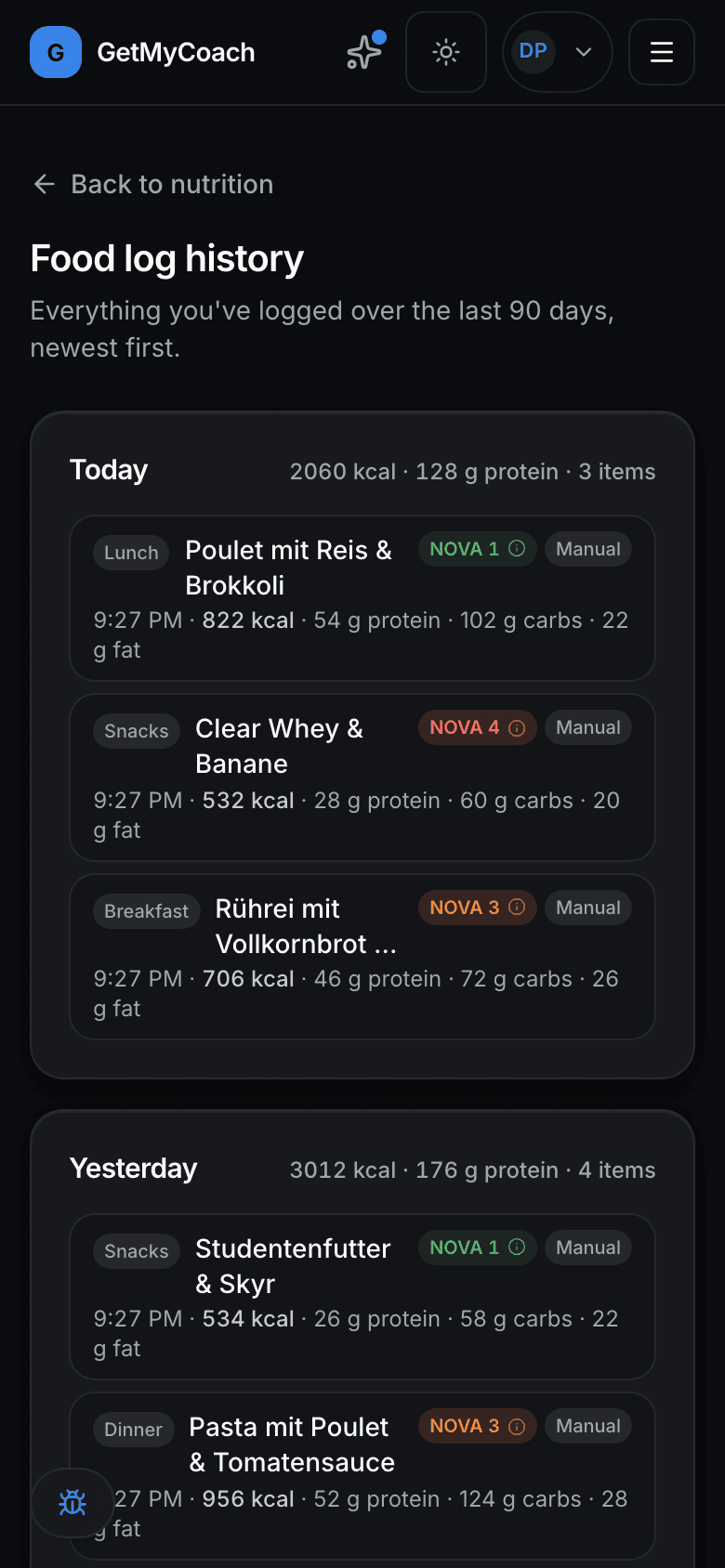
Here's how that looks in GetMyCoach: in your food log history, every logged food is automatically tagged with its NOVA group. Tapping a NOVA chip explains what the group means — without judging your diet.
See nutrition and training together
With GetMyCoach you can track meals, protein intake, energy balance and training goals in one place. The analysis helps you spot patterns in your day and tune your plan to fit your training goal.
Note: This article is general information and does not replace individual medical or dietetic advice. If you have a health condition, are pregnant, have a history of disordered eating, allergies or special nutritional needs, please consult a qualified professional.
Sources
- Wikipedia: NOVA classificationFurther overview of the classification; not a standalone scientific primary source.
- WHO Regional Office for Europe: Commercial determinants of noncommunicable diseases in the WHO European Region
- WHO Europe: Just four industries cause 2.7 million deaths in the European Region every year
- WHO: Public notice and comment – WHO Guideline Development Group for ultra-processed foods
- Hall KD et al.: Ultra-Processed Diets Cause Excess Calorie Intake and Weight Gain
- Fazzino TL et al.: Hyper-Palatable Foods – Development of a Quantitative Definition