How Much Body Fat Do You Have? A Visual Guide with Pictures
What 10%, 15%, 20%, 25% and 30%+ body fat actually look like on men — and 18% to 38%+ on women — with comparison pictures, healthy ranges, how to measure more precisely, and what to do with your estimate.

Step on a scale and you get one number — your weight. But two people with the same weight can look completely different, because the scale can't tell muscle from fat. What actually shapes how you look, how your clothes fit and a good part of your health risk is your body fat percentage: the share of your body weight that is fat.
The fastest way to estimate it costs nothing: compare yourself to reference images. This short guide shows what different body fat levels actually look like on men and women, what a healthy range is, and how to measure more precisely if you want to.
The short version: Compare your mirror image to the pictures below — that gets most people within a few percentage points, which is accurate enough to act on. Healthy and sustainable for most men is roughly 10–20%, for most women roughly 18–28%. Visible abs sit near the lean end of those ranges. Don't chase a single number; pick the range that matches how you want to look, feel and perform, and let your training and nutrition move you there.
What body fat looks like on men
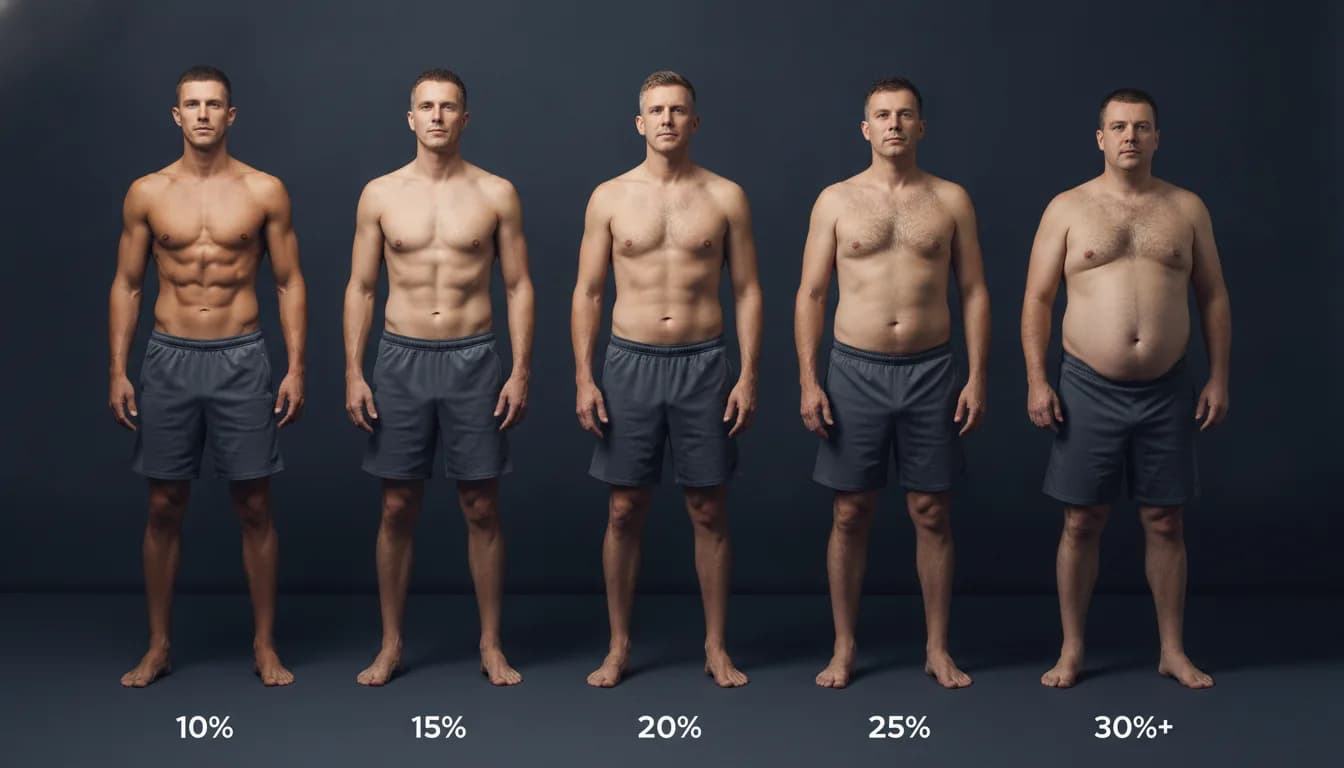
- ~10% — very lean. Clearly visible abs, vascularity, sharp muscle separation. Great for photos, hard to maintain; many men feel hungrier, colder and flatter here.
- ~15% — athletic. Light ab definition in good lighting, athletic look in a t-shirt. For most men the sweet spot of looking fit and living normally.
- ~20% — average-healthy. No visible abs, a soft midsection, but a normal healthy look. Plenty of room to train and recomposition well from here.
- ~25% — soft. Noticeable belly fat, shirt sizes creep up. Health risk starts rising; a modest, steady fat-loss phase pays off.
- ~30%+ — high. A clearly round belly and fat stored across the whole torso. Worth addressing for health, not looks — and very responsive to consistent training plus a calorie deficit.
What body fat looks like on women
Women naturally carry more essential fat than men — hormones, breast tissue and fat distribution around hips and thighs are part of a healthy female body. The same "look" therefore sits roughly 8–10 percentage points higher than in men.
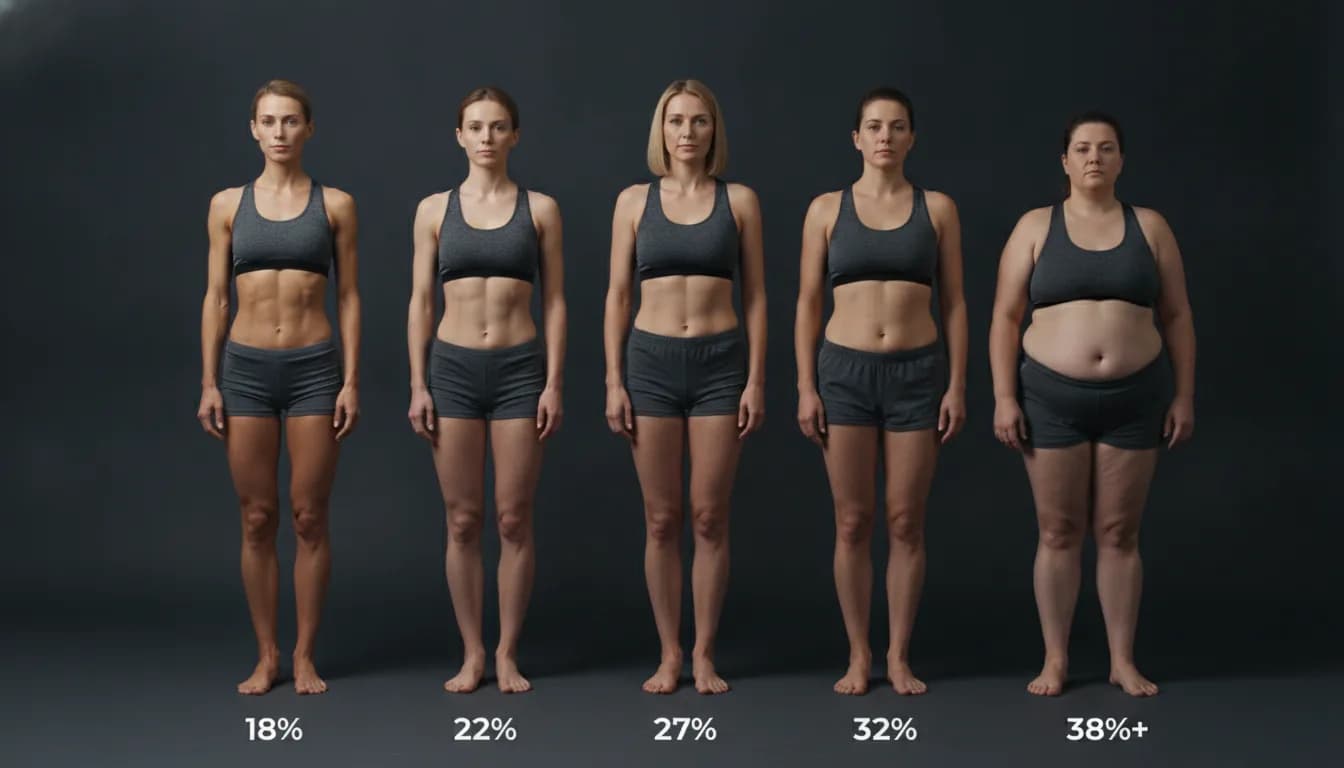
- ~18% — very lean/athletic. Visible muscle tone, some ab definition. Common in competitive athletes; below this, many women see hormonal side effects.
- ~22% — fit. Toned, athletic look with a flat midsection. Lean end of sustainable for most women.
- ~27% — average-healthy. Softer midsection, healthy and completely normal. A great base to build strength from.
- ~32% — soft. Noticeable fat around belly, hips and thighs. Still far from alarming, but a good moment to build consistent habits.
- ~38%+ — high. Fat stored across the whole body; health risk rises meaningfully. Same answer as for men: strength training, protein, modest deficit, patience.
One honest caveat: these images are AI-generated illustrations, and real bodies vary. Genetics decide where you store fat (belly-first vs. hips-first), and muscle mass changes the picture a lot — a muscular person looks leaner at the same percentage. Use the images as a range finder, not a verdict.
What counts as healthy?
| Category | Men | Women |
|---|---|---|
| Essential fat | 2–5% | 10–13% |
| Athletes | 6–13% | 14–20% |
| Fitness | 14–17% | 21–24% |
| Average | 18–24% | 25–31% |
| Elevated | 25%+ | 32%+ |
These bands (based on the widely used ACE classification) are guidance, not judgement. Age matters too — carrying a little more at 55 than at 25 is normal and fine. The health signal to watch most is belly fat: a waist measurement creeping up is more meaningful than any single body-fat reading.
Want a more precise number?
- Photos + the images above — free, and within roughly ±3–5 points for most people. Take front/side photos in consistent light every few weeks; the change is what matters.
- A body composition (BIA) scale — convenient daily trend tracking, though the absolute number can be off by several points. We wrote an honest guide to body composition scales.
- Tape measure (Navy method) — waist, neck (and hips for women) in a formula; surprisingly decent and free.
- Calipers — skinfold measurement; good in experienced hands, noisy in inexperienced ones.
- DEXA scan — the practical gold standard if you want a true baseline, typically 50–100 francs at a clinic.
Whichever you pick: measure the same way, under the same conditions, and judge the trend over weeks — never a single reading.
What to do with your estimate
The estimate is only useful if it changes what you do next:
- Above the range you want? Combine strength training with a moderate calorie deficit and high protein — that's how you lose fat, not muscle. Our no-counting weight loss guide covers the whole playbook.
- Already lean but skinny? Your priority is building muscle, not losing more fat — see when to build and when to cut.
- Happy where you are? Then train for performance and let body composition take care of itself.
At GetMyCoach, you don't have to translate a body-fat number into a plan yourself: tell your coach your goal, and you get a structured training plan plus nutrition targets that move you toward it — and adapt as your body changes.
Frequently asked questions
How accurately can I estimate body fat from pictures?
For most people, within roughly 3–5 percentage points — which is precise enough to know your range and act on it. Consumer methods like BIA scales carry similar error margins, so visual comparison is a legitimate starting point. Precision matters less than tracking change consistently.
What is a healthy body fat percentage?
For most men roughly 10–20%, for most women roughly 18–28%. Athletes sit lower, and a little more with age is normal. Health risk rises meaningfully above about 25% for men and 32% for women — especially when the fat sits around the waist.
Why is a healthy body fat percentage higher for women?
Because women carry more essential fat — fat the body needs for hormones and reproductive health, stored in breast tissue, hips and thighs. Around 10–13% of a woman's body weight is essential fat versus 2–5% for men, so all female ranges sit roughly 8–10 points higher.
At what body fat percentage do abs become visible?
Typically around 10–14% for men and 18–22% for women, depending on genetics and how much ab muscle you've built. Abs are made visible by low body fat, but they're made worth seeing by training — and staying that lean year-round is neither necessary nor healthy for everyone.
What is the most accurate way to measure body fat?
A DEXA scan is the practical gold standard and worth it for a true baseline. For everyday tracking, a consistent routine with photos, a tape measure or a BIA scale beats occasional lab precision — the trend over weeks is what guides decisions.
This article is general information about body composition, not medical or diagnostic advice. Visual estimates and body-fat figures are approximate and vary from person to person; for a health assessment, speak to a doctor.
Sources
- Gallagher et al. (2000), American Journal of Clinical Nutrition: healthy percentage body fat ranges — the evidence behind the sex- and age-dependent bands
- American Council on Exercise: percent body fat norms — the essential-fat / athletes / fitness / average / elevated classification quoted in the table
- Achamrah et al. (2018), PLOS ONE: body composition by DXA versus bioelectrical impedance — the size of the error in a consumer-grade estimate
- WHO (2008): waist circumference and waist-hip ratio, report of a WHO expert consultation — why where the fat sits matters more than a single percentage
- WHO: obesity and overweight fact sheet — the health-risk framing used in this article