HIIT for Weight Loss: How Often Is Actually Sensible?
HIIT is intense, but it is not a weight-loss trick. What the head-to-head trials show, how many hard sessions a week hold up, and how to place them around strength and recovery.
HIIT is sold as the shortcut: twenty minutes, a burning afterburn, fat melting off for the rest of the day. The training is genuinely good. The story around it is not.
The short answer: HIIT works for fat loss about as well as steady cardio does — in roughly 40% less time — and it does not work better. When trials put the two head to head, neither wins on body fat. What HIIT buys you is time efficiency and a strong fitness stimulus, which are real reasons to do it. How often is the question that actually decides whether it helps you: for most people two hard sessions a week, placed around strength work and easy days, is the dose that keeps producing rather than grinding you down.
In short: Two meta-analyses comparing HIIT with moderate continuous training found no significant difference in body fat or fat mass — but HIIT required about 40% less training time. The "afterburn" is small: EPOC accounts for only about 6–15% of the energy cost of the exercise itself, and its role in weight loss has been described as generally unfounded. Running intervals produced large fat-loss effects in these trials; cycling ones did not. Two hard sessions a week is the working dose for most people, and daily HIIT is the single most common way to ruin it.
This is general training information, not medical advice. Vigorous interval training is a meaningful cardiovascular load — if you have a heart, lung or metabolic condition, are pregnant, or have been inactive for a long time, talk to a doctor before starting. Sources checked 11 September 2026 and listed at the end.
What HIIT is, and what "hard" actually means
HIIT is repeated bouts of near-maximal effort separated by recovery. That is the whole definition — the specifics vary by protocol, and most of what gets labelled HIIT in a gym timetable is not it.
The test is honest and simple: during a work interval you should not be able to speak in sentences, and by the last repetition you should be genuinely unsure you can hold the same quality for another one. A circuit you can chat through is a good conditioning workout; it is not HIIT, and calling it HIIT is how people end up doing "high intensity" five times a week without ever reaching high intensity.
Two practical consequences follow. First, the recovery is part of the prescription — shortening it does not make the session better, it makes the work intervals slower, which is the opposite of the point. Second, the total hard work is small: eight rounds of 30 seconds is four minutes of actual intensity. If your "HIIT session" contains twenty minutes of hard work, it was not hard.
If you want the steady-state counterpart properly explained, our zone 2 running guide covers the easy end of the same spectrum — and you need both.
Does HIIT help you lose weight?
Yes, in the same way and to a similar degree as other cardio. Not more.
Two independent meta-analyses tested exactly this. One pooled 31 studies comparing interval training with moderate-intensity continuous training and found reductions in body fat percentage and fat mass in both groups, with no significant difference between them on any body-composition measure. The other, restricted to overweight and obese adults across 13 trials averaging 10 weeks, found the same thing — and added the number that actually matters for a busy week: HIIT required about 40% less training time commitment for equivalent results.
That second review also found something more specific and more useful than the headline: running-based training produced large effects on whole-body fat mass for both HIIT and steady cardio, while cycling-based training did not induce fat loss. Modality is not a detail. If fat loss is the goal and your knees allow it, intervals on your feet are the better bet.
Now the afterburn. The claim is that HIIT keeps your metabolism elevated for hours, and that this is where the fat goes. The measured reality: excess post-exercise oxygen consumption accounts for only about 6–15% of the net energy cost of the exercise itself, and the review that established this concluded that earlier optimism about EPOC's role in weight loss is "generally unfounded". On a 200 kcal session that is perhaps 12–30 kcal. It is not nothing; it is not a mechanism you can build a diet around.
And the ceiling on all of it: guideline-level activity is generally insufficient for clinically significant weight loss without also changing what you eat. Two hard sessions a week is not guideline-level activity — it is less. Train for fitness, and handle the deficit on the plate; losing weight without counting every calorie covers the ways people actually sustain that.
Intervals are one ingredient
What decides whether hard sessions pay off is the week around them — how much strength work, how much easy cardio, and where the rest days fall. That proportion is what a plan is for.
How often per week
There is no official guideline for HIIT frequency, so treat what follows as a coaching heuristic rather than a standard. The WHO recommendation it sits inside is real: 75–150 minutes of vigorous activity a week, or 150–300 moderate, plus muscle-strengthening work on two days.
| Where you are | Hard interval sessions | Why |
|---|---|---|
| Returning after months off | 1 per week, for 3–4 weeks | The limit is connective tissue and recovery, not willpower |
| Training consistently, general fitness | 2 per week | The common working dose; leaves room for strength and easy days |
| Well-conditioned, no competing sport | 2–3 per week | Third session only if sleep, mood and lifting are all holding |
| Also lifting seriously | 2, and keep them off leg days | See the interference note below |
The reason it caps out so low is that hard intervals and hard lifting draw on the same recovery. A meta-analysis of concurrent training found that combining resistance training with running — but not with cycling — produced significant decrements in both hypertrophy and strength, and that the losses correlated with how often and how long the endurance work was. Frequency and duration are the levers. Two short hard sessions interfere far less than five long moderate ones.
A simple self-check that beats any table: if your interval times are getting slower week over week, you are not training hard, you are accumulating fatigue. Back off to one session and let it come back.
Two example weeks
Both weeks assume one priority: keep the hard days hard and the easy days genuinely easy. The rest days are where the adaptation happens.
Mon
Strength
Full body, 45 min
Tue
Rest
Wed
Intervals
8 × 30s hard / 60s easy
Thu
Rest
Fri
Easy cardio
30–40 min conversational
Sat
Rest
Sun
Walk
Optional, easy
Mon
Strength
Lower body
Tue
Intervals
10 × 40s hard / 80s easy
Wed
Rest
Thu
Strength
Upper body
Fri
Rest
Sat
Intervals
5 × 3 min hard / 3 min easy
Sun
Easy cardio
50–60 min conversational
Note what is not in either week: a third hard day squeezed between the other two, and back-to-back intervals and heavy legs. Both are the changes people make first, and both are why the block stops working in week five.
Progression should be slow: add one round, or ten seconds of work per round, or a little speed — one of those, not all three, and only when last week felt repeatable. Our piece on progression methods covers why one variable at a time is what makes progress readable.
Low-impact versions that are still HIIT
Intervals do not require running, and the low-impact options are genuinely useful if your joints or your history make running a bad first choice — as long as you are honest about the trade-off rather than pretending the load is identical.
- Rowing — full-body, high aerobic demand, no impact. The closest substitute for running intervals in stimulus.
- Assault/air bike — brutally effective and very controllable. The trials found cycling modality produced less fat loss than running, so treat it as fitness work rather than the fat-loss lever.
- Incline walking intervals — steep treadmill walking at a pace you cannot sustain. Low impact, genuinely hard, underrated.
- Swimming — excellent if your technique is good enough that effort is the limit rather than skill. If it is not, you will train swimming, not intensity.
- Bodyweight circuits — accessible, but the hardest of these to actually reach high intensity with; the movements usually fail before your cardiovascular system does.
None of these is "the same as running, without the impact". They are different tools with different stimuli, chosen deliberately.
How your coach places hard and easy days
This is where a plan earns its keep: the placement problem is harder than the session problem.
Pick "Feel stronger and fitter" in GetMyCoach and give it your level, your available days and how long a session can be. The General Fitness Coach builds the week from that — strength, conditioning and movement quality in proportion, hard days spaced rather than stacked — and lays out each session with its work and rest intervals.
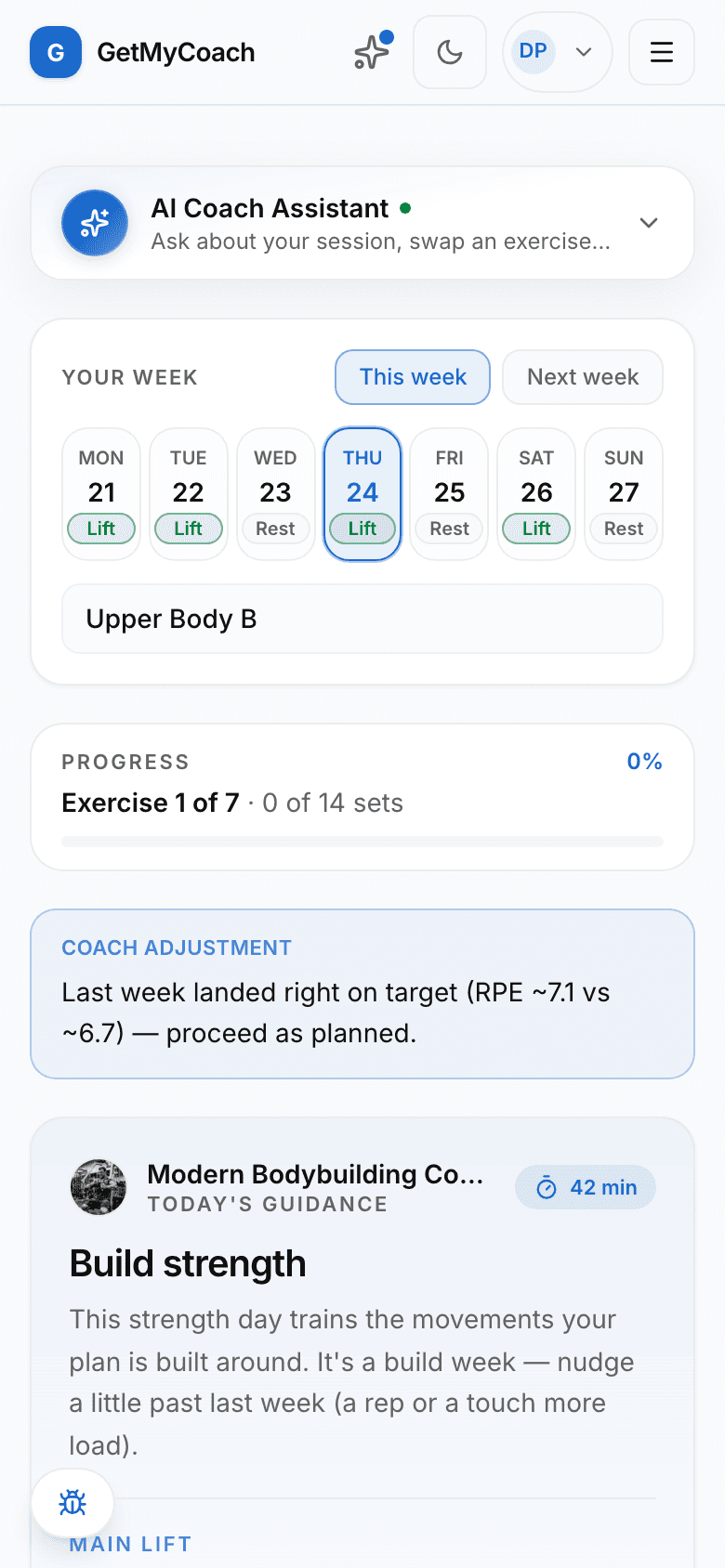
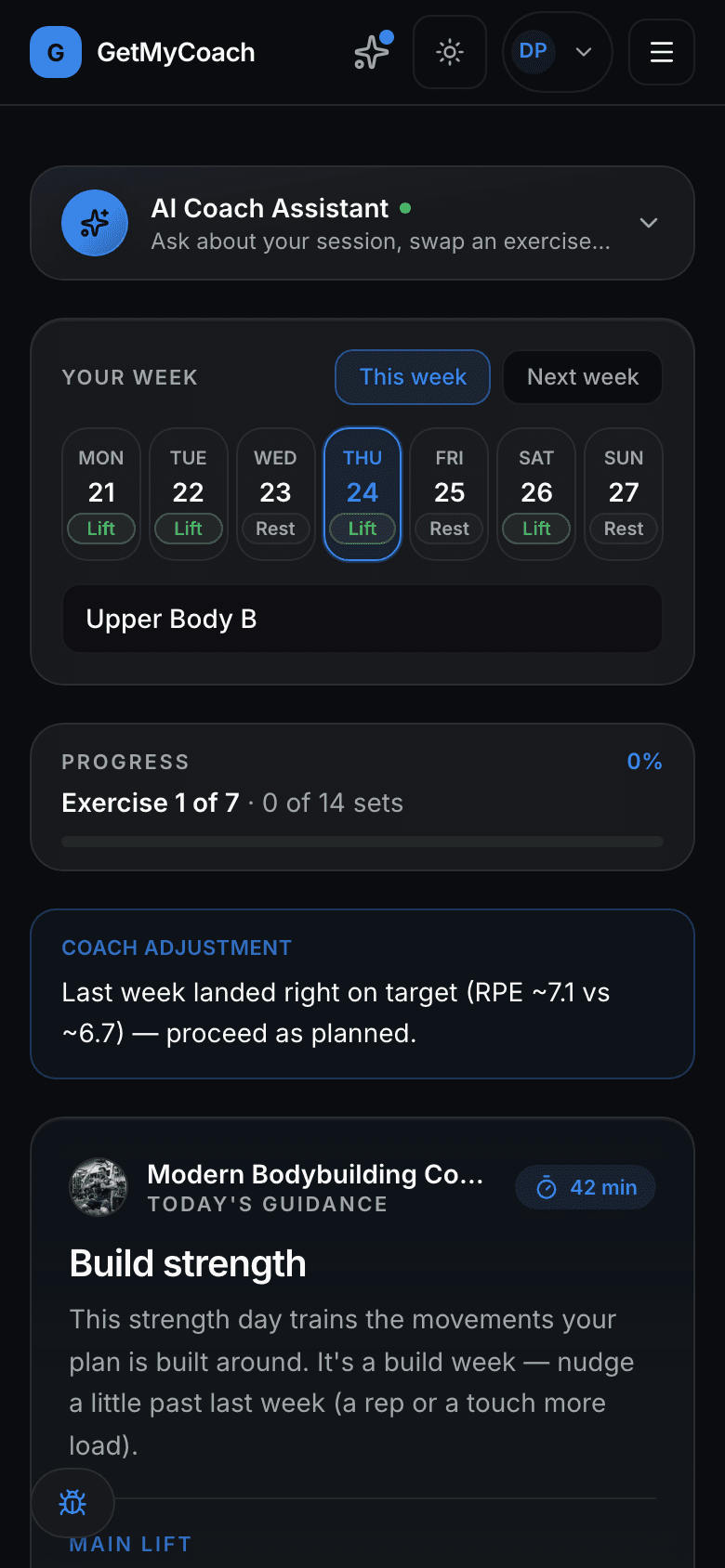
Two things it does not do, so you know what you are getting: it does not read a heart-rate strap, a watch or another app — the effort target is prescribed and you judge it — and it will not add a third hard day because you had a good week. What it does do is record what you actually completed, so the next block is built on real sessions rather than intended ones.
Warm-up, warning signs and who should wait
Near-maximal effort from cold is the one part of HIIT with a genuine injury and cardiac risk profile, and it is the part most often skipped.
The warm-up is not optional. Eight to ten minutes of progressive easy work, then two or three short accelerations at roughly interval pace with full recovery between them. The first hard round should not be the first time your body sees that intensity.
Stop the session for chest pain or pressure, unusual breathlessness, dizziness, an irregular or racing heartbeat that does not settle, or nausea that does not pass within a minute or two of easing off. These are reasons to stop and seek advice, not to finish the set.
Talk to a doctor first if you have known cardiovascular, metabolic or renal disease or symptoms suggestive of it, uncontrolled high blood pressure, are pregnant, or have been inactive for a long stretch. Standard pre-participation screening treats vigorous intensity differently from moderate for exactly this reason.
And a quieter one: in a large energy deficit, hard intervals are the first thing to reduce, not the last. Intensity is expensive, and a body without fuel recovers from it badly.
The five mistakes
- Doing it every day. HIIT is a stimulus, not a habit to maximise. Daily hard sessions produce a plateau that looks like a discipline problem and is actually a recovery problem.
- Intervals that are too long. Three minutes at "hard" is a threshold session, not HIIT. If you can hold the effort for five minutes, it was not near-maximal — which is fine, but name it correctly and dose it accordingly.
- Cutting the recovery. The rest exists so the work can be fast. Halving it turns eight quality rounds into eight mediocre ones.
- No progression. The same eight rounds at the same effort for twelve weeks is maintenance. Add one variable at a time, and only when last week felt repeatable.
- Expecting it to fix the diet. A 25-minute session costs perhaps 250–350 kcal including the afterburn. That is one snack. Training builds the body; eating decides the weight.
Frequently asked questions
How long should a HIIT session be?
Twenty to thirty minutes total, including warm-up and cool-down, is plenty. The hard work inside it is usually four to twelve minutes. A 45-minute "HIIT class" is almost always something else — usually a circuit at moderate intensity, which is fine but should not be counted as one of your hard days.
How often can I do HIIT per week?
Two sessions a week suits most people, with 48–72 hours between them. One if you are returning from a break; three only if you are well-conditioned, not training hard for another sport, and your sleep, mood and lifting are all holding. There is no official guideline for HIIT frequency — this is a coaching heuristic, not a standard.
Is HIIT better than steady cardio for fat loss?
No. Two meta-analyses comparing them directly found no significant difference in body fat or fat mass. HIIT's advantage is time: it achieved comparable results with about 40% less training time. Pick based on your schedule, your joints and what you will actually keep doing.
Does HIIT burn fat for hours afterwards?
Only a little. EPOC — the "afterburn" — accounts for roughly 6–15% of the energy cost of the exercise itself, and the review that quantified it concluded that its role in weight loss is generally unfounded. Real, measurable, and far too small to plan around.
Should I do HIIT fasted to burn more fat?
There is no body-composition advantage. In a four-week trial with women on a calorie-controlled diet, fasted and fed aerobic exercise produced the same changes in fat mass and fat-free mass. For near-maximal intervals specifically, training fed usually means better quality work — which is the thing that actually drives the adaptation.
Can I do HIIT and strength training in the same week?
Yes, and you should — resistance training protects muscle while you lose fat. Keep them on separate days where possible, and keep interval days away from heavy lower-body days. Concurrent-training research found that combining lifting with running endurance work reduced strength and hypertrophy gains, while cycling did not, and that the effect scaled with how often and how long the endurance work was.
How long until I see results?
Fitness changes first, usually within three to four weeks: the same intervals feel easier and your recovery between rounds improves. Body-composition change follows the diet, not the intervals, and the trials above ran around ten weeks on average. If the scale is your only measure, you will conclude it is not working while it is.
What if I have knee or joint pain?
Choose a low-impact modality rather than pushing through. Rowing and incline walking intervals are hard enough to be genuinely effective without the impact of running. Persistent joint pain is worth getting assessed — training around it is a short-term fix, and why you might not be seeing results covers the other reasons a block stalls.
The bottom line
- HIIT is not better than steady cardio for fat loss — it is faster. About 40% less time for comparable body-composition change.
- The afterburn is small. Roughly 6–15% of the session's energy cost, and not a mechanism to plan a diet around.
- Two hard sessions a week is the working dose for most people, spaced by 48–72 hours and kept off heavy leg days.
- Modality matters for fat loss. Running-based intervals produced large effects in the trials; cycling-based ones did not.
A sustainable fitness plan, not a harder week
Tell GetMyCoach your level, the days you have and how long a session can be. The General Fitness Coach places the hard days, the strength work and the easy days in a proportion you can hold for months — and adjusts as your completed sessions come in.
Sources
- Keating SE, Johnson NA, Mielke GI, Coombes JS (2017). A systematic review and meta-analysis of interval training versus moderate-intensity continuous training on body adiposity. Obes Rev 18(8):943–964 — 31 studies; both reduced body fat, with no differences between HIIT/SIT and MICT on any body-composition measure
- Wewege M, van den Berg R, Ward RE, Keech A (2017). The effects of high-intensity interval training vs. moderate-intensity continuous training on body composition in overweight and obese adults: a systematic review and meta-analysis. Obes Rev 18(6):635–646 — 13 trials, ~10 weeks; no significant between-group differences, HIIT required ~40% less time; running produced large fat-mass effects while cycling did not
- LaForgia J, Withers RT, Gore CJ (2006). Effects of exercise intensity and duration on the excess post-exercise oxygen consumption. J Sports Sci 24(12):1247–1264 — EPOC comprises only 6–15% of the net total oxygen cost of the exercise; its role in weight loss is described as generally unfounded
- Wilson JM, Marin PJ, Rhea MR, Wilson SM, Loenneke JP, Anderson JC (2012). Concurrent training: a meta-analysis examining interference of aerobic and resistance exercises. J Strength Cond Res 26(8):2293–2307 — running, but not cycling, produced significant decrements in hypertrophy and strength; interference scaled with endurance frequency and duration
- Schoenfeld BJ, Aragon AA, Wilborn CD, Krieger JW, Sonmez GT (2014). Body composition changes associated with fasted versus non-fasted aerobic exercise. J Int Soc Sports Nutr 11:54 — four weeks, hypocaloric diet, volume-equated; no significant between-group differences in fat mass or fat-free mass
- Bull FC et al. (2020). World Health Organization 2020 guidelines on physical activity and sedentary behaviour. Br J Sports Med 54(24):1451–1462 — 75–150 min vigorous or 150–300 min moderate activity weekly, plus muscle strengthening on two days
- Riebe D, Franklin BA, Thompson PD, Garber CE, Whitfield GP, Magal M, Pescatello LS (2015). Updating ACSM's recommendations for exercise preparticipation health screening. Med Sci Sports Exerc 47(11):2473–2479 — the basis for treating vigorous intensity differently from moderate when screening before starting
- Swift DL, McGee JE, Earnest CP, Carlisle E, Nygard M, Johannsen NM (2018). The effects of exercise and physical activity on weight loss and maintenance. Prog Cardiovasc Dis 61(2):206–213 — guideline-level aerobic activity is generally inadequate for clinically significant weight loss without caloric restriction