Solein: The Protein Grown From Air, Explained
Solein is protein grown by a bacterium fed CO₂ and hydrogen. What is actually on the panel, how it compares with whey and pea, whether it beats them — and why you still cannot buy it in Switzerland.
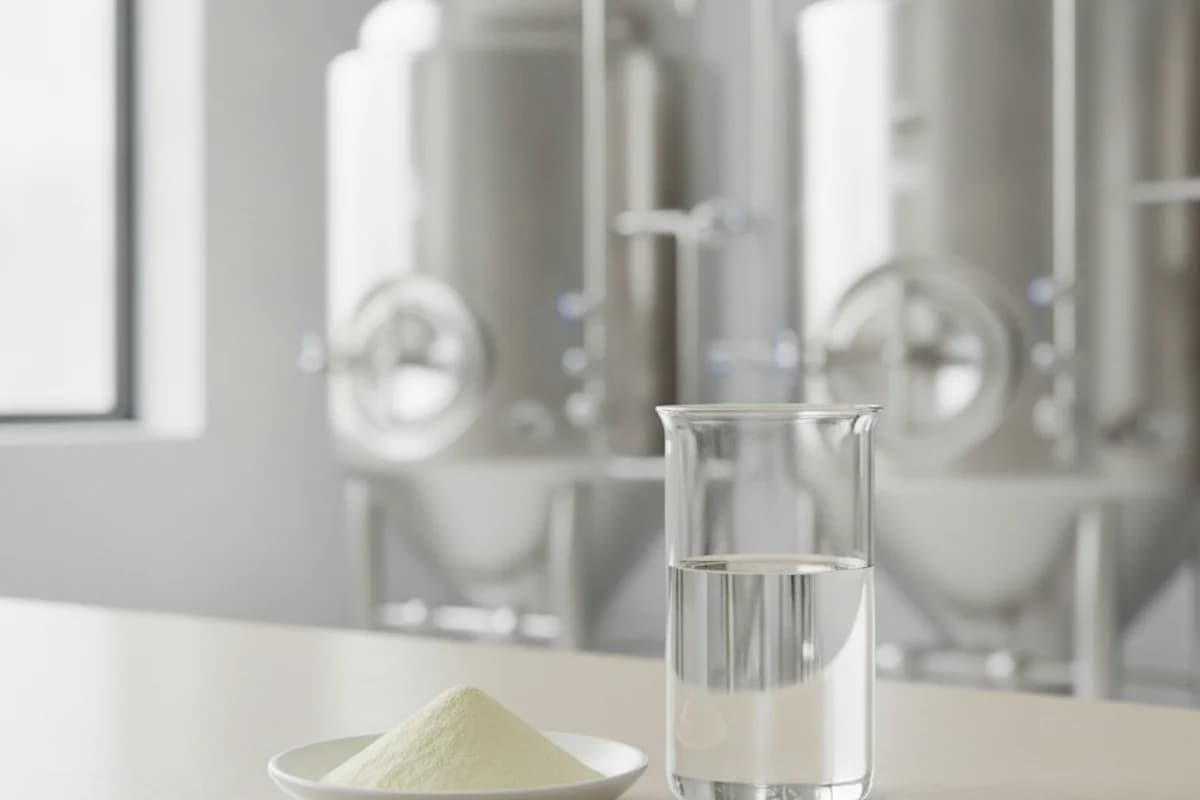
Every few years a protein arrives with a headline attached, and this one is hard to beat: food made out of thin air. Solein is a yellow powder grown by a bacterium that eats carbon dioxide and hydrogen inside a steel tank, with no field, no cow and no harvest.
Underneath the headline are two questions an athlete actually has. Is it good protein? And can you buy it?
The short version: Solein is dried bacterial biomass — around 80% protein by dry weight, all nine essential amino acids, plus iron and vitamin B12. It has been legal in Singapore since 2022 and on sale in the US since early 2026. The EU application has been running since October 2021 and Switzerland needs its own authorisation on top, so there is no Swiss shelf date. On paper it is a strong protein; the open questions are digestibility data and price, not safety.
What Solein actually is
Most "fermented" proteins are still farm products one step removed: Quorn's fungus and precision-fermented whey proteins are fed sugar or glucose that grew in a field. Solein is not. Its carbon comes from CO₂ and its energy from electricity, which is why the "out of thin air" line is more than marketing.
The organism is Xanthobacter sp. SoF1, a hydrogen-oxidising bacterium isolated in Finland. In the bioreactor, electrolysis splits water into hydrogen and oxygen; the bacteria burn the hydrogen for energy, fix CO₂ for carbon through the Calvin cycle, and take nitrogen from ammonia, with added mineral nutrients. The cells are then heat-inactivated, homogenised and dried into a powder with a neutral flavour and a distinctly yellow colour.
The honest description is protein made from electricity. That matters later, because the environmental case stands or falls on where the electricity comes from.
What is on the nutrition panel
Solar Foods publishes the composition as typical dry-weight values. Set against the powders you already know:
| Per 100 g (dry) | Solein | Whey isolate | Pea protein isolate |
|---|---|---|---|
| Protein | ~80 g | ~88–92 g | ~78–85 g |
| Fat | ~6 g | ~0.5–1 g | ~5–8 g |
| Carbohydrate | ~2 g | ~1–3 g | ~2–5 g |
| Dietary fibre | ~10 g | 0 g | ~5–6 g |
| Minerals (ash) | ~4 g | ~2–3 g | ~4–5 g |
| Iron | ~110 mg | traces | ~5–10 mg |
| Vitamin B12 | ~5 µg | ~2–3 µg | 0 |
Two features stand out. The fibre is unusual for a protein powder — roughly a tenth of the dry weight, a large share of it beta-glucans. And the iron number is enormous on paper: a 25 g scoop would carry something like 27 mg, several times an adult daily reference intake. Treat that as a claim about content, not about absorption. Microbial non-haem iron has no established bioavailability figure, and iron is one nutrient where more in the food does not reliably mean more in you.
Solar Foods describes the protein as complete, with all nine essential amino acids and roughly 43% essential amino acids and 20% BCAAs by protein weight — figures in the same region as dairy protein. Independent reviews of hydrogen-oxidising bacteria add a caveat worth knowing: a meaningful share of bacterial protein sits in structural forms that digestive enzymes reach poorly, which is part of why the process includes high-pressure homogenisation to break the cells open. There is no published human digestibility trial specific to Solein, so the "as good as whey" framing is currently a compositional argument, not a measured one.
Where you can actually buy it
This is where most articles get vague, so here it is plainly:
| Market | Status |
|---|---|
| Singapore | Approved as a novel food since September 2022 — the first market, via limited-edition gelato and a Fazer snack bar |
| USA | Self-affirmed GRAS since September 2024; a GRAS notification is with the FDA. On sale since early 2026 in Ambrosia Collective's Planta powder, at 20 g protein per serving |
| EU | Novel-food application filed 29 October 2021; still under EFSA assessment. The company expects approval during 2026 — a company expectation, not a decision |
| Switzerland | Not authorised. An EU authorisation does not carry over automatically; Solein needs its own clearance from the BLV |
So: no Swiss or German shelf date, and nothing you can legally order into Switzerland. If you see it offered here before an authorisation lands, that is a reason to be suspicious of the seller, not an early scoop.
The sustainability case, and what is established
Solar Foods puts the emissions at roughly 1% of conventional meat and about 20% of plant proteins, and around 100 times less land and water than whey. Those are company figures from company life-cycle work, not independently audited numbers, and the multiples should be read as order-of-magnitude rather than precise.
The direction, though, has independent support. A 2021 PNAS analysis found that solar-powered microbial protein can produce more protein per hectare of sunlight than any staple crop — roughly an order of magnitude more than soy on the same land. Growing protein in a tank genuinely uncouples it from arable land and rainfall.
The condition attached is the electricity. Electrolysis is energy-hungry, and the advantage narrows considerably on a fossil-heavy grid. "Made from air" is accurate about the carbon; the footprint is decided by the power socket.
What it means for your training
- Source matters far less than total. Hitting your daily protein target and spreading it across meals moves more than which powder you use. Our guide to how much protein you need per day is the lever worth pulling.
- The interesting case is vegan athletes. A complete amino-acid profile plus B12 and iron in a single non-animal ingredient is rare — most plant powders need blending or fortification to get there.
- It is not the cheap option. Solar Foods projects an ingredient cost of roughly €4.30–5.20 per kg from its planned 2028 facility, but today's consumer products sit at premium plant-protein pricing, comfortably above whey concentrate per serving. Whey stays the value choice for now.
- One group should pay attention. Single-cell proteins are screened for nucleic acid content because dietary purines raise uric acid, and long-standing guidance for this food category has been to keep added nucleic acids to around 2 g a day. That is a category question regulators assess, not a Solein-specific warning — but if you have gout or a history of urate kidney stones, it is the detail to ask about when it does arrive.
Nothing here asks you to change anything today. If Solein reaches a Swiss shelf, it will compete with whey on price and taste, because on nutrition it already looks competitive.
In the GetMyCoach nutrition coach
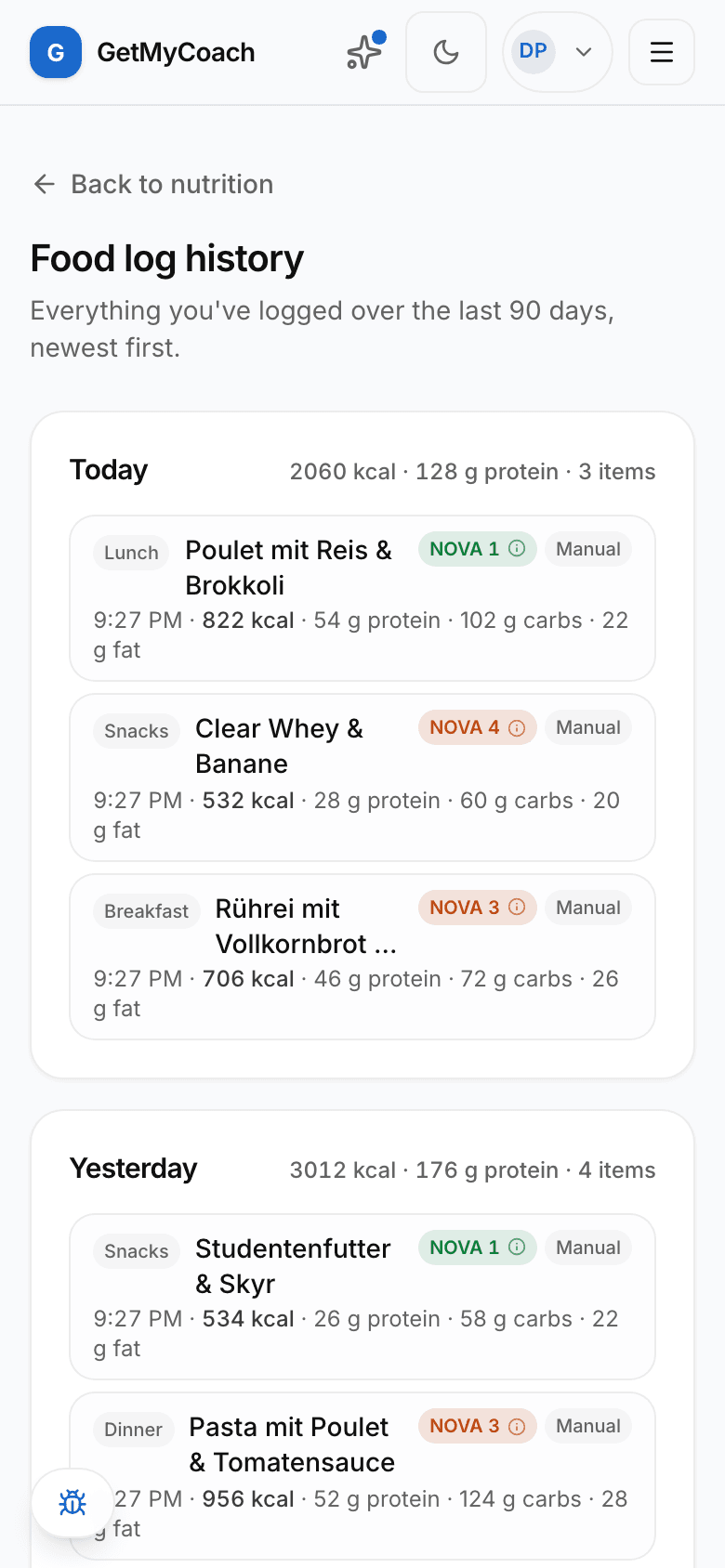
The protein question that actually changes your results is not which powder, it is how much — and that depends on what you trained this week. The GetMyCoach nutrition coach reads the sessions your plan prescribes and turns them into calorie and protein targets that move with your training load, then scores what you log for food quality, so a powder is judged on the whole label rather than the protein line.
Frequently asked questions
Is Solein vegan?
Yes. Nothing animal-derived goes in or comes out — the microbe is grown on CO₂, hydrogen, ammonia and mineral nutrients. It is not a plant protein either. Microbial or single-cell protein is a third category alongside animal and plant, closer in kind to nutritional yeast or Quorn than to soy. It is also an industrially processed ingredient, which puts finished Solein products in the ultra-processed bracket by the NOVA classification regardless of how clean the input list looks.
Is Solein better than whey protein?
Not on the numbers you can check. Whey isolate is more protein-dense per 100 g, dissolves better, costs less per serving and carries decades of human trials. Solein's real advantages are a complete profile without dairy, the B12 and iron, and the footprint. Until there is published human digestibility and performance data, whey and casein remain the evidence-backed default, and Solein is the promising newcomer.
Is Solein safe to eat?
Two regulators have accepted it so far: Singapore's food authority approved it as a novel food in 2022, and it entered the US market on a self-affirmed GRAS determination with a notification now filed with the FDA. The safety package includes 90-day oral toxicity work in rats and in-vitro genotoxicity testing, and the company reports no allergenicity signals in its compositional data. EFSA's own opinion is still outstanding, which is exactly why it is not yet on sale in Europe.
The bottom line
- It is genuinely novel, not a rebranded plant protein. Carbon from CO₂, energy from electricity, protein from a bacterium — a third category, not a soy substitute.
- The panel is strong; the human data is thin. Around 80% protein with a complete amino-acid profile, but no published digestibility or performance trial yet.
- You cannot buy it here, and there is no date. EU approval is expected by the company in 2026; Switzerland needs a separate authorisation after that.
Your protein target is a training question
GetMyCoach works out your calorie and protein needs from the sessions you actually do, scores what you log for food quality, and moves the targets as your training week changes.
Sources
- Solar Foods: What is Solein's nutritional composition?The manufacturer's typical dry-weight values: ~80% protein, 6% fat, 10% fibre, 4% minerals, iron 1.1 g/kg and vitamin B12 50 µg/kg.
- Solar Foods: Solein submitted to the European Commission for novel food approvalThe EU novel-food application filed on 29 October 2021, still under EFSA assessment.
- Solar Foods: GRAS notification submitted to the FDAThe US route: self-affirmed GRAS in September 2024 followed by a notification to the FDA.
- Solar Foods: First consumer product made with Solein available in the United StatesThe Planta protein powder by Ambrosia Collective — 20 g of protein per serving, the first consumer Solein product outside Singapore.
- BLV: Bewilligung von neuartigen LebensmittelnThe Swiss authorisation route for novel foods — separate from the EU procedure.
- Angenent et al., The Open Microbiology Journal 2022 — Hydrogen Oxidizing Bacteria as Novel Protein Source for Human ConsumptionIndependent review of the category: protein content, amino-acid composition, digestibility limits and the nucleic-acid question.
- Leger et al., PNAS 2021 — Photovoltaic-driven microbial protein production can use land and sunlight more efficiently than conventional cropsThe independent basis for the land-efficiency claim, and the dependence of the result on the electricity source.
- FAO/WHO Protein Advisory Group — guidance on single-cell proteinThe long-standing guidance to limit added dietary nucleic acids from single-cell protein to about 2 g per day.
Last reviewed: August 2026. This article is general nutrition and training information, not medical advice. Regulatory status is the most volatile fact here — EU and Swiss authorisation decisions can change at any time, so check the current position before assuming availability. Composition figures are the manufacturer's typical values and vary by batch and product. If you have gout, kidney disease or another condition affected by protein or purine intake, get individual advice before changing your protein sources.