Which Flour for Fat Loss, Muscle Gain and Training?
Spelt, wheat, rye and oats compared — when wholegrain is the better call, and when light flour is actually the smarter choice around training. Plus what 405, 550, 630 and 1050 really mean.

Most flour guides end with a ranking: wholegrain good, white flour bad. That ranking is fine as far as it goes — and it falls apart the moment you're an athlete standing 45 minutes out from a hard session.
The honest answer has two halves. For your everyday diet, the type number on the packet matters far more than whether it says spelt or wheat. Around training, the flour that's best for your health is sometimes the wrong one for the next 90 minutes.
The short version: Wholegrain versus light matters more than spelt versus wheat — a whole-wheat flour beats a light spelt 630 on fibre. For everyday eating, spelt or wheat 1050 is the easiest upgrade that still bakes a bread you want to eat. But no flour causes fat loss or muscle gain: bread is a carbohydrate source, your calorie balance and protein do the work, and close to a hard session a lighter, low-fibre option is often the smarter call.
The four grains, and what actually separates them
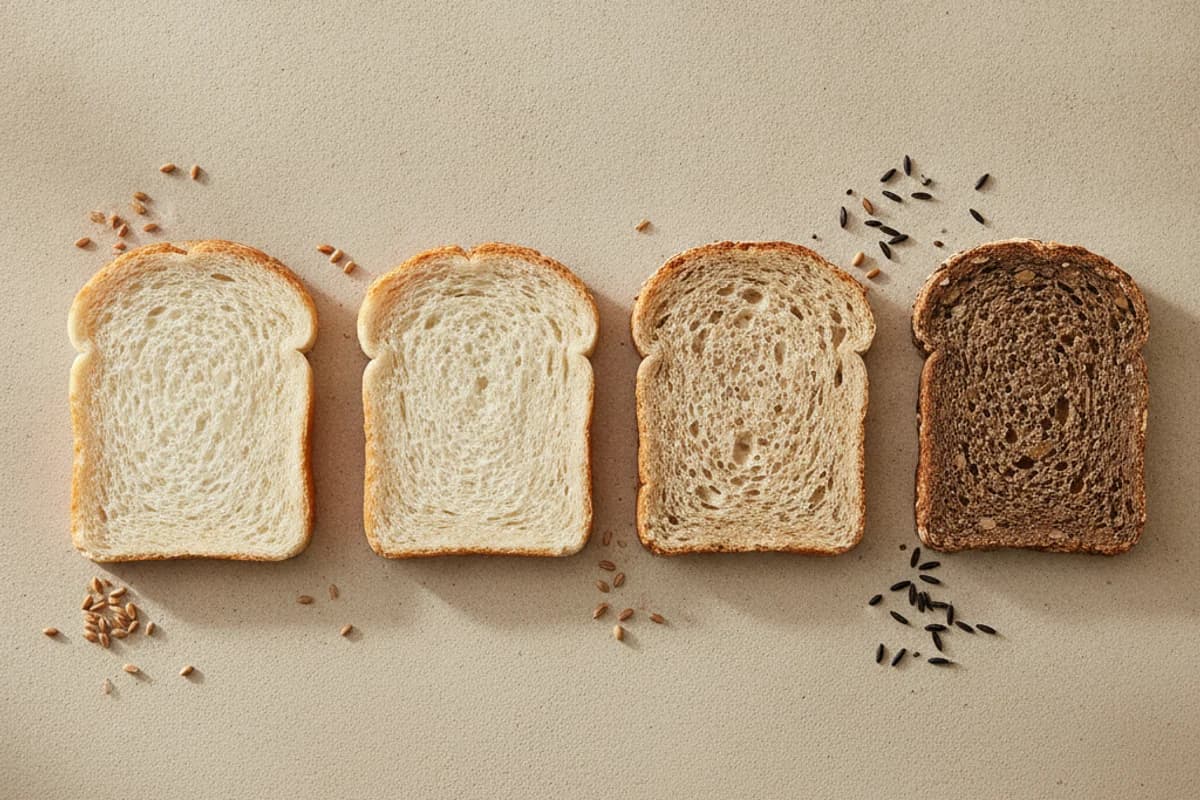
They're four different plants, bred over centuries for different things.
| Grain | What it is | Taste | Dough behaviour | Satiety | Best used for |
|---|---|---|---|---|---|
| Wheat | the classic bread grain | mild | very elastic, forgiving | varies by type | pizza, bread, rolls, cakes |
| Spelt | a close relative of wheat | slightly nutty | good, but more fragile | good | bread, rolls, cakes |
| Rye | its own species | strong, slightly sour | little elasticity | very high | sourdough, hearty loaves |
| Oats | a different grain altogether | mild and nutty | poorly suited to airy bread on its own | very high | porridge, pancakes, as a blend-in |
Wheat was selected hard for yield and baking performance; its gluten forms a strong elastic network that traps gas well. Spelt is a close relative with a nuttier flavour and a more fragile gluten structure, so its dough tolerates less kneading and less proofing. Rye sits further away genetically, forms almost no gluten network, and instead binds large amounts of water through its pentosans — that's the dense, moist, long-keeping crumb. It also needs acidity to bake properly, which is why rye and sourdough belong together.
Oats form no comparable gluten structure at all, so oat flour won't carry an airy loaf on its own. What oats do have is beta-glucan, a soluble fibre. The EU has authorised a health claim that 3 g of oat beta-glucan per day contributes to lowering blood cholesterol — a regulated claim, not a wellness slogan.
What 405, 550, 630 and 1050 actually mean
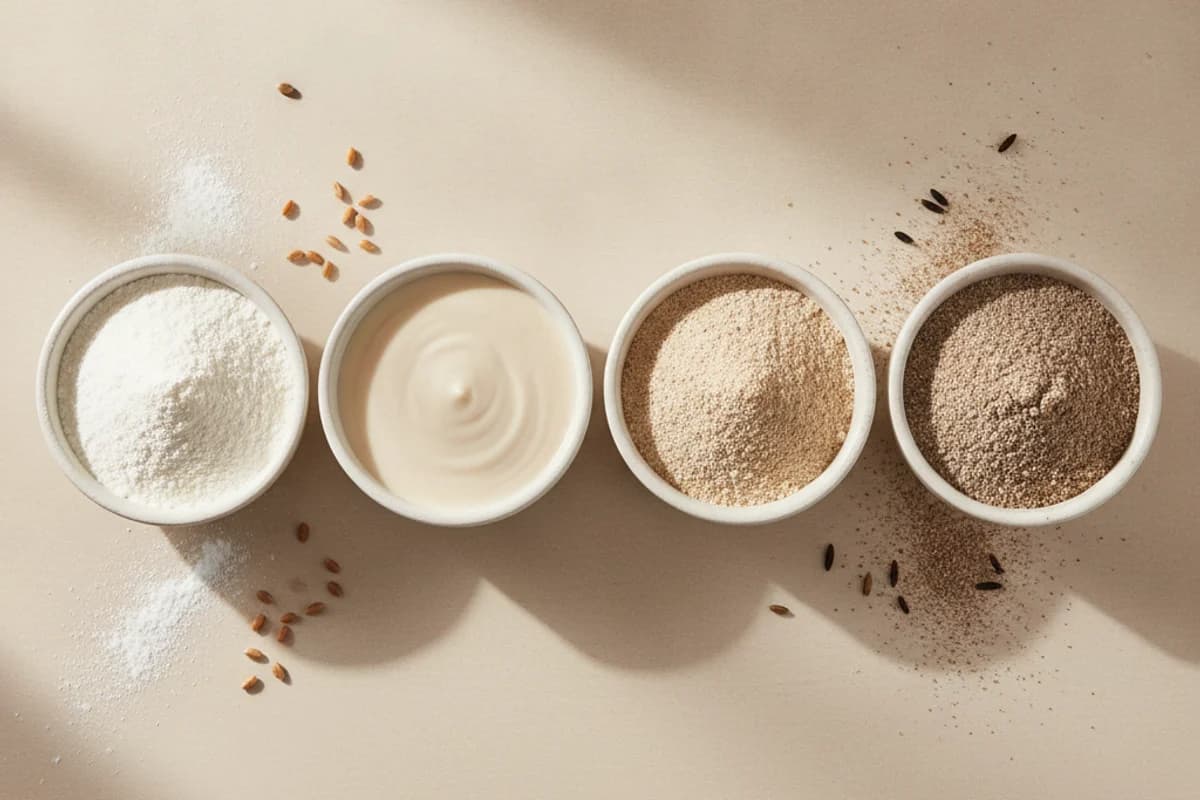
The type number isn't a quality grade. It's a lab measurement: the flour's mineral content in milligrams per 100 g of dry matter, determined by burning a sample and weighing the ash. In Germany and Austria it's standardised under DIN 10355.
Because the minerals sit mostly in the grain's outer layers, the number tells you how much of the whole kernel stayed in the bag:
- Low number → light, fine flour. Mostly the starchy inside.
- High number → more of the outer layers. More fibre, minerals, flavour and colour.
- Wholegrain → the entire cleaned kernel, which is why it carries no type number.
One catch if you shop in Switzerland: these numbers barely appear on Swiss packets. Swiss mills sell flour by name instead — Weissmehl (white), Halbweissmehl (half-white), Ruchmehl (a mid-dark Swiss speciality, roughly Type 1100) and Vollkornmehl (wholegrain). Type 1050 sits between half-white and Ruch. Our guide to bread and flour covers the Swiss shelf and bread-buying side in detail.
Fibre, protein and calories — and what that means per slice
Approximate values per 100 g of flour. Treat them as ranges: composition tables and individual mills disagree by a couple of grams, and the packet's own nutrition table always wins.
| Flour | kcal | Protein | Fibre |
|---|---|---|---|
| Rye wholegrain | ~330 | 8–10 g | 12–15 g |
| Oat flour (wholegrain) | ~370 | 12–14 g | 9–11 g |
| Wheat wholegrain | ~335 | 12–14 g | 10–12 g |
| Spelt wholegrain | ~340 | 13–15 g | 9–11 g |
| Rye 1150 | ~330 | 7–9 g | 7–9 g |
| Spelt 1050 | ~345 | 12–14 g | 4–6 g |
| Wheat 1050 | ~340 | 11–13 g | 4–6 g |
| Spelt 630 | ~350 | 11–13 g | 3–4 g |
| Wheat 550 | ~350 | 10–12 g | ~3 g |
| Wheat 405 | ~350 | 9–11 g | 2–3 g |
Nobody eats 100 g of flour, though. Here's the same thing in portions you actually put on a plate — approximate, since slice thickness and recipes vary a lot:
| Real portion | Calories | Protein | Fibre |
|---|---|---|---|
| 2 slices wholegrain bread (~100 g) | ~220–250 kcal | ~8–9 g | ~6–8 g |
| 2 slices white bread (~100 g) | ~240–260 kcal | ~8 g | ~2–3 g |
| 1 bread roll (~60 g) | ~160–180 kcal | ~5–6 g | ~1.5–2 g |
| 1 wholegrain roll (~60 g) | ~150–170 kcal | ~6 g | ~4–5 g |
| 1 portion pizza base (~150 g dough) | ~380–420 kcal | ~11–13 g | ~3 g |
Two things stand out. Calories barely differ — swapping white bread for wholegrain saves you almost nothing on energy. Fibre differs by a factor of three or more, and that's where the real difference lives. Adults are advised to get at least 30 g of fibre a day and most people fall short, so two slices of wholegrain bread covering 6–8 g of that is a meaningful chunk of the daily target. Our fibre guide goes deeper on hitting it.
What each flour is actually good at
Not a healthy-to-unhealthy ranking — a read on which job each flour does well. Rye wholegrain tops the satiety column and sits at the bottom of the pre-workout one, and both of those are correct at the same time.
Rye wholegrain
- Satiety
- Satiety: strong fit
- Pre-workout
- Pre-workout: weak fit
- Endurance fuel
- Endurance fuel: weak fit
- Everyday
- Everyday: strong fit
- Baking (airy)
- Baking (airy): weak fit
In short: The satiety champion, and the one to avoid right before a hard session.
Wheat / spelt wholegrain
- Satiety
- Satiety: strong fit
- Pre-workout
- Pre-workout: weak fit
- Endurance fuel
- Endurance fuel: decent fit
- Everyday
- Everyday: strong fit
- Baking (airy)
- Baking (airy): decent fit
In short: The best everyday fibre upgrade; still heavy close to training.
Oat flour (as a blend-in)
- Satiety
- Satiety: strong fit
- Pre-workout
- Pre-workout: decent fit
- Endurance fuel
- Endurance fuel: decent fit
- Everyday
- Everyday: strong fit
- Baking (airy)
- Baking (airy): weak fit
In short: Very filling and easy in porridge; won't carry an airy loaf alone.
Spelt 1050
- Satiety
- Satiety: decent fit
- Pre-workout
- Pre-workout: decent fit
- Endurance fuel
- Endurance fuel: decent fit
- Everyday
- Everyday: strong fit
- Baking (airy)
- Baking (airy): strong fit
In short: The all-rounder: real fibre, still bakes a bread people want to eat.
Wheat 1050
- Satiety
- Satiety: decent fit
- Pre-workout
- Pre-workout: decent fit
- Endurance fuel
- Endurance fuel: decent fit
- Everyday
- Everyday: strong fit
- Baking (airy)
- Baking (airy): strong fit
In short: Same job as spelt 1050, a touch more forgiving in the dough.
Spelt 630
- Satiety
- Satiety: weak fit
- Pre-workout
- Pre-workout: strong fit
- Endurance fuel
- Endurance fuel: strong fit
- Everyday
- Everyday: decent fit
- Baking (airy)
- Baking (airy): strong fit
In short: Light and easy to digest — useful in the hour or two before training.
Wheat 550
- Satiety
- Satiety: weak fit
- Pre-workout
- Pre-workout: strong fit
- Endurance fuel
- Endurance fuel: strong fit
- Everyday
- Everyday: decent fit
- Baking (airy)
- Baking (airy): strong fit
In short: The pizza and pre-race flour. Low fibre is the point here, not a flaw.
Fat loss: the bread helps, it doesn't decide
Here's the order that actually matters, from most to least decisive:
- Your calorie balance. This is the one that determines whether you lose fat.
- Enough protein. Protects muscle in a deficit and is the most filling macronutrient.
- Fibre and satiety. This is where bread choice earns its place.
- The specific foods. Useful, but the smallest lever of the four.
Wholegrain flour doesn't have dramatically fewer calories than white flour — look at the table above. Spelt wholegrain isn't 100 kcal lighter than white flour. What it does is help you stay full inside your calorie budget, which makes the budget easier to keep. That's a real advantage, and it's a different claim from "wholegrain burns fat".
Muscle gain: stop looking for a high-protein flour
Spelt flour has 13–14 g of protein per 100 g, which sounds respectable and leads people to hunt for the "most protein-rich flour". That's the wrong search.
Grain protein is incomplete in the amino acids that matter most for building muscle, and by the time flour becomes two slices of bread you're looking at 8–9 g. What builds muscle is enough total energy, enough total protein, and progressive strength training — the bread's job is the carbohydrate base that fuels the training.
So instead of chasing a protein flour, or paying extra for a "protein bread", build the meal:
- Spelt bread + cottage cheese + 2 eggs — roughly 30 g of protein
- Wholegrain bread + chicken + skyr — roughly 35 g of protein
- Spelt bread on its own — roughly 8 g of protein
Same bread in all three. The topping is doing the work. If you want ideas for the protein half of the plate, our high-protein recipes and the recipe library are built exactly for that.
Carbs around training — and when light flour wins
This is where the standard advice breaks down, and where the interesting coaching lives.
Carbohydrate isn't the enemy of a lean physique; it's the fuel that makes hard sessions possible. But when you eat it changes what form works best. The American College of Sports Medicine is direct about this in its guidance on pre-event meals: a meal high in fat, protein or fibre needs extra time to digest, and high-fibre carbohydrate sources "are not recommended" close to an event because they can cause intestinal discomfort. Their own list of good pre-event choices includes toast, a bagel and pancakes — light flour, deliberately.
A practical way to run it:
| When | What works | Why |
|---|---|---|
| Everyday meals | wholegrain, rye, spelt/wheat 1050 | fibre, minerals, satiety — the bulk of your week |
| 3–4 hours before training | spelt 1050 or wholegrain + a protein source | enough time to digest, still nutrient-dense |
| 1–2 hours before | spelt 630, wheat 550, toast, a bagel | low fibre and low fat sit lighter when the session is intense |
| After training | any bread + a protein source | carbohydrate and protein together support recovery |
None of this makes wholegrain bad. It makes timing real. If you tolerate a wholegrain sandwich an hour before lifting, keep doing it — individual tolerance varies a lot, and this is a rule of thumb rather than a law.
Fuelling isn't the same across sports
A lifting session and a five-hour ride do not have the same carbohydrate demand, and treating them the same is one of the more common fuelling mistakes.
- Strength training (45–75 min). Carbohydrate need is moderate. A normal wholegrain-leaning diet covers it; the pre-session meal matters more for comfort than for fuel.
- Running (45–90 min) and HYROX. Now carbohydrate availability starts limiting performance, and gut comfort matters because you're moving. Lighter bread 1–2 hours before is genuinely useful here.
- Long endurance (2h+ runs, 4–5h rides). Total daily carbohydrate becomes the priority, and it climbs substantially with training volume. Light, easily digestible sources have a real role before and during — this is the one case where white flour is a performance tool rather than a compromise.
Five flour myths worth dropping
Which flour for your goal?
What's your goal right now?
Pick a goal and you'll get the flour, the bread it makes and the thing that actually drives that goal.
Flour
Rye wholegrain, spelt wholegrain or spelt 1050
On the plate
2 slices with cottage cheese, tomato and a boiled egg
What actually decides it
Your calorie balance, then enough protein. High-fibre bread helps because it keeps you full inside that budget — it doesn't burn fat on its own.
| Your goal | The pick | The thing that actually decides it |
|---|---|---|
| Fat loss | rye or spelt wholegrain | calorie balance, then protein |
| Fat loss, but normal bread | spelt 1050 | satiety inside your calorie budget |
| Muscle gain | spelt or wheat 1050 + protein topping | total energy, protein, progressive training |
| Strength session soon | lighter spelt or wheat | comfort, not fuel |
| Running | wheat 550 or spelt 630 beforehand | digestibility and timing |
| Long endurance | light flour before and during | total daily carbohydrate |
| Everyday health | mostly wholegrain, or 1050 | consistency across the week |
How this looks in the GetMyCoach nutrition coach
Everything above needs one number you can't read off a flour packet: how much energy and carbohydrate your own training actually costs.
That's what the nutrition coach works out. Instead of a generic activity slider, it reads the sessions your plan actually prescribes — the sport, the duration, the prescribed intensity — and turns them into a calorie target. Protein is set from your bodyweight and goal and stays stable day to day, while calories and carbohydrate move with the week: more on heavy training days, less on deload and rest days, and workout carbohydrate is protected on hard days even when you're in a deficit.
So the question stops being "is spelt better than wheat" and becomes the one that matters: does today have enough energy and carbohydrate in it for the session I'm about to do?
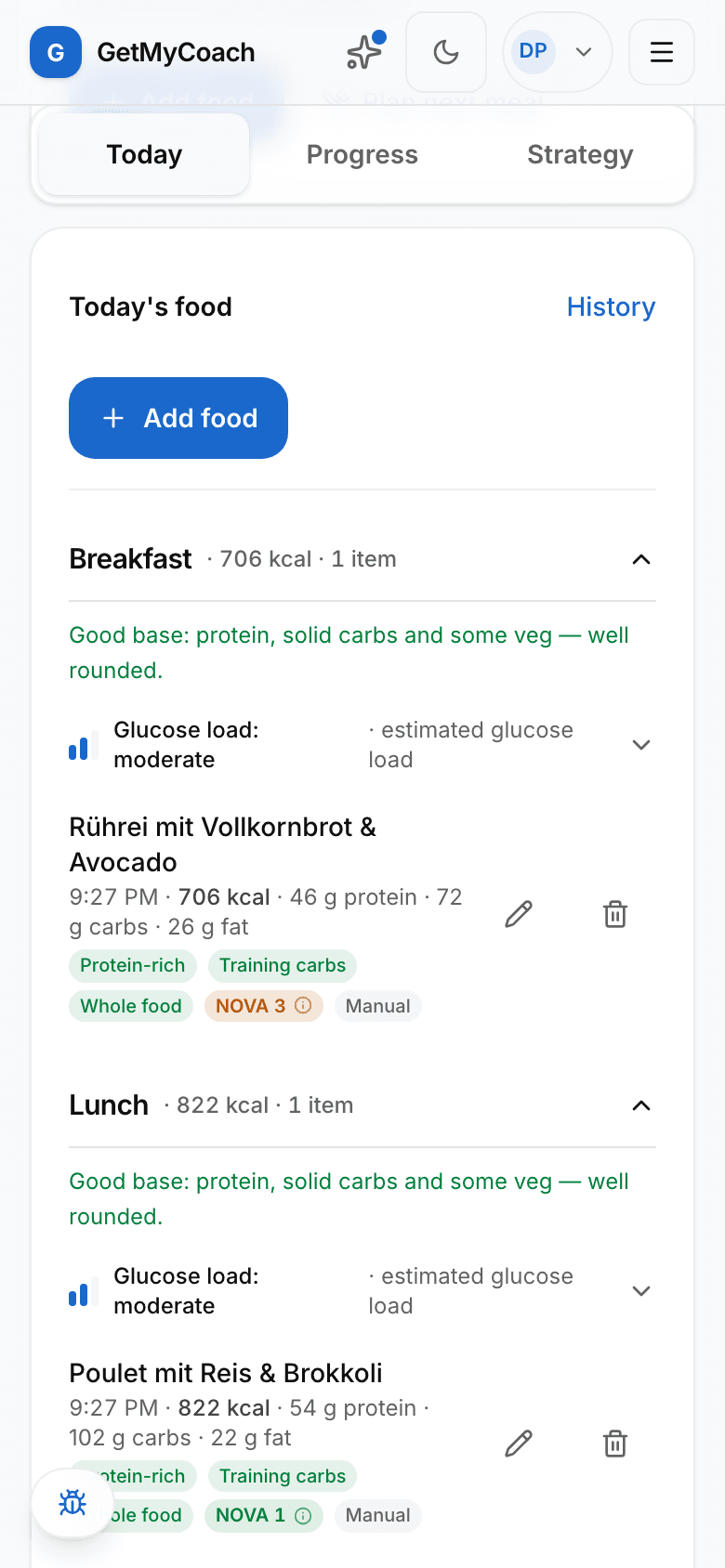
One honest limitation: the coach tracks calories, protein, carbohydrate and fat, plus a food-quality score — it does not currently track fibre. For that, the 30 g rule of thumb and the portion table above are your guide.
Frequently asked questions
Which flour is best for losing weight?
None of them cause weight loss. Rye wholegrain, spelt wholegrain and oats help most because their fibre keeps you full inside a calorie deficit, and spelt 1050 is a good compromise if you still want a light-textured loaf. Your calorie balance and protein intake are what actually decide the outcome.
Is spelt bread good for building muscle?
It's a good carbohydrate base, not a protein source. Two slices give you roughly 8–9 g of protein, which is modest. Combine it with cottage cheese, eggs, chicken or skyr and the same bread becomes a 30 g protein meal — that's the change worth making, rather than hunting for a higher-protein flour.
What should I eat before training — wholegrain or white bread?
It depends on how soon and how hard. Three to four hours out, a wholegrain or 1050 bread with a protein source is fine. In the last one to two hours before an intense session, a lighter, low-fibre option like spelt 630 or toast often sits better, because fibre and fat slow digestion. Tolerance varies, so test it in training rather than before a race.
What does Type 1050 mean on a flour packet?
It means the flour contains roughly 1,050 mg of minerals per 100 g of dry matter, measured as ash. Practically, a higher number means more of the grain's outer layers stayed in the flour — more fibre, more flavour and a darker colour than a 405 or 550.
The bottom line
- The number beats the grain. Wholegrain versus light changes fibre far more than spelt versus wheat does.
- No flour causes a result. Fat loss runs on calorie balance and protein; muscle runs on energy, protein and training. Bread supports both by being a good carbohydrate source.
- Healthiest isn't always best right now. Close to a hard session, lighter and lower in fibre is often the better call — and that's coaching, not a compromise.
- Spelt or wheat 1050 is the everyday default most people should reach for: real fibre, and still a bread worth eating.
Your ideal bread depends on more than the flour
GetMyCoach works out your calorie, protein and carbohydrate needs from the training you're actually doing — and moves them with your week, so hard days are fuelled and easy days aren't overfed.
Sources
- ACSM Current Comment: Pre-Event MealsOfficial ACSM statement: meals high in fat, protein or fibre need extra digestion time; high-fibre carbohydrate is not recommended close to an event.
- Academy of Nutrition and Dietetics, Dietitians of Canada and ACSM: Nutrition and Athletic Performance (2016)Joint position stand on carbohydrate needs, which scale with training volume and intensity.
- IREKS Compendium of Baking Technology — flour mineral (ash) contentThe ash measurement behind the type number, and the DIN 10355 ranges for each flour type.
- EFSA: Scientific opinion on oat beta-glucan and blood cholesterol (2010)Basis for the authorised EU claim at an intake of 3 g of oat beta-glucan per day.
- Aune et al., BMJ 2016 — whole grain intake, cardiovascular disease and mortalityDose-response meta-analysis of 45 prospective studies.
- DGE reference value for dietary fibre: at least 30 g per day for adultsJoint reference value of the German, Austrian and Swiss nutrition societies.
Last reviewed: August 2026. This article is general nutrition and training information, not medical advice. Nutrition figures are typical approximate values and vary by mill, brand, recipe and portion — the packet's nutrition table is what decides. If you have coeliac disease, a wheat allergy or another medical condition, get individual advice before changing your diet.