Keeping the Weight Off: Habits for the Maintenance Phase
Maintenance is its own phase with its own plan: a target you eat around instead of under, a weight range instead of a number, and a trend that lets you correct in kilos rather than in another diet.

The diet had a start, an end and a number. Maintenance has none of those, which is exactly why it catches people out.
The short answer: holding a new weight is its own phase with its own plan — a maintenance calorie target instead of a deficit, a weight range instead of a goal number, and a trend you keep watching so you can correct in kilos rather than in stones. Most of the habits that got you here stay; a few of them are allowed to get looser. What does not work is treating the last day of the diet as the finish line, because the biology that made losing hard does not switch off when the scale hits your number.
In short: Set an explicit maintenance target rather than drifting off the deficit. Define a range of about 2 kg rather than a single number, and judge it on a weekly trend, never on a morning. Keep the two habits with the strongest track record — regular weigh-ins and regular training — and let the food logging get lighter. React early and small: a trend that has climbed for three or four weeks is worth one deliberate adjustment, not a new diet.
Sources checked 11 September 2026 against the primary literature listed at the end; figures are quoted as published, with the population each came from named. This is general information, not medical advice.
Maintenance is a phase, not the end of the work
Two facts make this phase different from the one before it, and both are about biology rather than discipline.
Your body uses less energy than its new size suggests. When people were studied at a bodyweight 10% below their starting point, total energy expenditure came out lower than what the smaller body alone would predict — the classic finding behind the phrase "adaptive thermogenesis". The practical translation is modest but real: the calorie level that maintains you at 78 kg is somewhat lower than the level that would have maintained someone who was always 78 kg.
Appetite does not reset on the last day of the diet. A year after a ten-week weight-loss programme, participants still showed altered appetite hormones — ghrelin up, leptin down — alongside greater subjective hunger than before they started. That is not a willpower problem presenting itself as biology; it is biology, and knowing it is what stops a hungry Tuesday from being read as personal failure.
Put those together and the average outcome across structured programmes is sobering: pooled across studies with four- and five-year follow-up, participants had kept off about 3 kg on average — roughly a fifth of what they originally lost. That is not an argument against losing weight. It is an argument for treating maintenance as a phase you plan, the same way you planned the deficit.
Switching the goal from losing to holding
The most common mistake is never making the switch at all: the diet simply stops, and nothing takes its place. There is no universal maintenance calorie number — it depends on your body size, your training and how much you move the rest of the day — but there is a universal action, which is to set the target deliberately instead of letting it drift.
Deficit phase
Maintenance minus 300–500 kcal
A target you eat under, protein at the top of the range, weight trending down
Maintenance phase
Around maintenance, ±100 kcal
A target you eat around, protein still high, weight trending flat
One number moves. The habits behind it mostly do not.
Two details are worth getting right.
Add the calories back over two or three weeks, not overnight. Going from a deficit straight to maintenance in one step usually produces a rapid two-kilo rise on the scale that is mostly glycogen and its water rather than fat — real in kilos, not real in fat, and demoralising precisely at the moment your confidence matters. Stepping up in two or three increments makes it easier to see where you actually land.
Expect the first kilo, and do not chase it. For the same reason, a small rise in the first fortnight of eating more is normal. The trend over the following month is the thing to judge, and a stalled or bouncing scale covers in full why glycogen, salt and the menstrual cycle move the number more than a week of body-composition change does.
Your weight is a range and a trend
In the deficit you had a direction, so the trend line did the talking. In maintenance there is no direction, which is why a single number becomes such a bad instrument: your weight is supposed to wobble, and reading each wobble as a verdict is the fastest route back to dieting.
Two changes fix it.
Work with a range, not a number. Something like 2 kg wide, with your maintenance weight in the middle. Inside the range nothing happens. Leaving the top of it for several weeks running is a signal.
Judge a weekly average, not a morning. Day-to-day swings from food volume, salt, glycogen and fluid are routinely larger than anything that could have changed about your body overnight.
Weekly average, relative
W1
78.2 kg
W2
78.6 kg
W3
78.1 kg
W4
78.5 kg — a holiday week
W5
78.3 kg
W6
78.7 kg
W7
78.2 kg
W8
78.4 kg
How often to weigh is a personal decision with a research backdrop. In the long-term maintainer registry, about three quarters of members weighed themselves at least weekly, and reviews of self-weighing find it associated with better weight management without consistent evidence of psychological harm in the general population. That last clause matters: if the scale reliably ruins your day, or you have a history of disordered eating, weekly or fortnightly is a legitimate choice, and so is measuring by how clothes fit instead.
What stays, and what is allowed to get looser
The most useful evidence here comes from people who actually did it. The National Weight Control Registry follows thousands of adults who lost at least 13.6 kg and kept it off for over a year, and their shared behaviours are unglamorous: a lot of physical activity, regular self-weighing, eating breakfast, and — the surprising one — eating much the same way on weekends and holidays as on weekdays rather than running a strict/loose cycle. It is a self-selected, observational registry, so it describes what maintainers do rather than proving what caused it.
Keep these:
- Regular weigh-ins, in whatever rhythm you can do without dread.
- Protein around the level you ate while dieting. Around 1.6–2.2 g per kilo of bodyweight is a sensible maintenance band; it keeps you full and it keeps supporting the muscle you fought to hold. Our guide to protein while losing weight covers the reasoning, and how much protein per day has the food tables.
- Two or three strength sessions a week, for the reason in the training section below.
- Daily movement that is not training — walking is the largest lever most people have, and walking after meals is the version with the best evidence behind it.
- A rough sense of your portions, even once you stop logging every day.
Let these go:
- Logging every single day. A week of logging every couple of months recalibrates your eye; daily tracking is optional once your habits are stable.
- Eating identically every day. Flexibility is the point of maintenance. Consistency across the week matters more than consistency across the day.
- Weighing every food. You already calibrated your eye in the deficit.
- The 0.5 kg weekly expectation. There is no longer a number that is supposed to move.
What GetMyCoach reads once the goal is "hold"
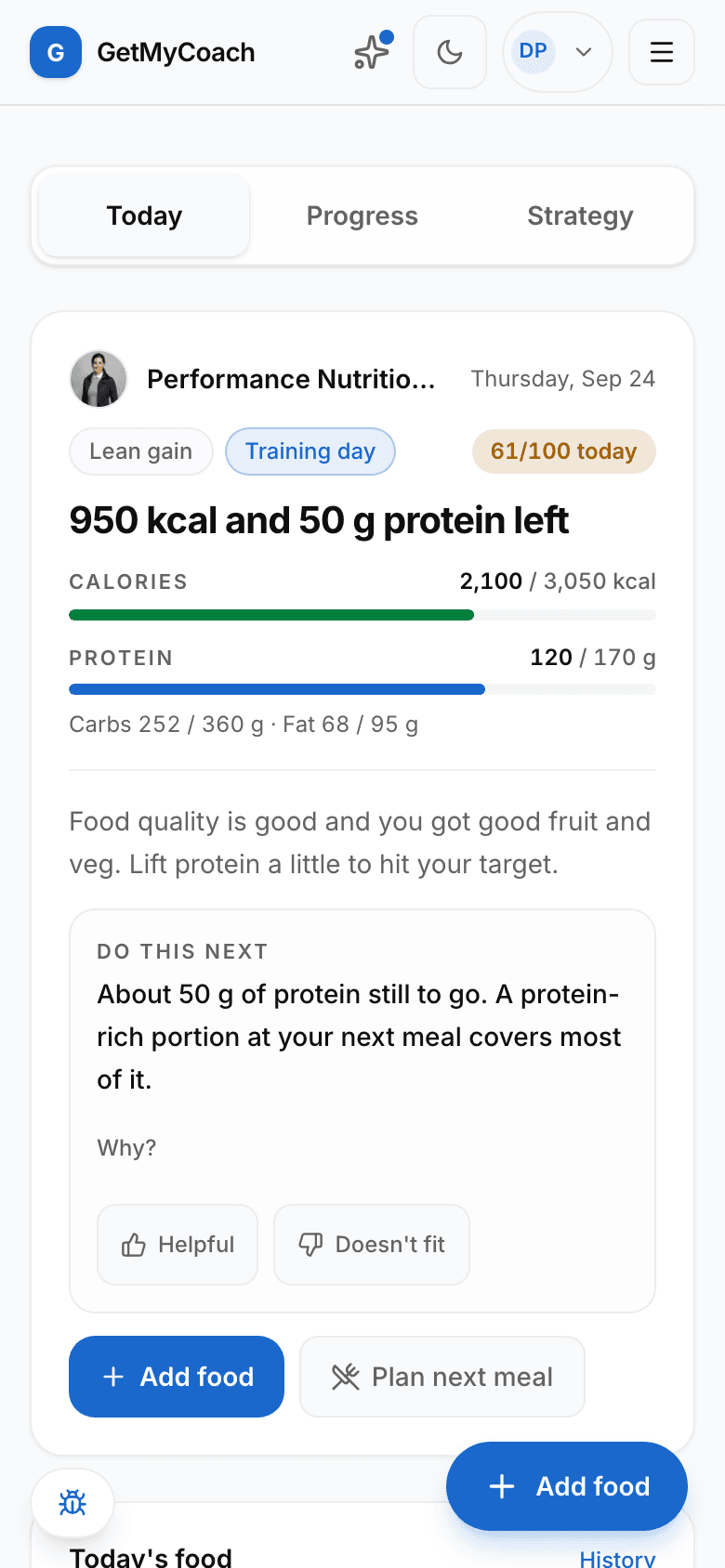
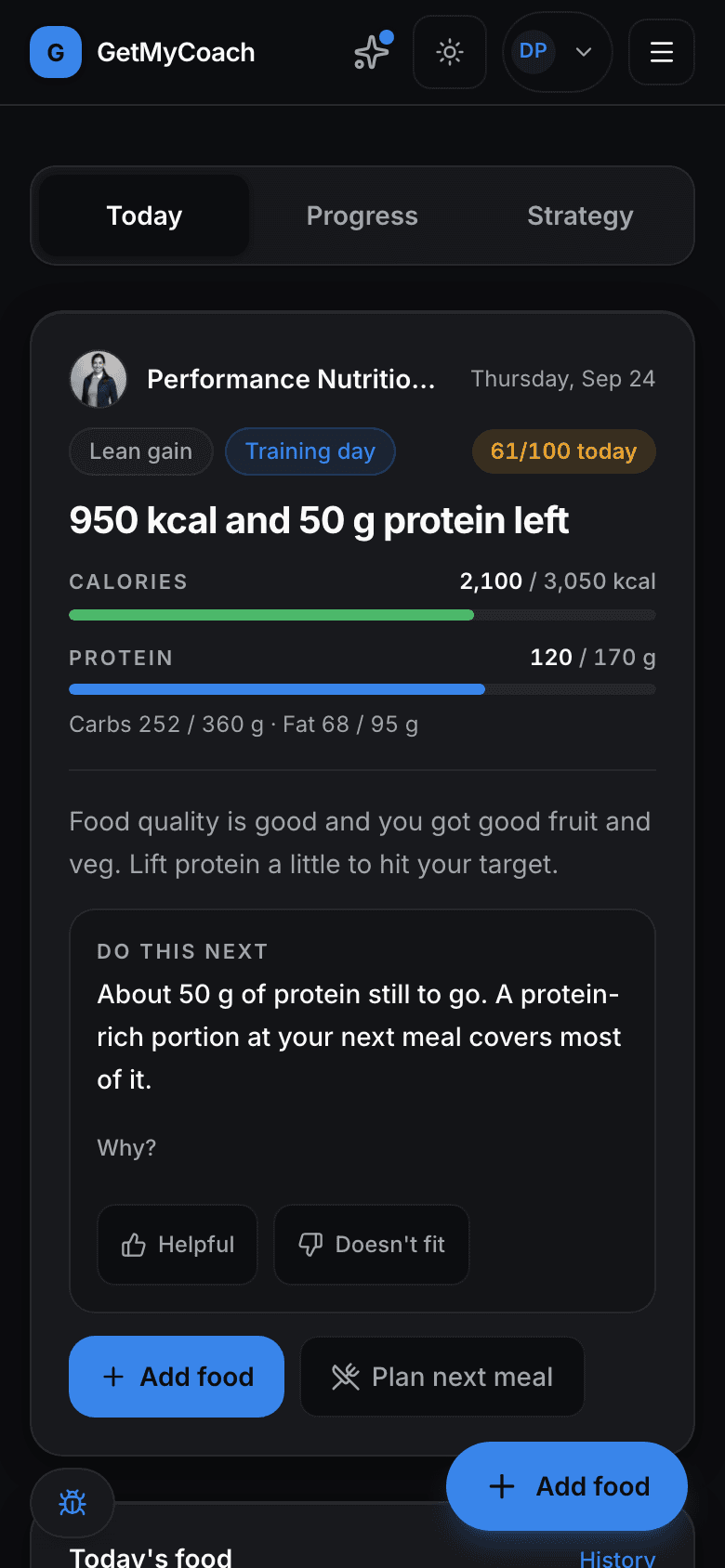
Setting the nutrition goal to maintenance moves your daily calorie target to roughly your needs, with a band of about ±100 kcal around it rather than a single figure to hit exactly. Protein stays high. Nothing else about the app changes, which is the point: the instrument you used to lose the weight is the instrument that tells you whether you are holding it.
Three behaviours are worth knowing about before you rely on them.
- Your weight is shown as a smoothed trend with a pace in kilos per week, viewable by day, week or month, and compared against the four weeks before it. On a maintenance goal, "no pace worth reporting" is the result you want.
- A four-week check reads adherence and the scale together. If you have been eating to your target and the trend is flat, it says so and tells you to change nothing. If the trend has drifted up or down while you were eating to target, it says that instead and points you at your goal settings. And if you have not eaten to the target, it says the target has not been tested yet rather than declaring it broken.
- It does not adjust a maintenance target behind your back. The automatic calorie nudge only runs on directional goals — losing or gaining. On a hold goal the app flags the drift and leaves the decision with you, which is the correct division of labour for a phase whose whole point is that you are steering.
The threshold it uses for "holding" is a trend under about 0.15 kg a week, and it will only say anything at all once there are at least ten fully logged days and four weigh-ins spread over a fortnight. Below that it says there is not enough data yet — which is more useful than a confident answer built on three weigh-ins.
Give the maintenance phase the same instrument the diet had
A maintenance calorie and protein target from your own numbers, your weight as a smoothed trend with a real pace per week, and a four-week check that tells you when nothing needs changing. No training plan required.
Small corrections early, instead of panic later
Almost everyone who regains a lot of weight did it the same way: nothing, nothing, nothing, then a crash diet in March. The alternative is boring and it works — act on a trend, act early, and change one thing.
- 1Check the data first1 week
Log normally, including the awkward days · Most 'mystery' rises are a few unlogged habits
- 2Confirm it is a trend2–3 weeks
Weekly averages, not mornings · Salt, travel and cycle phase all imitate a gain
- 3Restore the habit that slippedOngoing
Breakfast protein, the second session, the daily walk · Usually enough on its own
- 4Tighten portions of one thing2–3 weeks
Drinks, oils, the evening snack · Small, specific and reversible
- 5Run a short, mild deficit3–4 weeks
About 200–300 kcal under maintenance · Returns 1–2 kg without another diet
- 6Reset the maintenance targetLast
Your needs changed — weight, training, life · The target was right once; it need not be right forever
The size of the response should match the size of the signal. A kilo above the middle of your range is a rung one or two situation. Four kilos above the top of it, sustained over a couple of months, is a rung five situation — and rung five is a small deficit for a few weeks, not a repeat of the original diet.
Training is not a penance for eating
The training that belongs in maintenance is the training that belongs in a normal healthy life. Two claims are worth separating.
Strength training protects the composition of what you are maintaining. Holding 78 kg with the muscle you built is a different body from holding 78 kg without it — and lean mass is what makes the maintenance calorie level liveable rather than punishing.
Activity volume is associated with staying there. Among women who had lost at least 10% of their bodyweight, those still holding it at two years reported around 275 minutes a week of activity — a description of what maintenance tended to look like, not a threshold anyone must hit. Most of it is not training: walking, stairs, cycling to work, standing up.
What does not belong is the transaction — the extra session because of the dessert. It rarely balances anything, and it teaches the one thing worth unlearning in maintenance: that eating has to be paid for. For a structured programme, the weight-loss training plan page shows how GetMyCoach builds one around a goal, and strength training after 40 covers the case where holding muscle matters most.
Holidays, illness and the weeks that break the pattern
A maintenance plan that only works in ordinary weeks is not a maintenance plan. Three cases cover most of it.
A holiday or a week of celebrations. Expect the scale to be up 1–2 kg afterwards, and expect most of that to be food volume, salt and glycogen rather than fat. Return to your normal eating pattern — not a corrective diet — and read the trend again after ten days.
Illness or injury. Training stops, movement drops and appetite does whatever it wants. This is a hold-the-line phase, not an optimise phase: keep protein up because it supports the muscle you are not currently loading, and accept a small drift rather than adding a diet on top of being unwell.
A genuinely busy stretch. Pick the one habit with the most leverage and keep only that. For most people it is the weigh-in, because it is the thing that tells you whether the other habits mattered.
None of these needs a decision on the day. They need a trend read two weeks later.
Frequently asked questions
How long does the maintenance phase last?
Indefinitely — the honest answer and the uncomfortable one. What changes is the effort: the first three to six months ask for real attention, because the habits are new and the biology is still adapting. After that it is a handful of retained habits rather than a continuous project.
How many calories should I eat to maintain my weight?
There is no universal number — it follows from your body size, your training and how much you move the rest of the day. A bodyweight-based estimate is a reasonable starting point, but the only thing that confirms it is your own trend over three or four weeks of eating to it. If the trend is flat, the number was right; if it drifts, adjust the number rather than your expectations.
How often should I weigh myself once I have stopped dieting?
Weekly is enough to see a trend, and daily is fine if it does not bother you — around three quarters of long-term maintainers in the registry weighed at least once a week. The frequency matters much less than reading an average instead of a single morning. If weighing distresses you or you have a history of disordered eating, waist measurements or how clothes fit are legitimate instruments.
Is the yo-yo effect inevitable?
No, but it is common enough to plan against rather than hope away. What separates the people who hold their loss is not a different metabolism but a retained routine: they kept weighing, kept moving, and did not run a strict week against a loose weekend.
Do I have to track my food forever?
No. Most people move from daily logging to occasional logging — a week every month or two, or whenever the trend starts drifting. Tracking is a measuring instrument, not the diet. What is worth keeping permanently is the weigh-in, because it is the cheapest early-warning signal you have.
How much weight gain is normal before I should act?
Movement of 1–2 kg inside your range is normal and needs nothing. The signal is direction: a weekly average that has climbed for three or four weeks running and sits above the top of your range.
Do I still need a lot of protein when I am not dieting?
You need less than in a deficit and more than the packaging reference value. Around 1.6–2.2 g per kilo of bodyweight is a sensible maintenance band: it keeps meals filling and supports the muscle that makes your maintenance calorie level comfortable. Trials of extra protein during the post-diet period point in the direction of better maintenance, and it costs you nothing to keep.
Should I go straight from a deficit to maintenance?
Step up over two or three weeks rather than all at once. It makes the inevitable glycogen-and-water rise smaller and easier to interpret, and it gives you a clearer read on where your actual maintenance level sits — which is the number this whole phase is built on.
The bottom line
- Maintenance is a phase you plan, not the absence of one. Set a maintenance target deliberately; do not let the deficit just stop.
- A range and a trend, never a morning. About 2 kg wide, judged on weekly averages, with nothing happening inside the range.
- Keep the weigh-in, the protein and the training. Let the daily logging and the rigid routine go — that flexibility is what makes the phase sustainable.
- Correct early and small. Three or four weeks of upward drift earns one change, given two to three weeks to work. That is what keeps a kilo from becoming a diet.
Hold it with the same numbers you lost it with
Switch the goal to maintenance and GetMyCoach gives you a target to eat around, your weight as a trend rather than a morning, and a four-week check that is happy to tell you nothing needs changing.
Sources
- Leibel RL, Rosenbaum M, Hirsch J (1995). Changes in energy expenditure resulting from altered body weight. N Engl J Med 332(10):621–628 — total energy expenditure at a 10% reduced bodyweight is lower than the new body size predicts
- Sumithran P et al. (2011). Long-term persistence of hormonal adaptations to weight loss. N Engl J Med 365(17):1597–1604 — appetite hormones and subjective hunger still altered twelve months after the diet
- Anderson JW et al. (2001). Long-term weight-loss maintenance: a meta-analysis of US studies. Am J Clin Nutr 74(5):579–584 — about 3 kg, roughly a fifth of the original loss, still off after four to five years
- Wing RR, Phelan S (2005). Long-term weight loss maintenance. Am J Clin Nutr 82(1 Suppl):222S–225S — the National Weight Control Registry: high activity, frequent self-weighing, breakfast, and consistent eating across weekdays and weekends
- Wing RR et al. (2006). A self-regulation program for maintenance of weight loss. N Engl J Med 355(15):1563–1571 — daily self-weighing with a support programme reduced regain over 18 months
- Zheng Y et al. (2015). Self-weighing in weight management: a systematic literature review. Obesity 23(2):256–265 — more frequent self-weighing associated with better weight management, without consistent evidence of psychological harm
- Jakicic JM et al. (2008). Effect of exercise on 24-month weight loss maintenance in overweight women. Arch Intern Med 168(14):1550–1559 — around 275 minutes a week of activity among those sustaining a 10% loss
- Leidy HJ et al. (2015). The role of protein in weight loss and maintenance. Am J Clin Nutr 101(6):1320S–1329S — higher protein supports satiety and body composition during and after weight loss
- Westerterp-Plantenga MS et al. (2004). High protein intake sustains weight maintenance after body weight loss in humans. Int J Obes 28(1):57–64 — added protein during the maintenance period improved the outcome
- Cava E, Yeat NC, Mittendorfer B (2017). Preserving healthy muscle during weight loss. Adv Nutr 8(3):511–519 — why resistance training belongs in and after a deficit
- Hall KD, Kahan S (2018). Maintenance of lost weight and long-term management of obesity. Med Clin North Am 102(1):183–197 — why maintenance requires ongoing effort against a physiological pull