Protein for Weight Loss: How Much, and How to Spread It Across the Day
Why protein goes up in a deficit rather than down, the range that fits your bodyweight and age, how much distribution across meals really buys you — and the food that delivers the most protein per calorie.

You already know the hard part is the deficit. Protein is what decides how much of the weight you lose is fat, and how much of it is you.
The short answer: if you are training while you lose weight, aim for roughly 1.8–2.4 g of protein per kilogram of bodyweight a day, spread across three or four meals. In a deficit protein goes up, not down. It does not burn fat — the deficit does that. What it does is protect the muscle you already have and keep you fuller on fewer calories, which is why it is the one macronutrient worth being deliberate about while you are eating less.
In short: Total per day first, distribution second. A reasonable target while dieting is 1.8–2.4 g/kg of bodyweight, which for an 80 kg adult is roughly 145–190 g. Three or four eating occasions of 25–45 g cover it without arithmetic. Breakfast is where most days leak. And the protein only does its job if something asks the muscle to stay — training is the other half of the pair.
Sources checked 11 September 2026 against the primary literature listed at the end; figures are quoted as published, with the population each came from named. This is general information, not medical advice.
What protein can and cannot do in a deficit
Start with what it does not do. Protein is not a fat burner, and no amount of it produces weight loss on its own. Energy balance does that. What changes when protein is high is the composition of the loss and how liveable the diet is.
It protects lean mass. In a four-week study of young men in a steep deficit who also lifted and did interval work, the group eating 2.4 g/kg gained a little lean mass while the 1.2 g/kg group held theirs — and the higher-protein group lost more fat. In trained athletes cutting weight over two weeks, 2.3 g/kg preserved lean mass far better than 1.0 g/kg did. Both are small, short, supervised studies; the direction is consistent, the exact numbers are not a promise.
It keeps you fuller. When participants' protein went from 15% to 30% of their calories and they were then allowed to eat freely, they spontaneously ate about 441 kcal a day less and lost weight over twelve weeks without being asked to restrict anything. That study had nineteen people in it, so treat the number as an illustration rather than a dose. The mechanism is well supported: protein is the most satiating of the three macronutrients.
That is the whole case, and it is enough. Protein makes a deficit cost you fat rather than muscle, and makes it easier to stay in.
How much per day, and what moves the number
The reference value you see on packaging — 0.83 g/kg a day in the European dietary reference values — is a population minimum for weight-stable adults who are not training. It is not a target for someone in a deficit lifting three times a week. Those are different questions.
| Your situation | Protein per kg / day | 70 kg | 85 kg |
|---|---|---|---|
| Losing weight, training regularly | 1.8–2.4 g | 126–168 g | 153–204 g |
| Losing weight, little or no training | 1.4–1.8 g | 98–126 g | 119–153 g |
| Lean and cutting hard | top of the range | — | — |
| 65 and older, losing weight | 1.4–2.0 g, not below 1.2 g | 98–140 g | 119–170 g |
Three things move where you sit in that band.
How much fat you have to lose. The ranges are per kilogram of current bodyweight, which overstates the requirement for someone carrying a lot of fat mass — fat tissue does not need feeding with protein. The published recommendations for lean, resistance-trained athletes in a deficit are written per kilogram of fat-free mass (2.3–3.1 g/kg of fat-free mass) for exactly this reason. If you have a large amount to lose, use the lower end of the bodyweight-based band, or work from a realistic goal weight.
Age. From 65, reference intakes rise — the German-speaking reference values move to 1.0 g/kg, and an international expert position paper recommends 1.0–1.2 g/kg for healthy older adults and 1.2–1.5 g/kg during illness. Losing weight in your sixties and beyond means sitting at the top of the band, not the bottom: muscle is harder to hold and harder to rebuild.
Training, but less than you think. For building muscle in energy balance, the pooled evidence puts the point of clearly diminishing returns near 1.6 g/kg. A deficit is a different problem — you are defending tissue rather than adding it, so the sensible band sits higher than the building one.
Spreading it across the day
The daily total is what matters most. Distribution is a real but second-order gain, and it is worth having because it costs nothing.
What the research supports is unglamorous. Over the twelve hours after a training session, four servings of 20 g every three hours stimulated muscle protein synthesis more than eight servings of 10 g every ninety minutes, and more than two servings of 40 g every six hours. Reviewing that literature, Schoenfeld and Aragon suggest roughly 0.4 g/kg per meal across at least four meals as a practical way to reach 1.6 g/kg and above. Older adults appear to need a larger per-meal dose to get the same response — around 0.40 g/kg per meal against 0.24 g/kg in younger adults.
Translated into food: 25–45 g of protein at three or four eating occasions, for most adults, with no arithmetic required. What you do not need to do is fear a big portion. The claim that the body can only "use" 30 g at a time is a misreading — a larger dose is simply less efficient per gram for muscle protein synthesis, not wasted.
Protein per eating occasion
Breakfast
~8 g — coffee, bread, jam
Lunch
~30 g — the one deliberate meal
Snack
~5 g — fruit or a biscuit
Dinner
~60 g — everything else at once
Breakfast is where the day leaks. A coffee and a croissant is close to zero; quark, skyr, eggs or a bowl built on soy yoghurt turns the same slot into 25–35 g without changing anything else about the day.
Where the protein comes from when calories are tight
In a deficit the useful question is not protein per 100 g of food. It is protein per calorie, because calories are the thing you are short of.
That single shift does most of the work. Lean dairy, white fish, poultry breast, egg whites alongside whole eggs, tofu, tempeh, edamame, seitan and soy yoghurt all deliver a lot of protein for very few calories. Cheese, nuts, fatty cuts and most protein bars deliver protein too, but they arrive with a lot of energy attached — fine in a diet, just not the base of it.
200 kcal of hard cheese
about 14 g protein
Roughly 50 g of a mature hard cheese — typical values
200 kcal of low-fat quark
about 36 g protein
Roughly 300 g of Magerquark — typical values
Same calories, more than twice the protein
Plant-based works, it just asks for more planning. When protein intake was matched at about 1.6 g/kg, young men eating an entirely plant-based diet gained the same muscle and strength over twelve weeks as omnivores on the same training programme. The catch is arithmetic rather than biology: most plant foods carry their protein alongside more carbohydrate or fat, so a vegan day at 2 g/kg needs to be anchored on the dense sources rather than assembled from legumes alone.
For the full food table by portion, our guide to how much protein per day already covers it, and high-protein recipes and the supermarket lunch guide turn it into actual meals. If you would rather see the whole day planned around the target instead of only the protein, the nutrition plan for losing weight page walks through how the calorie and protein numbers fit together. For your own two numbers rather than a band, the calorie deficit calculator returns both at once — the deficit to eat in and the protein to hold while you do.
Protein and training are one pair
Protein supplies the raw material. Resistance training supplies the reason for the body to keep the muscle. Take either away and the other does less than you hoped: high protein with no training stimulus preserves lean mass only partly, and hard training on a low-protein deficit is a fast way to lose strength.
Two to three honest strength sessions a week is the dose most of the evidence sits on, and it does not have to be a gym. What matters is that the sets are genuinely hard near the end and that the load or the reps climb over the weeks. If you want the programming side, the weight-loss training plan page shows how GetMyCoach builds that around a deficit, and strength training after 40 covers the case where holding muscle matters most.
What this looks like in GetMyCoach
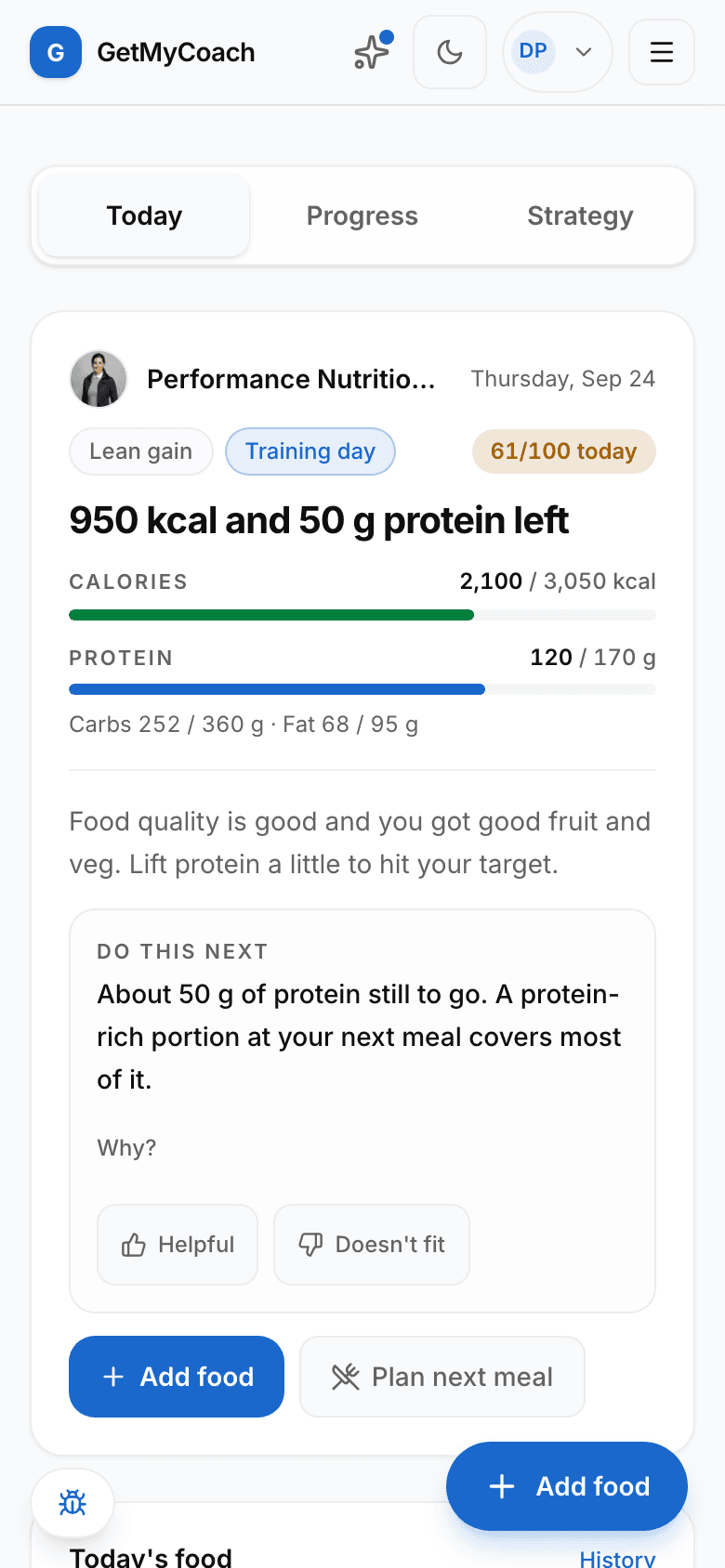
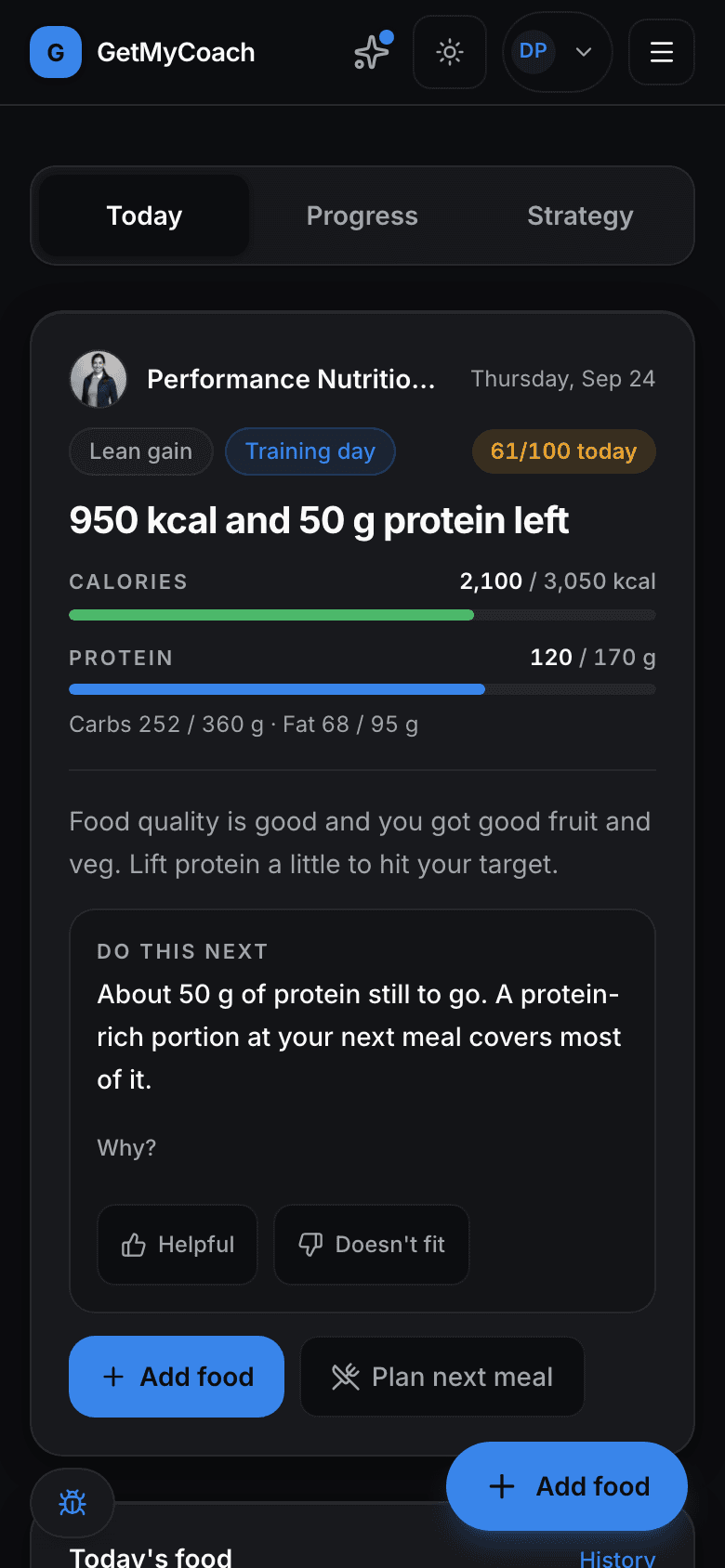
Pick fat loss as your goal, add your bodyweight and body basics, and you get a daily calorie target and a daily protein target derived from them — the protein one sits in the 1.8–2.4 g/kg band this article describes, because a deficit is what it is for. Log meals by name, by barcode or from a photo, and the protein figure fills in against the target as the day goes.
Three things make it worth doing rather than estimating:
- Protein is read against your bodyweight, not in isolation. Grams alone do not say whether 130 g is enough for you; grams per kilo does. If no bodyweight is on file, the app says so instead of guessing at one.
- You get one prioritised thing, not a wall of numbers. And when your protein target is reliably met but most of it keeps landing in a single meal, the coach says exactly that — softly, only as a repeated pattern, and never for someone who deliberately eats in two or three larger meals.
- Only days you actually tracked count, and today is left out until it is over, so one half-logged day cannot flatter or spoil the read. Behind every statement there is a "Why?" showing how many days it rests on.
Stop estimating your protein
Your target in grams, what you have logged against it today, and how that compares to your bodyweight — free during early access, and it works with no training plan at all.
The mistakes that cost people their protein
Four patterns account for most days that fall short, and none of them is about willpower.
- Everything at dinner. The one deliberate meal is in the evening; the other two are whatever was around. Distribution is a second-order concern, but a day built this way usually misses the total as well.
- Shakes instead of meals. A shake closes a gap. Used as the plan, it replaces the food that would have kept you full — which in a deficit is the thing you need the food for.
- Chasing a bigger number instead of hitting the one you have. Going from 150 g to 220 g adds nothing except the carbohydrate and fat you gave up to fit it in. Consistency at the target beats overshooting occasionally.
- Treating protein bars as free. They are food, with calories, and they come out of the same budget. Two of them can quietly erase a day's deficit — the same trap as eating back the calories a watch says you burned, which the guide to a stalled scale covers in full.
- 1Fix breakfastOne meal
Quark, skyr, eggs, soy yoghurt · The single biggest gap in most days
- 2Anchor lunch and dinnerTwo meals
Build the plate around the protein first · Gets most days to target without counting
- 3Swap, do not addOngoing
Same calories, denser source · Protein rises, the deficit stays intact
- 4Add one protein-led snackIf still short
Cottage cheese, edamame, skyr · Closes 15–25 g without a meal
- 5Use powder for the remainderLast
Whey, soy or pea, once a day · Convenience, never the foundation
When this belongs with a professional
High protein is well tolerated by healthy adults — a meta-analysis of controlled trials found no adverse effect of higher-protein diets on kidney function in people whose kidneys were healthy to begin with. That finding says nothing about someone whose kidneys are not, which is the point of this section.
Talk to a doctor or a registered dietitian rather than an article if any of the following applies:
- diagnosed kidney disease or reduced kidney function — protein intake is then a medical decision, not a training one
- pregnancy or breastfeeding, where a deliberate deficit is not the goal
- a current or previous eating disorder, or tracking that is becoming compulsive
- liver disease, gout, or medication that interacts with diet
- weight that is falling without you intending it to
Frequently asked questions
How much protein do I need to lose weight?
If you train while dieting, roughly 1.8–2.4 g per kilogram of bodyweight a day — about 145–190 g for an 80 kg adult. Without training, 1.4–1.8 g/kg is a reasonable band. If you have a large amount of fat to lose, use the lower end or work from a realistic goal weight, because the ranges are written per kilogram of bodyweight and fat tissue does not need the protein.
Does protein burn fat?
No. The calorie deficit produces the weight loss; protein decides what the lost weight is made of, and makes the deficit easier to hold because it is the most filling of the three macronutrients. Digesting protein does cost more energy than digesting carbohydrate or fat, but that difference is a rounding error next to the deficit itself.
How much protein per meal is best while dieting?
For most adults, 25–45 g at three or four eating occasions. The research suggests around 0.4 g/kg per meal is a sensible working figure, and that older adults need a larger per-meal dose than younger ones to get the same muscle response. Hitting the daily total still matters more than hitting a per-meal number exactly.
Can I lose weight on a plant-based diet and still hit my protein?
Yes. With intake matched at about 1.6 g/kg, a plant-based diet produced the same muscle and strength gains as an omnivorous one over twelve weeks of training. It takes more planning, because most plant foods carry their protein with more carbohydrate or fat — anchor meals on tofu, tempeh, seitan, edamame and soy products rather than on legumes alone.
Do I need protein shakes?
No. A shake is a convenient way to close a gap of 20–30 g when food is not practical. Everything it does, quark, skyr, eggs, fish or poultry do as well, usually with more to chew on — which is worth more in a deficit than it is at maintenance.
Should I still eat high protein on rest days?
Yes. Muscle protein turnover does not stop on the days you do not train, and the deficit does not stop either. Protein is the one target worth keeping flat across the week; carbohydrate is the macronutrient that sensibly moves with the training day.
Is a high-protein diet bad for my kidneys?
In healthy adults, the controlled evidence does not support that concern: pooled trials found no adverse change in kidney function on higher-protein diets. If you have diagnosed kidney disease or reduced kidney function, that evidence does not apply to you and protein intake becomes something to agree with your doctor.
Do I have to weigh every food to track protein?
No. Log meals by name and correct what looks wrong, or scan a barcode for packaged food. Weighing is worth it early on for the five or six foods you eat most, because it calibrates your eye — after that, consistency beats precision, and a fully logged ordinary day is worth more than a perfectly logged good one.
The bottom line
- Protein goes up in a deficit, not down. Around 1.8–2.4 g/kg of bodyweight a day if you train, adjusted down if you have a lot of fat to lose and up if you are over 65.
- Total first, distribution second. Three or four occasions of 25–45 g, and fix breakfast before you optimise anything else.
- Protein per calorie is the number that matters when the calorie budget is the constraint — swap towards denser sources rather than adding food.
- Training is the other half. Protein supplies the material; hard sets are what tell your body to keep the muscle while the weight comes off.
Track the one number this article is about
Set fat loss as your goal and GetMyCoach turns your bodyweight into a daily protein and calorie target, then shows what you have logged against it — and tells you when protein is the thing to fix, or when it is not.
Sources
- Longland TM et al. (2016). Higher compared with lower dietary protein during an energy deficit combined with intense exercise promotes greater lean mass gain and fat mass loss. Am J Clin Nutr 103(3):738–746 — 2.4 versus 1.2 g/kg over four weeks in young men
- Mettler S, Mitchell N, Tipton KD (2010). Increased protein intake reduces lean body mass loss during weight loss in athletes. Med Sci Sports Exerc 42(2):326–337 — 2.3 versus 1.0 g/kg over two weeks
- Weigle DS et al. (2005). A high-protein diet induces sustained reductions in appetite, ad libitum caloric intake, and body weight. Am J Clin Nutr 82(1):41–48 — protein from 15% to 30% of energy; about 441 kcal/day lower spontaneous intake (n = 19)
- Helms ER, Zinn C, Rowlands DS, Brown SR (2014). A systematic review of dietary protein during caloric restriction in resistance trained lean athletes: a case for higher intakes. Int J Sport Nutr Exerc Metab 24(2):127–138 — 2.3–3.1 g per kg of fat-free mass
- Morton RW et al. (2018). A systematic review, meta-analysis and meta-regression of the effect of protein supplementation on resistance training-induced gains in muscle mass and strength. Br J Sports Med 52(6):376–384 — diminishing returns near 1.6 g/kg for building in energy balance
- Areta JL et al. (2013). Timing and distribution of protein ingestion during prolonged recovery from resistance exercise alters myofibrillar protein synthesis. J Physiol 591(9):2319–2331 — 4 × 20 g every 3 h beat 8 × 10 g and 2 × 40 g
- Schoenfeld BJ, Aragon AA (2018). How much protein can the body use in a single meal for muscle-building? J Int Soc Sports Nutr 15:10 — about 0.4 g/kg per meal across at least four meals
- Moore DR et al. (2015). Protein ingestion to stimulate myofibrillar protein synthesis requires greater relative protein intakes in healthy older versus younger men. J Gerontol A Biol Sci Med Sci 70(1):57–62 — about 0.40 g/kg per meal in older adults versus 0.24 g/kg in younger ones
- Bauer J et al. (2013). Evidence-based recommendations for optimal dietary protein intake in older people: a position paper from the PROT-AGE Study Group. J Am Med Dir Assoc 14(8):542–559 — 1.0–1.2 g/kg for healthy older adults, 1.2–1.5 g/kg during illness
- Hevia-Larraín V et al. (2021). High-protein plant-based diet versus a protein-matched omnivorous diet to support resistance training adaptations. Sports Med 51(6):1317–1330 — matched at about 1.6 g/kg, same muscle and strength gains over twelve weeks
- Devries MC et al. (2018). Changes in kidney function do not differ between healthy adults consuming higher- compared with lower- or normal-protein diets: a systematic review and meta-analysis. J Nutr 148(11):1760–1775
- Cava E, Yeat NC, Mittendorfer B (2017). Preserving healthy muscle during weight loss. Adv Nutr 8(3):511–519 — why protein alone is not enough without a resistance-training stimulus
- EFSA Panel on Dietetic Products, Nutrition and Allergies (2012). Scientific Opinion on Dietary Reference Values for protein. EFSA Journal 10(2):2557 — population reference intake of 0.83 g/kg per day for weight-stable adults