Good Fats, Bad Fats: What Actually Belongs in Your Kitchen
Butter, rapeseed, olive, coconut and the seed oils everyone argues about — which fatty acids matter, the one family that is genuinely bad, and the Swiss daily numbers for oil, butter and nuts.
Butter was the enemy, then it was fine. Coconut oil was a superfood, then it wasn't. Seed oils are the current villain. Every few years the fat aisle changes its story, and the practical question — what do I cook with, and how much of it — never gets a straight answer.
It has one, and it has held up for two decades. It just isn't a list of good and bad foods. Almost everything you buy is a mixture of fatty acids, and what matters is which one dominates it and what you're replacing when you swap one fat for another.
The short version: There are four fatty-acid families, and only one is genuinely bad — industrially produced trans fats, capped by law in Switzerland since 2008 and in the EU since 2021. The rest is a swap question. Replacing saturated fat (butter, cream, fatty meat, coconut oil) with unsaturated fat (rapeseed and olive oil, nuts, fatty fish) lowers LDL cholesterol and cardiovascular events; replacing it with white bread does not. Swiss guidance is 2 tablespoons of plant oil a day, at least one of them rapeseed, plus a maximum of 10 g of butter.
Four families, one shelf
Every edible fat is a blend of the same four families — saturated, monounsaturated, polyunsaturated and trans. The dominant one tells you nearly everything you need:
| Family | Dominant in | What it does to blood lipids | The verdict |
|---|---|---|---|
| Saturated | butter, cream, cheese, fatty meat, coconut and palm oil | raises LDL | budget it — WHO says under 10% of energy |
| Monounsaturated | olive oil, rapeseed oil, avocado, hazelnuts, almonds | neutral to favourable as a replacement | the everyday base |
| Polyunsaturated, omega-6 | sunflower, corn and soy oil, most nuts and seeds | lowers LDL when it replaces saturated | needed, not feared |
| Polyunsaturated, omega-3 | fatty fish, rapeseed, linseed and walnut oil | lowers triglycerides; supplies EPA and DHA | the one most people under-eat |
| Trans, industrial | partially hydrogenated fats | raises LDL and lowers HDL | the only genuinely bad one — legally capped |
| Trans, ruminant | butter, milk, beef | same direction, far smaller amounts | unavoidable, not the problem |
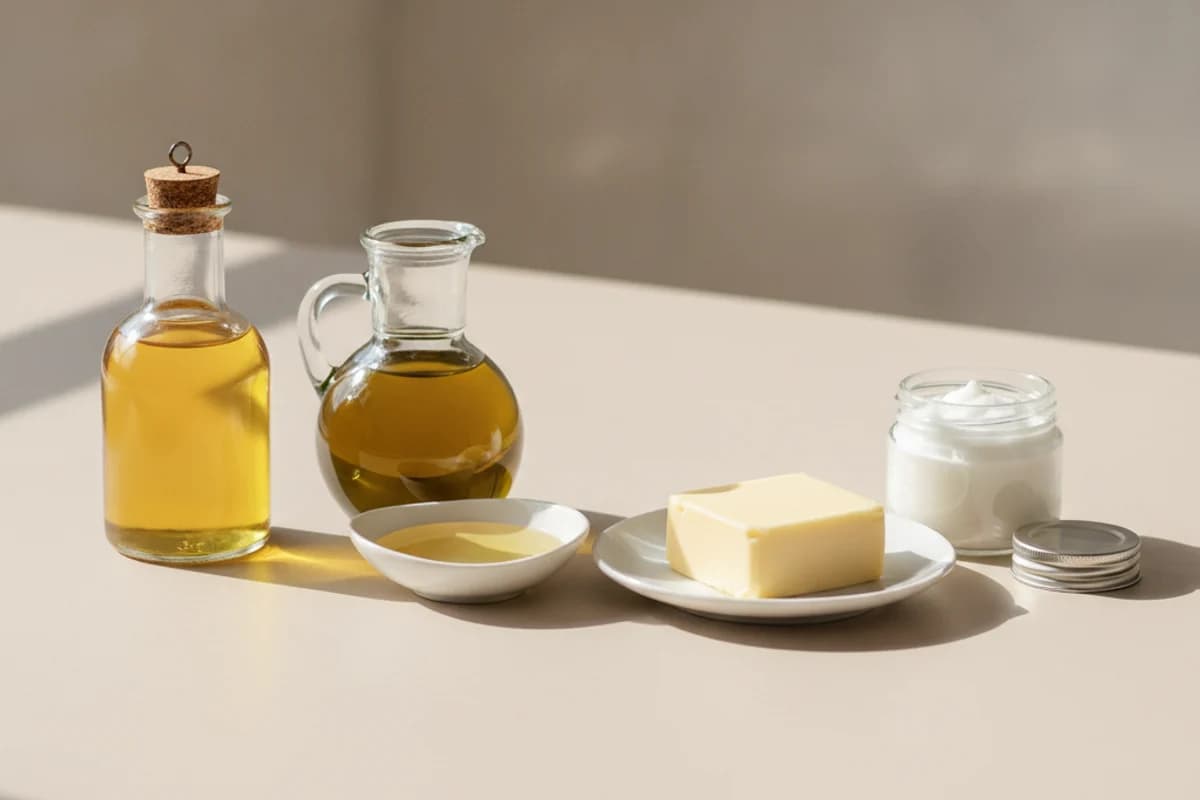
No food sits in one row. Butter is roughly 51 g saturated fat per 100 g — but also about 21 g monounsaturated. Olive oil is around 14 g saturated. That's why "avoid saturated fat" works as a daily budget and fails as a ban list.
The swap is the whole story
The strongest evidence here isn't about eating less fat — it's about exchanging one kind for another. A Cochrane review of 15 randomised trials in more than 56,000 people found that cutting saturated fat reduced combined cardiovascular events by about 17%, with the benefit tracking how far serum cholesterol fell, and the effect clearest when polyunsaturated fat took its place. Swap it for sugar or refined starch instead and the benefit largely disappears.
That is also what the WHO's 2023 guideline says in numbers: keep saturated fat under 10% of total energy, trans fat under 1%, and make the rest predominantly unsaturated. On a 2,500 kcal day, 10% is roughly 28 g of saturated fat — about 55 g of butter, or a 100 g bar of milk chocolate plus 40 g of hard cheese. Not a starvation budget, but not one that survives cheese, cream sauce and a croissant in the same day either.
The genuinely bad one is nearly gone from Swiss shelves
Industrial trans fats are the exception to everything above: they raise LDL and lower HDL at the same time, which no other fat does. They come from partial hydrogenation — the process that turns liquid oil into a spreadable, long-life fat.
Switzerland moved early — from April 2008, the second country in Europe to set a limit after Denmark. Today's rule sits in the EDI ordinance on foods of plant origin: the sum of trans fatty acids may not exceed 2 g per 100 g of edible oil or fat. The EU followed with Regulation 2019/649, in force since 1 April 2021, at the same 2 g per 100 g of the fat in a food. In a Swiss supermarket this is close to a solved problem — the residual exposure is imported baked goods bought online, and deep-frying fat that has been reheated far too often. The phrase on the label is partially hydrogenated / teilweise gehärtet; if you see it, put it back. Our guide to reading food labels covers where it hides.
Ruminant trans fats — the small amounts naturally present in butter, milk and beef — count toward the same 1% in the WHO guideline, but no authority recommends dropping dairy to chase them.
What Switzerland actually recommends
The Swiss food pyramid was revised in September 2024, and the fat advice became more specific than the old "use oils sparingly":
- 2 tablespoons (20 g) of plant oil a day, at least one of them rapeseed oil
- Butter, margarine and similar fats: sparingly, maximum 10 g a day
- A small handful of unsalted nuts or seeds daily (15–30 g) — now their own group rather than part of the fats
Which oil does which job comes down to the profile:
| Per 100 g | Saturated | Monounsaturated | Polyunsaturated | Best for |
|---|---|---|---|---|
| Rapeseed | ~7 g | ~59 g | ~29 g (incl. ~9 g ALA) | the default: dressings and normal pan heat; HOLL for hot work |
| Olive, extra virgin | ~14 g | ~73 g | ~11 g | dressings, gentle frying, flavour |
| Sunflower, standard | ~11 g | ~20 g | ~63 g (omega-6) | baking and dressings; little omega-3 |
| Sunflower, high-oleic | ~9 g | ~83 g | ~4 g | the heat-stable one — hot pan and deep frying |
| Butter | ~51 g | ~21 g | ~3 g | flavour, inside the 10 g |
| Coconut fat | ~87 g | ~6 g | ~2 g | flavour for curries — not a health oil |
Coconut oil is the one where the marketing has outlived the evidence. A meta-analysis of 16 trials in Circulation found it raised LDL cholesterol by roughly 10.5 mg/dL compared with non-tropical vegetable oils. The medium-chain-triglyceride argument doesn't rescue it: coconut oil's main fatty acid is lauric acid, which behaves much more like a long-chain saturated fat than like the MCT oil in the studies people cite.
Omega-3 and omega-6: the ratio isn't the lever
EFSA's reference values turn a vague "eat more omega-3" into a number: an adequate intake of 250 mg of EPA plus DHA per day for adults, plus 0.5% of energy as alpha-linolenic acid (ALA, roughly 1.4 g on 2,500 kcal) and 4% of energy as linoleic acid.
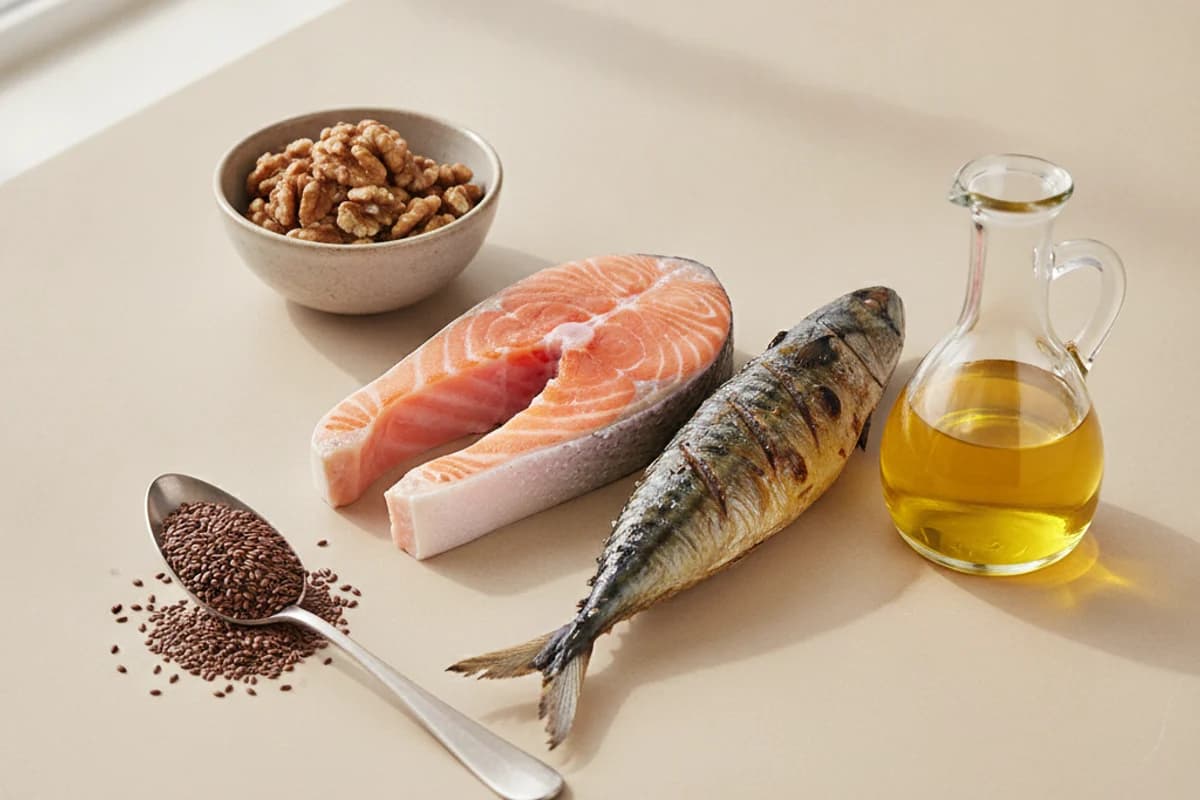
Two portions of fatty fish a week — salmon, mackerel, herring, sardines — covers that comfortably. Plant sources don't substitute cleanly: the ALA in rapeseed oil, linseed and walnuts converts to EPA at a low single-digit percentage and to DHA at well under one percent. ALA is worth eating on its own merits, but if you skip fish and want the EPA and DHA, an algae-oil supplement is the direct route.
The omega-6 half is where the internet goes wrong. A systematic review of randomised trials found essentially no evidence that raising linoleic acid raises inflammatory markers in healthy people, and it lowers LDL when it displaces saturated fat. Chasing a "perfect ratio" by cutting sunflower oil is the harder, less useful move; adding omega-3 is the easy one.
What this means when you train
- There is a floor, and dropping below it costs you. A meta-analysis of six crossover trials in 206 healthy men found that moving from around 40% to around 20% of energy from fat lowered total testosterone by roughly 10–15%. These were small studies in mostly untrained men, and the drop started from an unusually high-fat baseline — but the practical read holds: in a cut, don't strip fat below about 20% of your calories, or roughly 0.8 g per kg of bodyweight.
- Fat is the slow macro. It delays gastric emptying, which is exactly what you don't want sitting in your stomach before a hard session. Keep the pre-session meal lean and put the oil, nuts and cheese in the meals furthest from training — the same logic as what to eat before or after training.
- In a deficit, oil is the invisible calorie. Fat carries 9 kcal per gram against 4 for protein and carbohydrate, and two tablespoons of oil is around 180 kcal that vanishes into a pan. Measuring cooking oil with a spoon instead of pouring is one of the easiest hundred-plus calories to find — see losing weight without counting calories and how many calories you actually need.
In the GetMyCoach nutrition coach
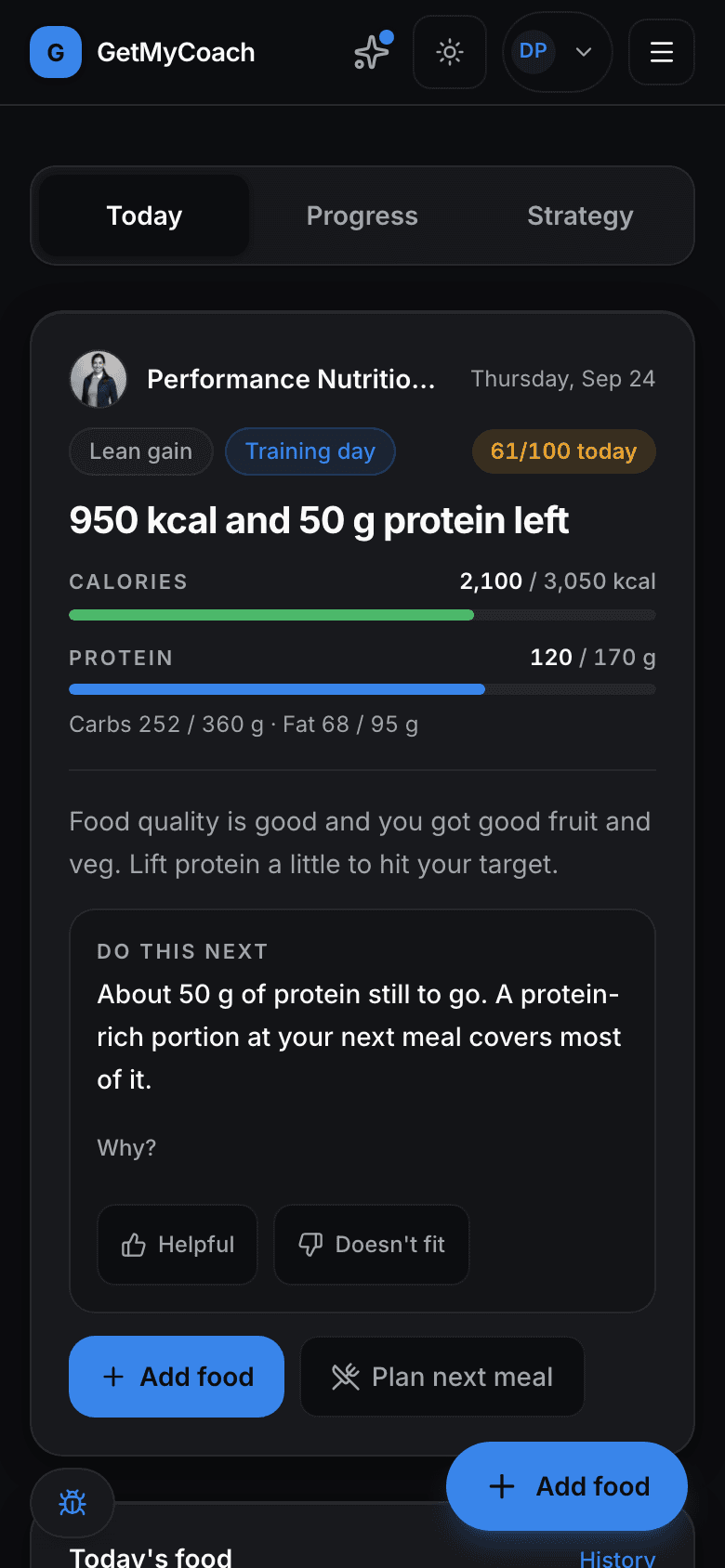
Fat is the macro people either fear or forget, and both go wrong for the same reason: the right amount depends on the rest of your day and your training week. The nutrition coach reads the sessions your plan prescribes and turns them into calorie, protein, carbohydrate and fat targets that move with your week — so a heavy training day and a rest day don't get the same fat number.
Frequently asked questions
Is butter bad for you?
No — it's concentrated saturated fat, and it uses up a lot of a small daily budget. At roughly 51 g per 100 g, the Swiss maximum of 10 g of butter a day costs you about 5 g of saturated fat, leaving room for the cheese and meat you'll also eat. Butter's problem isn't toxicity, it's opportunity cost: every 10 g you spread is 10 g not spent on rapeseed or olive oil, where the evidence for a benefit actually sits.
Are seed oils bad for you?
Not on the trial evidence. The claim rests on the omega-6 in sunflower, corn and soy oil supposedly driving inflammation, and randomised trials in healthy people have not found that linoleic acid raises inflammatory markers. Replacing saturated fat with these oils lowers LDL. The fair criticism of seed oils is indirect: they are the cheap fat in deep-fried and heavily processed food, so a high intake usually marks a diet that has other problems — the bottle in your kitchen is not one of them.
Which oil should I use for frying?
For a normal pan, refined rapeseed or olive oil is fine. For a genuinely hot pan or deep frying, use a high-oleic oil — HOLL rapeseed or high-oleic sunflower — because monounsaturated fat resists heat better than the polyunsaturated kind, and both stay stable above roughly 200 °C. Unrefined and cold-pressed oils, linseed especially, belong in dressings only. And don't keep reheating the same fat: Swiss food law caps the polar compounds — the breakdown products of repeated heating — in deep-frying fat at 27%, which is what a restaurant inspector measures. At home the proxies are your nose and eyes: fat that smells acrid, foams or smokes early is past it.
Do I need an omega-3 supplement?
Only if you don't eat fish. Two portions of fatty fish a week comfortably exceeds EFSA's 250 mg of EPA plus DHA per day, and there's no advantage to a capsule on top. If fish isn't on your menu, a fish-oil or algae-oil supplement is one of the few worth buying — algae oil being the vegan option that supplies EPA and DHA directly rather than relying on the poor conversion from plant ALA.
The bottom line
- Judge the swap, not the food. Replacing saturated fat with rapeseed oil, olive oil, nuts and fatty fish is the move with evidence behind it. Replacing it with refined carbohydrate isn't.
- One family is actually bad, and the law already handled it. Industrial trans fats are capped at 2 g per 100 g of fat in Switzerland and the EU; check imported goods for partially hydrogenated.
- Use the Swiss numbers as your budget. 2 tablespoons of plant oil (at least one rapeseed), maximum 10 g of butter, a handful of nuts — and don't cut total fat below about 20% of your calories when you're dieting.
How much fat you need depends on how you train
GetMyCoach works out your calorie, protein, carbohydrate and fat targets from the training you're actually doing, scores what you log for food quality, and moves the targets with your week.
Sources
- WHO: Saturated fatty acid and trans-fatty acid intake for adults and children (2023)The under-10%-of-energy ceiling for saturated fat, the under-1% ceiling for trans fat, and the recommendation to replace saturated fat primarily with polyunsaturated fat.
- Hooper et al., Cochrane Database of Systematic Reviews 2020 — Reduction in saturated fat intake for cardiovascular disease15 randomised trials, over 56,000 participants: cutting saturated fat reduced combined cardiovascular events by about 17%, with the benefit tracking the fall in serum cholesterol.
- BLV: Schweizer Ernährungsempfehlungen für Erwachsene (revised September 2024)2 tablespoons (20 g) of plant oil a day with at least 1 tablespoon rapeseed, a maximum of 10 g of butter or margarine, and 15–30 g of unsalted nuts or seeds.
- EDI Ordinance on foods of plant origin (SR 817.022.17), Art. 6 — Swiss trans-fat and frying-fat limits«Die Summe der Trans-Fettsäuren darf 2 g pro 100 g Speiseöl oder Speisefett nicht überschreiten» — in force since April 2008 — plus the 27% ceiling on polar compounds in deep-frying fat.
- Commission Regulation (EU) 2019/649 on trans fat in foodThe EU limit of 2 g of industrially produced trans fat per 100 g of fat, applicable since 1 April 2021.
- EFSA: Scientific Opinion on Dietary Reference Values for fats (2010)Adequate intakes of 250 mg EPA + DHA per day for adults, 0.5% of energy as alpha-linolenic acid and 4% of energy as linoleic acid.
- Neelakantan et al., Circulation 2020 — The effect of coconut oil consumption on cardiovascular risk factorsMeta-analysis of 16 trials: compared with non-tropical vegetable oils, coconut oil raised LDL cholesterol by about 10.5 mg/dL.
- Johnson & Fritsche, Journal of the Academy of Nutrition and Dietetics 2012 — Dietary linoleic acid and markers of inflammationSystematic review of randomised controlled trials: virtually no evidence that increasing linoleic acid raises inflammatory markers in healthy people.
- Whittaker & Wu, Journal of Steroid Biochemistry and Molecular Biology 2021 — Low-fat diets and testosterone in menSix crossover trials, 206 healthy men: moving from roughly 40% to roughly 20% of energy from fat lowered total testosterone by about 10–15%. The authors call for randomised trials to confirm the effect.
- Swiss Food Composition Database (naehrwertdaten.ch)Official Swiss reference values for the fatty-acid composition of oils, butter and coconut fat.
Last reviewed: August 2026. This article is general nutrition and training information, not medical advice. The fatty-acid figures are typical approximate values and vary by brand, harvest and refining — read the panel on your own bottle. Dietary reference values and food-law limits are reviewed periodically, so treat the numbers here as the position at the review date. If you have raised cholesterol, cardiovascular disease, a fat-absorption disorder or another condition, or you take lipid-lowering medication, get individual advice before changing how you eat fat.