Losing Weight With an App: What GetMyCoach Actually Does For You
How to use GetMyCoach to lose weight: a realistic calorie and protein target, fast meal logging, a daily verdict instead of a column of numbers, and your weight as a trend — with the honest limits of what an app can do.

You do not need an app to lose weight. What an app can do is stop you arguing with yourself about what actually happened last week.
The short answer: GetMyCoach does not lose the weight for you — it makes your goal, your eating and your weight trend visible enough to act on. It gives you a realistic daily calorie and protein target, a fast way to log meals, a single daily verdict instead of a column of numbers, and your weight as a smoothed trend rather than this morning's reading. A single day means little, and a watch's "calories burned" is an estimate rather than a fact. And the nutrition side works with no training plan at all.
In short: Tracking is one of the better-supported behaviours in weight management — self-monitoring of food and of weight both track with better outcomes — while apps themselves add a modest effect, around a kilogram in pooled trials. So the app is the instrument, not the intervention. Set the goal, log ordinary days rather than good ones, prioritise total energy and protein, weigh under comparable conditions, and change one thing at a time.
Sources checked 10 September 2026 against the studies listed at the end. Product behaviour described here is what GetMyCoach does today. This is general information, not medical advice.
What an app can and cannot do
Start with the honest size of the effect. Pooled across randomised trials, using a weight-management app was associated with about 1 kg more weight loss than the control condition — real, statistically solid, and modest. Trials running six months or longer did better than short ones, which tells you the useful thing: the benefit comes from sustained use, not from installing something.
The behaviours underneath are better supported than the software. Systematic reviews of self-monitoring find a consistent association between recording what you eat and losing weight, with the people who logged most consistently losing most; regular self-weighing shows the same pattern, without the negative psychological effects it is often assumed to cause. Both of those are associations from behavioural trials rather than proof that a particular app caused anything — and none of it transfers automatically to GetMyCoach.
So the fair claim is this. An app cannot create a deficit, cannot know what you ate unless you tell it, and cannot promise a rate of loss. What it can do is make four things visible that are otherwise guesswork: a target to aim at, what you actually ate, how the week compares with the last one, and what to do next.
What GetMyCoach does with what you log
Adding up calories is the easy part, and on its own it is not much help — a column of numbers at 22:00 does not tell you what to do at lunch tomorrow. GetMyCoach is built around the interpretation instead.
- A target from your goal and your body, not a generic number: a daily calorie and protein target for losing weight, maintaining or building.
- Nutrition on its own. No training plan is required, and none is created behind your back — the nutrition side never generates a training plan for you.
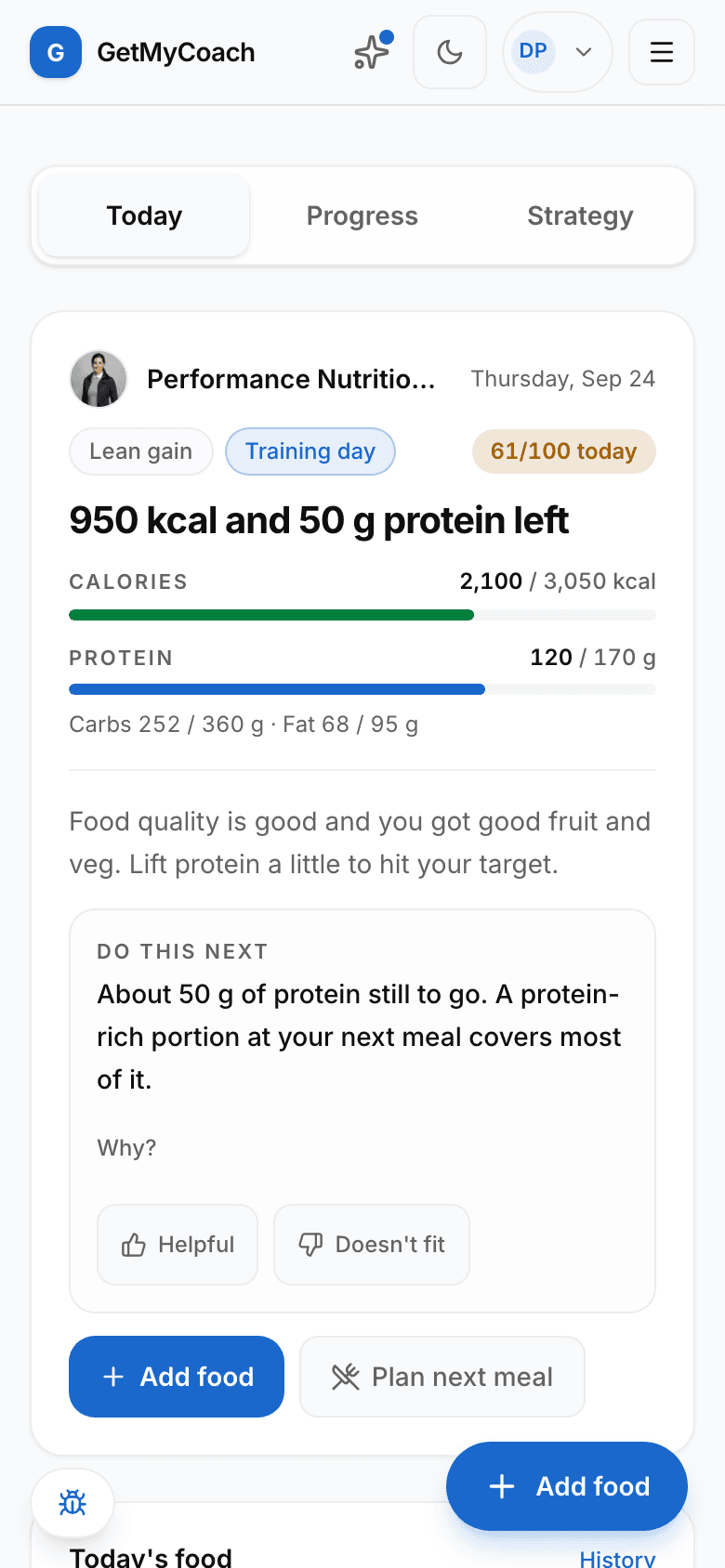
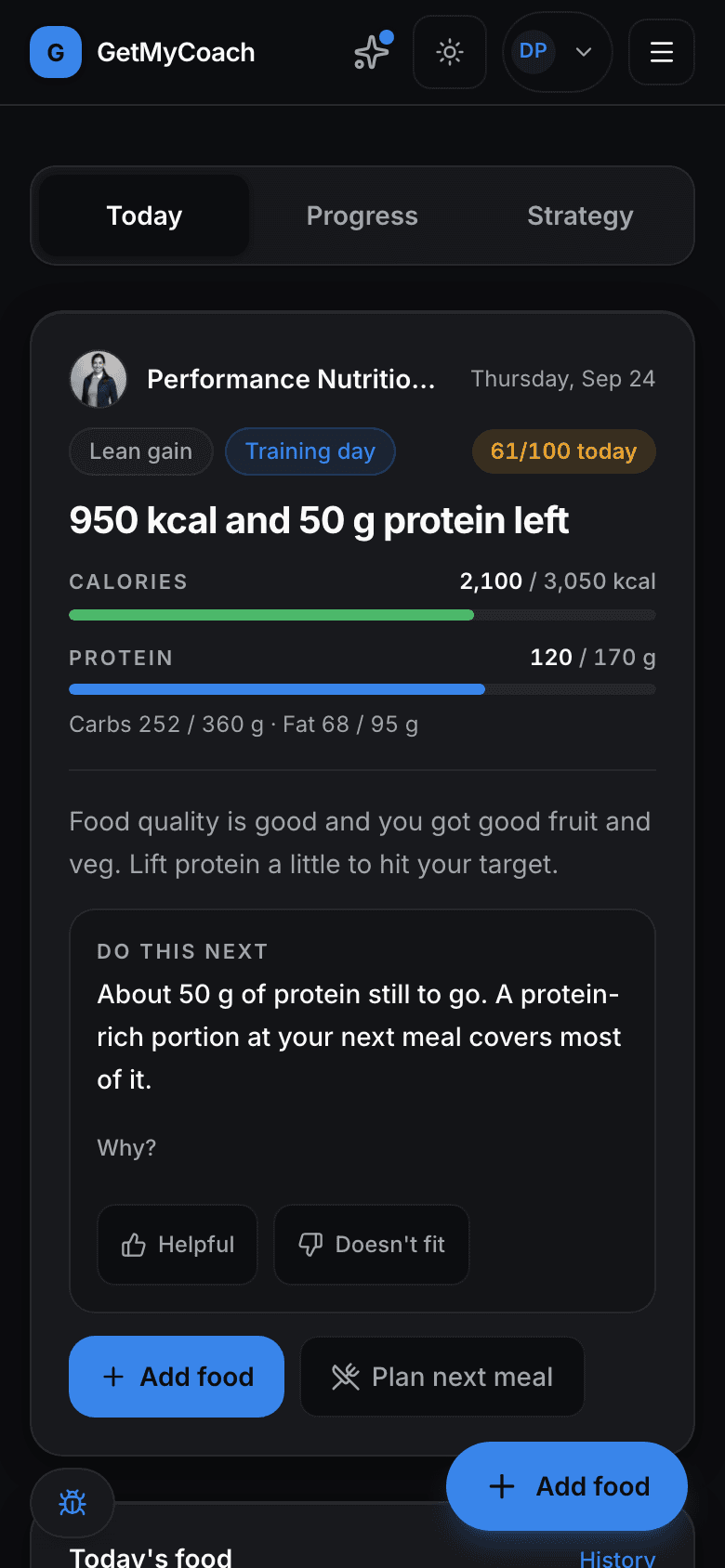
- A daily Coach Verdict — one score out of 100 weighing calories, protein, food quality, fuel timing and fibre, with a plain-language reason rather than a bare number.
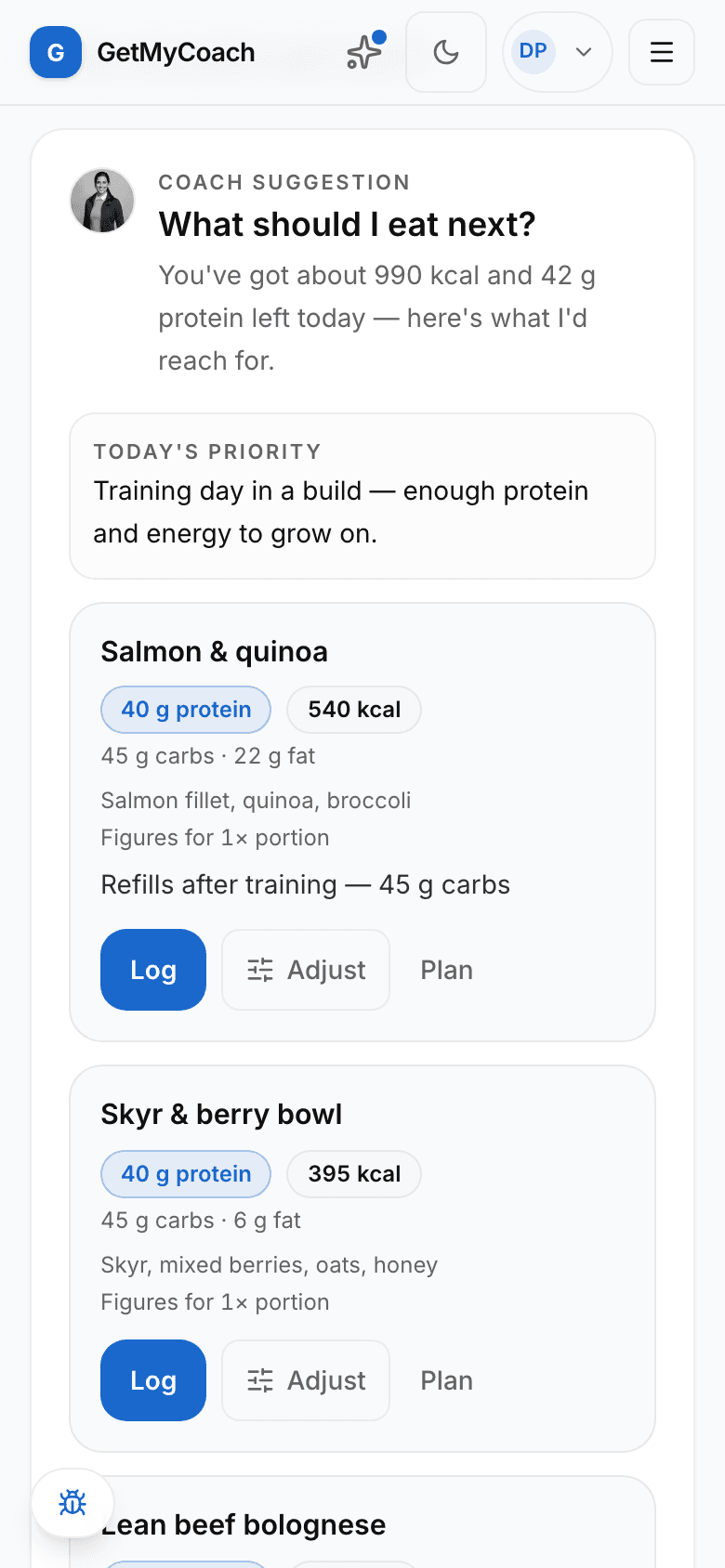
- Remaining targets turned into meals. The calories and protein you have left become two or three concrete suggestions with their macros, or a plan for the rest of the day. Suggestions, never a fixed menu.
- Days read together, not alone. Only days you actually tracked count towards a read, today is left out until it is finished, and when the data is too thin your coach says so instead of producing a number that merely looks precise.
- Weight as a trend, with a rate in kilos per week and whether it is faster or slower than the period before — and a plateau named as one, with how long it has lasted.
Starting properly, in seven steps
The first fortnight decides whether this works, and the common mistake is to start optimising before there is anything to optimise.
- Set the goal and your body basics honestly. Losing weight, current weight, height, age, activity. The target you get is a starting estimate, not a measurement.
- Log a normal week first. Not a good week. The point of the first seven days is to find out what you actually eat.
- Log the whole day, including the bad parts. A half-logged day is worse than no day, because it looks like information.
- Prioritise total energy and protein. Those two do most of the work; the rest is refinement. Our guide to daily protein has the numbers by goal.
- Weigh under comparable conditions. Same time, after the toilet, before eating. Daily is fine; the daily number is not the thing you read.
- Read the weekly average, not the morning. Give the trend two to four weeks before you judge it.
- Change one thing at a time. Two changes at once and the next fortnight tells you nothing.
For where the target number comes from in the first place, our guide to daily calorie needs covers the calculation properly; this page will not repeat it.
See what the nutrition side actually looks like
Daily calorie and protein targets, a verdict on how the day went, meal suggestions built from what you have left, and your weight as a trend — with or without a training plan.
The features you will actually use
Most days come down to four things.
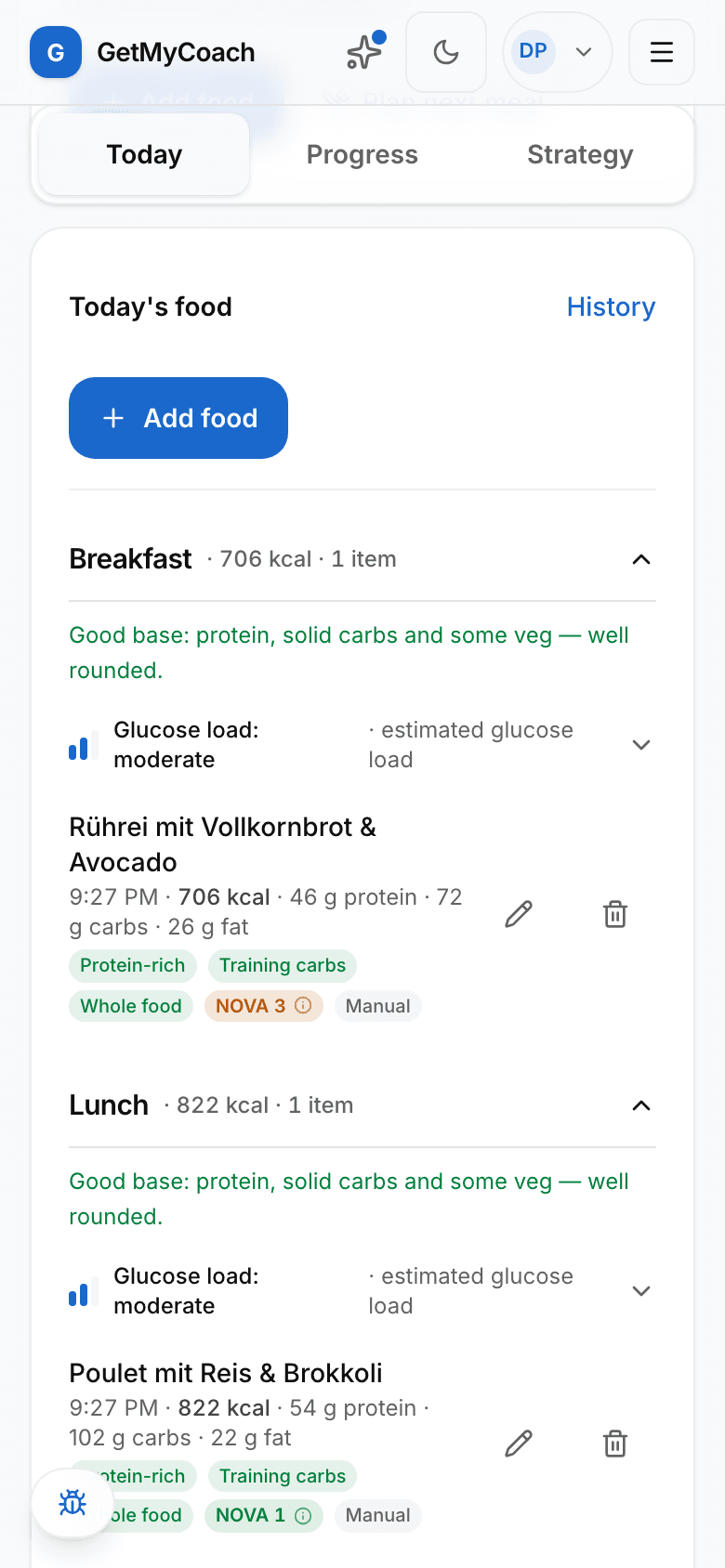
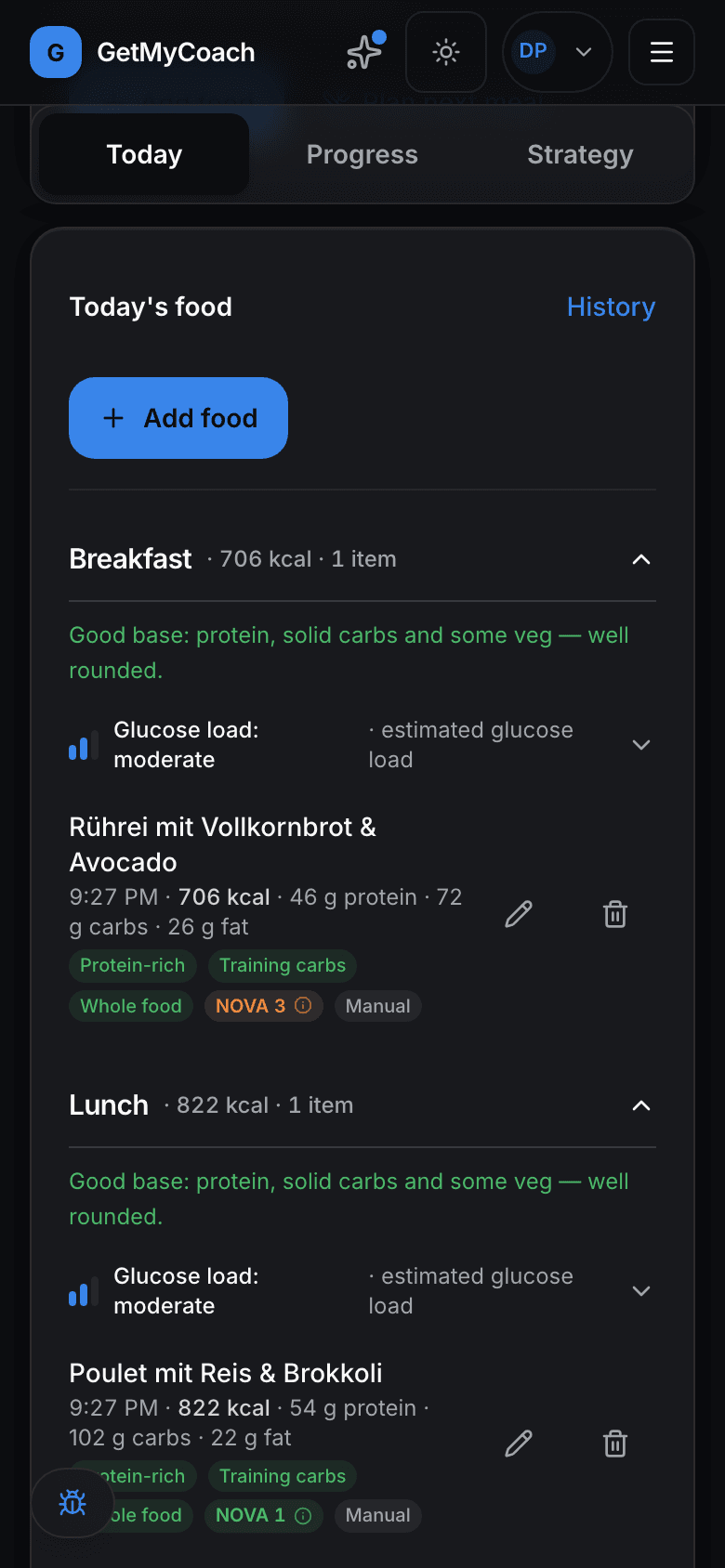
- Logging by name. Describe a meal in your own words in English or German; the app estimates the macros and you confirm or correct them. Portions stay editable afterwards.
- Barcode entry. Scan or type a barcode and get the values from the food database, so packaged food does not need estimating.
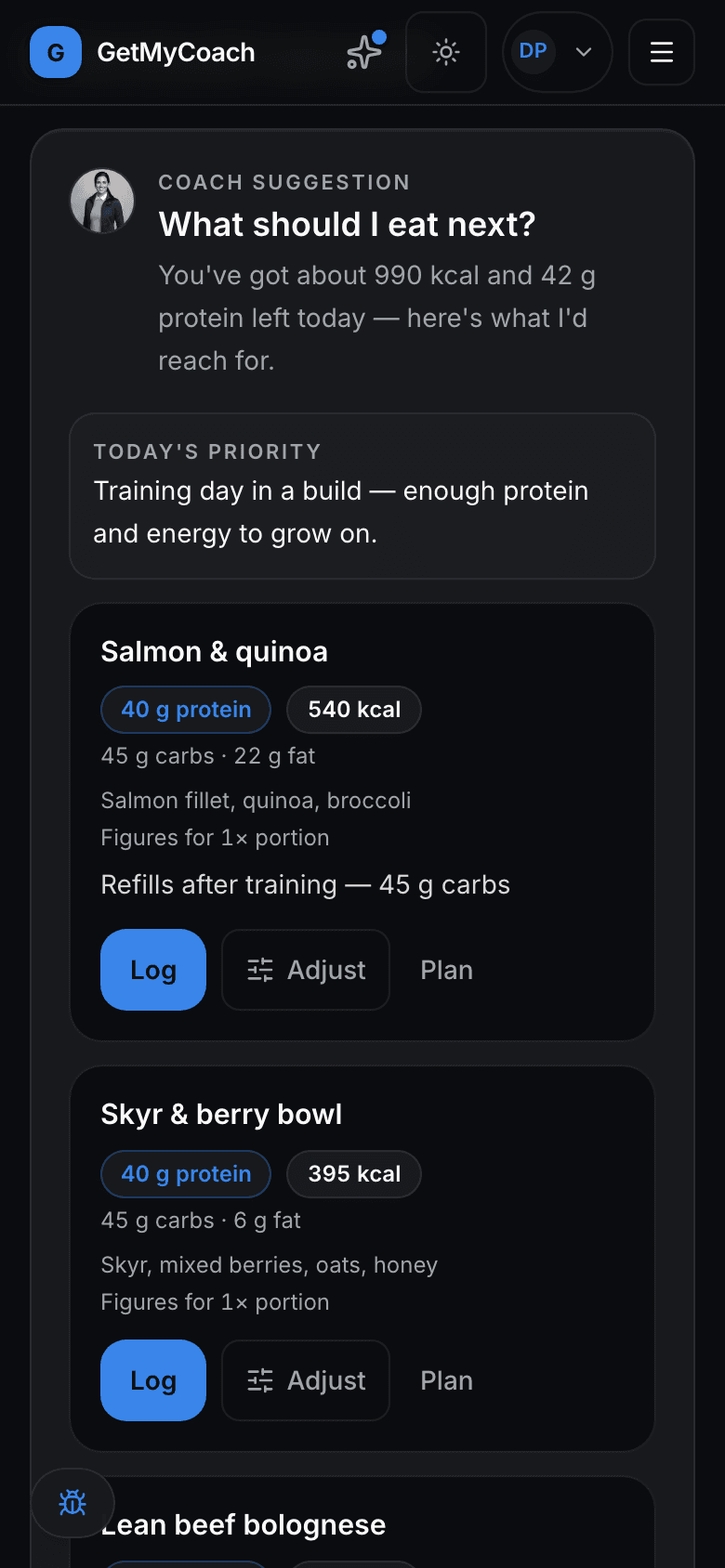
- What to eat next. The calories and protein left today become two or three concrete meals with their macros and a one-line reason each. "Plan the rest of the day" lays out lunch, a snack and dinner that together hit what is left.
- The week's read and your weight trend. Where the daily verdict tells you about a day, the weekly read tells you whether anything is actually moving — and shows the evidence behind it when you ask "Why?".
Every food you log also gets a NOVA 1–4 processing group, estimated from the name or read from the barcode and explained in a tap. It is context on how industrially processed your week is, not a verdict on you.
Losing weight with or without training
A calorie deficit does not require a training plan, and pretending otherwise puts a barrier in front of the one thing that has to happen. If you want to sort your eating out first, that is a coherent decision, and the nutrition plan for weight loss works on its own: pick the goal, add your body basics, get daily targets and a daily verdict from the nutrition tracker.
Training earns its place for different reasons — it protects muscle while you diet, and it is the part that changes how you look and feel at the same bodyweight. If you add a plan later, your targets simply become training-aware: harder days carry more fuel, rest days less. Nothing is created automatically, and no general-fitness plan appears behind your back because you used the tracker. If and when you want one, the weight-loss training plan is the place to start.
The mistakes that waste a month
None of these is a character flaw. All of them are common, and each one is worth more than another 100 kcal off your target.
- Logging only the good days. Five complete days and two vague ones produce a week that cannot be read.
- Forgetting oils, drinks and the mouthfuls. A tablespoon of oil is roughly 120 kcal, and it never gets logged.
- Taking database values as gospel. Declared nutrition values are averages within tolerance bands, and community entries can be further off again. Confirm what the app estimates rather than tapping through it.
- Eating back your training calories. In a comparison of seven wrist-worn devices, heart rate was measured well but no device estimated energy expenditure with an error under 20%. Treat it as a trend, never as a credit.
- Judging a day's weight instead of the trend. The scale moves with water, glycogen, salt and gut contents. Why the scale stalls in a real deficit unpacks that properly.
- Slashing the target after a flat week. The first fortnight is measurement, not evidence.
- Ignoring protein and food quality. A deficit hit entirely with low-protein convenience food costs you more muscle and leaves you hungrier.
- Reading a score as a moral judgement. A verdict is feedback on a day's fuelling. It is not an opinion about you.
Your data, and what it can honestly say
Two separate things, and both matter.
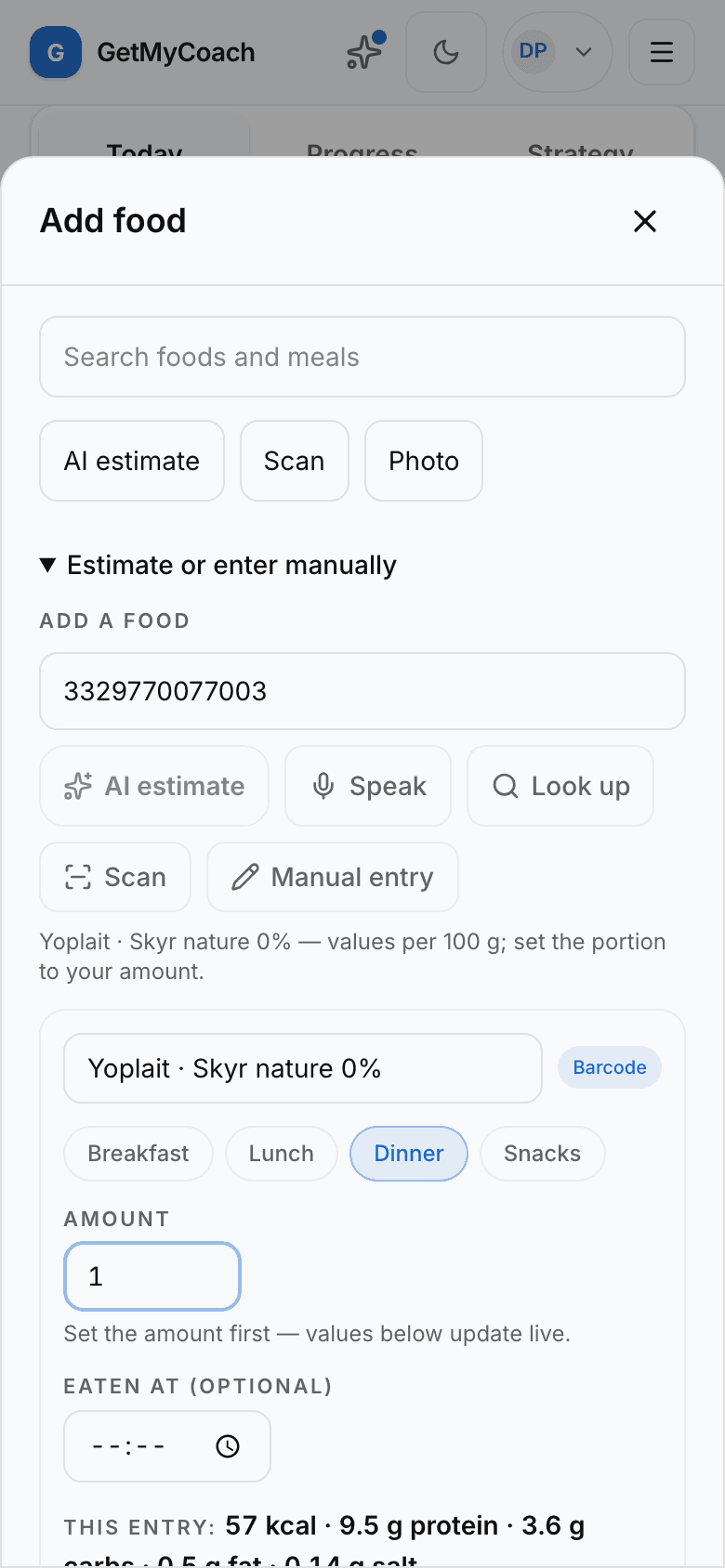
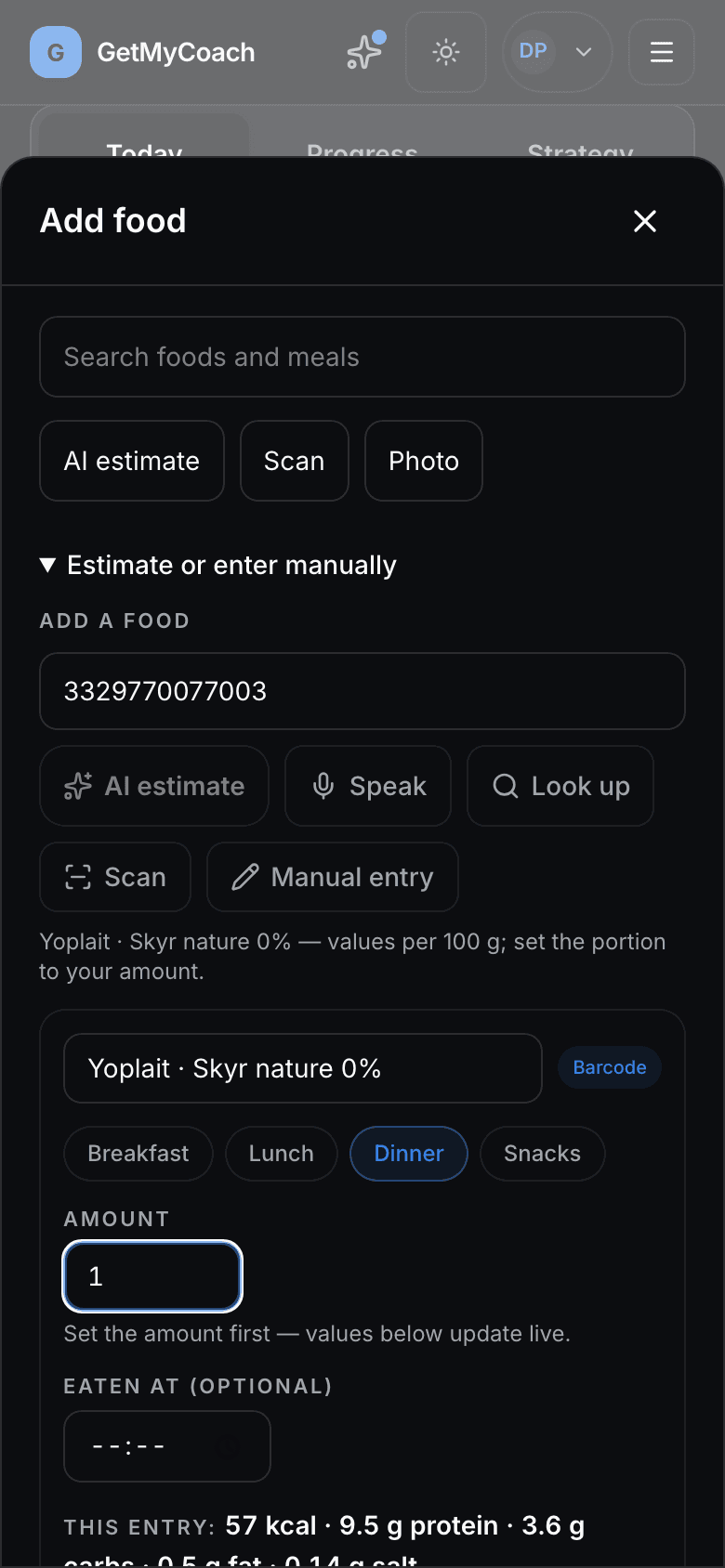
What the numbers are. Some values are verified — a barcode lookup from the food database. Some are estimates the app makes from your description and you confirm. Some are your own entries. The daily verdict is an interpretation built on all three, and it is only ever as good as the day you logged. Where the data is thin, GetMyCoach says so rather than producing a confident-looking number, and the "Why?" behind each read shows how many days and which values it used.
What happens to them. Our privacy policy is the accurate statement of what is collected and why. Nothing on this page will claim your data is "100% secure", because that is not a claim anybody can honestly make.
When tracking is not the right tool
Calorie tracking suits some people and actively harms others. Among people already in treatment for an eating disorder, a large majority who had used a calorie-tracking app reported that it contributed to their disorder — that is a self-reported association in a clinical sample rather than proof of cause, and it is still a serious reason for caution.
Talk to a professional before tracking, rather than starting and hoping, if any of these apply: you are under 18 and without appropriate guidance; you are pregnant or breastfeeding; you have a current or past eating disorder, or tracking starts to feel compulsive; your weight is changing without you intending it to; you have a condition or take medication that affects weight or appetite; or you have persistent symptoms such as dizziness, exhaustion or hair loss.
GetMyCoach does not diagnose anything, and no app is a substitute for a doctor or a registered dietitian.
Frequently asked questions
Can you actually lose weight with an app?
You can lose weight while using one, and the evidence supports it modestly: pooled trials show roughly a kilogram more loss than control, with better results in studies lasting six months or more. The behaviours the app supports — logging food, weighing regularly — have the stronger evidence. The app is the instrument; the deficit is still the thing that does the work.
Do I have to weigh every food?
No. You log meals by name and confirm what the app estimates, or scan a barcode for packaged food. Weighing is useful early on for the handful of foods you eat most, because it calibrates your eye. After that, consistency matters more than precision.
Can I lose weight with an app if I do not train?
Yes. A deficit comes from how you eat, and GetMyCoach's nutrition side works with no training plan at all — and never creates one for you. Training protects muscle and changes how you look at the same bodyweight, which is a good reason to add it later, not a precondition for starting.
Should I eat back the calories my watch says I burned?
No, and this is one of the most reliable ways to erase a deficit. Wrist-worn devices measure heart rate well but estimate energy expenditure poorly — none under 20% error in the Stanford comparison. Treat the figure as a rough trend.
How does GetMyCoach handle incomplete days?
It leaves them out of the read rather than pretending. Only days you actually tracked count, today is excluded until it is finished, and when there is not enough to say something solid your coach says exactly that. That is why logging a bad day fully is worth more than logging a good day perfectly.
Is it free?
The nutrition side is included free during GetMyCoach's early access, alongside the training plan. That is the current status rather than a permanent promise.
The bottom line
- The app is the instrument, not the intervention. Pooled trials put app use at about a kilogram of extra loss; the logging and weighing habits underneath it carry the stronger evidence.
- Log ordinary days, completely. A fully logged bad day is worth more than a perfectly logged good one.
- Read the trend, not the morning. Weekly averages over two to four weeks, and one change at a time.
- No training plan required — and none appears unless you ask for one.
Start with the eating, add training when you want to
Set your goal, get a daily calorie and protein target, log a normal week, and let your coach tell you the one thing worth changing — free during early access, no training plan needed.
Sources
- Flores Mateo G, Granado-Font E, Ferré-Grau C, Montaña-Carreras X (2015). Mobile phone apps to promote weight loss and increase physical activity: a systematic review and meta-analysis. J Med Internet Res 17(11):e253 — pooled weight difference −1.04 kg (95% CI −1.75 to −0.34), larger in trials of six months or more
- Burke LE, Wang J, Sevick MA (2011). Self-monitoring in weight loss: a systematic review of the literature. J Am Diet Assoc 111(1):92–102 — dietary self-monitoring consistently associated with weight loss, and with greater loss the more consistently it was done
- Zheng Y et al. (2015). Self-weighing in weight management: a systematic literature review. Obesity 23(2):256–265 — regular self-weighing associated with weight loss and not with negative psychological outcomes
- Lichtman SW et al. (1992). Discrepancy between self-reported and actual caloric intake and exercise in obese subjects. N Engl J Med 327:1893–1898 — 47% under-reporting of intake and 51% over-reporting of activity
- Shcherbina A et al. (2017). Accuracy in wrist-worn, sensor-based measurements of heart rate and energy expenditure in a diverse cohort. J Pers Med 7(2):3 — heart rate accurate, no device under 20% error for energy expenditure
- Levinson CA, Fewell L, Brosof LC (2017). My Fitness Pal calorie tracker usage in the eating disorders. Eat Behav 27:14–16 — in 105 people in treatment for an eating disorder, most users reported the app contributed to their disorder (self-reported, cross-sectional)
- European Commission (December 2012). Guidance document for competent authorities for the control of compliance with EU legislation on the setting of tolerances for nutrient values declared on a label — declared values are averages within tolerance bands