Ozempic, Wegovy and Training: Strength and Protein While You Lose Weight
What resistance training and protein actually change while a GLP-1 medicine takes the weight off — what the trials show about lean mass, the doses expert guidance converges on, and where the app stops and your treatment team starts.
Weight is coming off faster than it ever has, your appetite is gone, and nobody has told you what to do in the gym or at the table. This is the part the prescription does not cover.
The short answer: keep lifting and keep eating protein. The medicine decides how much weight you lose; resistance training and enough protein have a lot to say about what that weight is made of. The Swiss authorisation for Wegovy says so in its own wording — it is approved as an adjunct to a reduced-calorie diet and increased physical activity. The target expert guidance converges on is strength training at moderate-to-high intensity two to three times a week, alongside roughly 1.2 to 1.5 g of protein per kg of body weight per day.
In short: Across trials, the share of lost weight that is lean tissue varies widely — from about 15% to 60% — and lean mass is not the same thing as muscle. What is consistent is the fix. Resistance training during a calorie deficit prevented almost all of the lean-mass loss in a meta-analysis of older adults with obesity, higher protein protected muscle mass across 47 randomised trials, and in a year-long trial pairing exercise with a GLP-1 medicine, the exercise arm was the one associated with increased lean mass.
This article is general health and training information, not medical advice. It says nothing about whether a GLP-1 medicine is right for you, how to dose it, or when to change or stop it — those are decisions for the doctor who prescribed it. If you have symptoms, talk to your treatment team rather than to an app. Sources checked 11 September 2026 and listed at the end.
What these medicines are, and what they are approved for
Semaglutide and tirzepatide mimic GLP-1, a gut hormone released after eating. They slow stomach emptying and act on appetite regulation in the brain, which is why people on them eat less without deciding to. The brand names are not interchangeable prescriptions:
- Ozempic is authorised by Swissmedic for inadequately controlled type 2 diabetes, as an adjunct to diet and exercise. Weight management is not its authorised indication in Switzerland.
- Wegovy is the same active substance at a weight-management dose, authorised on 15 February 2022 for adults with a BMI of 30 kg/m² or more, or 27 to under 30 kg/m² with at least one weight-related condition.
Read that indication closely and it contains the point of this article: Wegovy is approved "as an adjunct to a reduced-calorie diet and increased physical activity." Training and eating are not extras bolted onto the treatment — they are written into what the treatment is. Swiss reimbursement goes further, making cover conditional on a documented 500 kcal/day deficit, dietary counselling and increased, evidenced physical activity. Those conditions are time-limited and revised periodically, so check the current federal health office listing rather than any figure on a blog, including this one.
What the weight you lose is actually made of
Here is where the internet gets loud and the evidence gets quiet.
When anyone loses weight — by diet, surgery or medication — some of what leaves is fat and some is fat-free mass. That is how weight loss works, not something specific to these drugs. And the share is variable: a 2024 review found reported lean-mass reductions ranging from roughly 15% to 60% of total weight lost, depending on study, population and measurement. Anyone quoting one confident percentage is quoting one study.
Two things make that range less alarming than it looks. "Lean mass" on a DXA scan is not muscle — it includes organs, bone and body water, all of which shrink as body size shrinks. And when the same review looked at MRI studies that see skeletal muscle directly, the changes looked adaptive: muscle volume fell roughly in line with the weight lost, while muscle fat infiltration and insulin sensitivity improved. A real-world 12-month cohort of 106 patients on semaglutide points the same way — fat mass down 18%, lean mass down 3 kg over seven months and then stable, grip strength up 4.1 kg, and the share meeting criteria for sarcopenic obesity falling from 49% to 33%.
So the risk is real, but it is a variable rather than a verdict — and you have two levers on it.
Diet alone
−0.76 kg lean mass
Calorie restriction on its own, pooled across six randomised trials in older adults with obesity.
Diet plus resistance training
−0.05 kg lean mass
Same deficit, same fat loss — training three times a week at 65–85% of a one-rep max, for 12 to 24 weeks.
One variable moved: whether the weeks contained resistance training.
Why training matters more on Ozempic, not less
Lifting is the lever people drop first, because you are eating far less, often feel flatter, and the scale is moving anyway. That is exactly when the gym stops feeling necessary and becomes most valuable.
The best evidence comes from a one-year randomised trial in adults with obesity after an initial diet-induced weight loss, with four arms: exercise plus placebo, a GLP-1 medicine (liraglutide) alone, both, or neither. The combination held the most weight off and roughly doubled the fall in body-fat percentage against either alone — 3.9 percentage points versus about 1.7 and 1.9. Two details beat the headline: exercise was the arm associated with increased lean mass, and only the combination improved HbA1c, insulin sensitivity and fitness together. That programme was mostly moderate-to-vigorous cycling and running with 15 minutes of circuit work twice a week, so read it as evidence for training alongside the medicine rather than for one specific split.
A 2026 international consensus on care for people on these therapies puts the rest about as bluntly as a consensus statement can: a high protein intake alone does not increase muscle mass — for preserving lean body mass during weight loss, a resistance-training programme at moderate-to-high intensity is what is advised, alongside at least 150 minutes a week of moderate-to-vigorous aerobic activity. That matches obesity-society guidance of resistance training two to three times a week. Out of reach right now? The same consensus accepts a stepped goal — a structured smaller plan, or a floor of 4,000 to 6,000 steps a day.
Expect progress to feel slower than it would in a surplus. That is not failure: on a deficit, holding your loads while your body weight falls is progress, so keep the progressive overload honest rather than heroic.
Protein when your appetite is gone
Protein is the second lever, and it gets harder to pull exactly when it starts to matter, because the whole mechanism is that you want less food.
The 2026 consensus recommends 1.2 to 1.5 g of protein per kg of actual body weight per day during the weight-loss phase, or about 25 to 30% of energy on a 1,600 kcal day, dropping to at least 0.8 g/kg in maintenance. That is deliberately lower than the 1.6 to 2.2 g/kg band that suits hard-training athletes — body-weight-based targets can overshoot in people carrying a lot of fat mass. Your treatment team's number beats any number on this page.
The wider evidence backs the direction: pooling 47 randomised trials in adults losing weight with overweight or obesity, higher protein significantly protected muscle mass, with the practical line put above about 1.3 g/kg/day and intakes below 1.0 g/kg/day associated with higher risk. Protein alone did not protect strength or physical function — protein defends the tissue, training defends what it can do. For the general version, see how much protein per day.
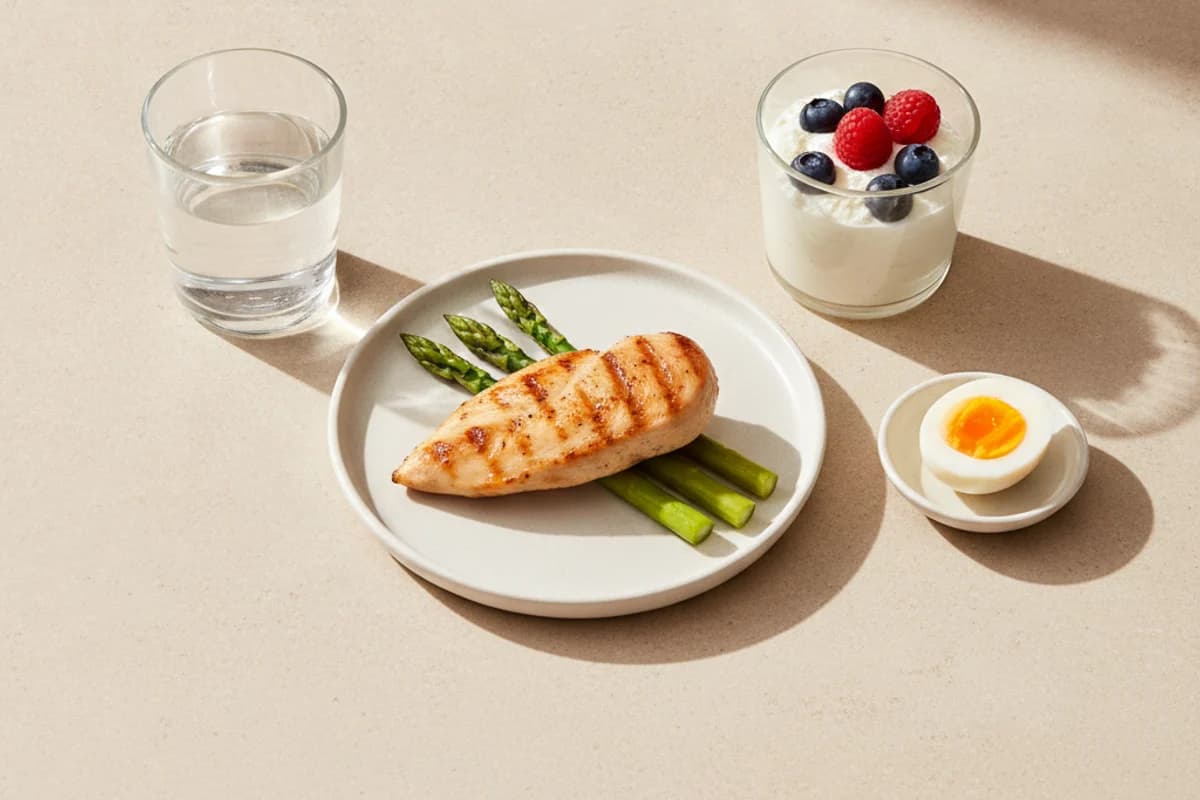
The practical problem is that 1.2 g/kg is a lot of food when three bites feel like enough. What works is protein first in the order of eating rather than more food overall: the protein part of the plate goes in while appetite is highest, which for most people is the first few minutes. Dense, small-volume sources do the work — quark, skyr, cottage cheese, eggs, fish, lean meat, tofu, legumes, and milk or a protein drink when solid food is unappealing. Our roundup of high-protein quark and skyr options in Swiss supermarkets is a shopping list for exactly this.
A day of eating that stays down
Getting enough in is partly structural, and the consensus is more specific here than most advice you will find.
| Situation | What the guidance suggests | Why |
|---|---|---|
| Meals feel too big | Four to six small meals rather than three, built on lean protein and plant foods | A structured smaller-meal pattern is explicitly offered as an option |
| Appetite gone entirely | Protein first, then vegetables, then the rest — and stop at "comfortably full" | Mindful eating and stopping at comfortably full are named recommendations |
| Constipation | Fibre at ≥25 g/day for women, ≥30 g/day for men, ≥35 g/day with diabetes, plus more fluid | Constipation is reported to outlast the other gut side effects |
| Dehydration creeping in | More than 2 L of fluid a day, and more around training, vomiting or diarrhoea | Hydration is called out as especially important with exercise |
| Diet has narrowed a lot | Keep variety across food groups; raise micronutrients with your team | Strong appetite suppression plus a narrow diet raises deficiency risk |
Two boundaries on that table: it is expert consensus for a population, not a prescription for you — persistent nausea, vomiting or diarrhoea belongs with your prescriber, who may adjust the dose. And none of it argues for eating less than your team planned for.
Seeing what you actually ate
This is where a tracker earns its place, and the boundary is worth stating plainly. GetMyCoach does not manage your therapy. It knows nothing about your medicine, your dose or your appointments, and it will never suggest changing any of them.
What it does is close the gap between thinking you ate enough protein and knowing. You log food by describing it, scanning a barcode or searching by name, and the day shows calories and protein against a target derived from your body data and your goal. That target is editable, which matters more than usual here: if your treatment team gave you a calorie and protein number, set theirs and let the app measure you against it.
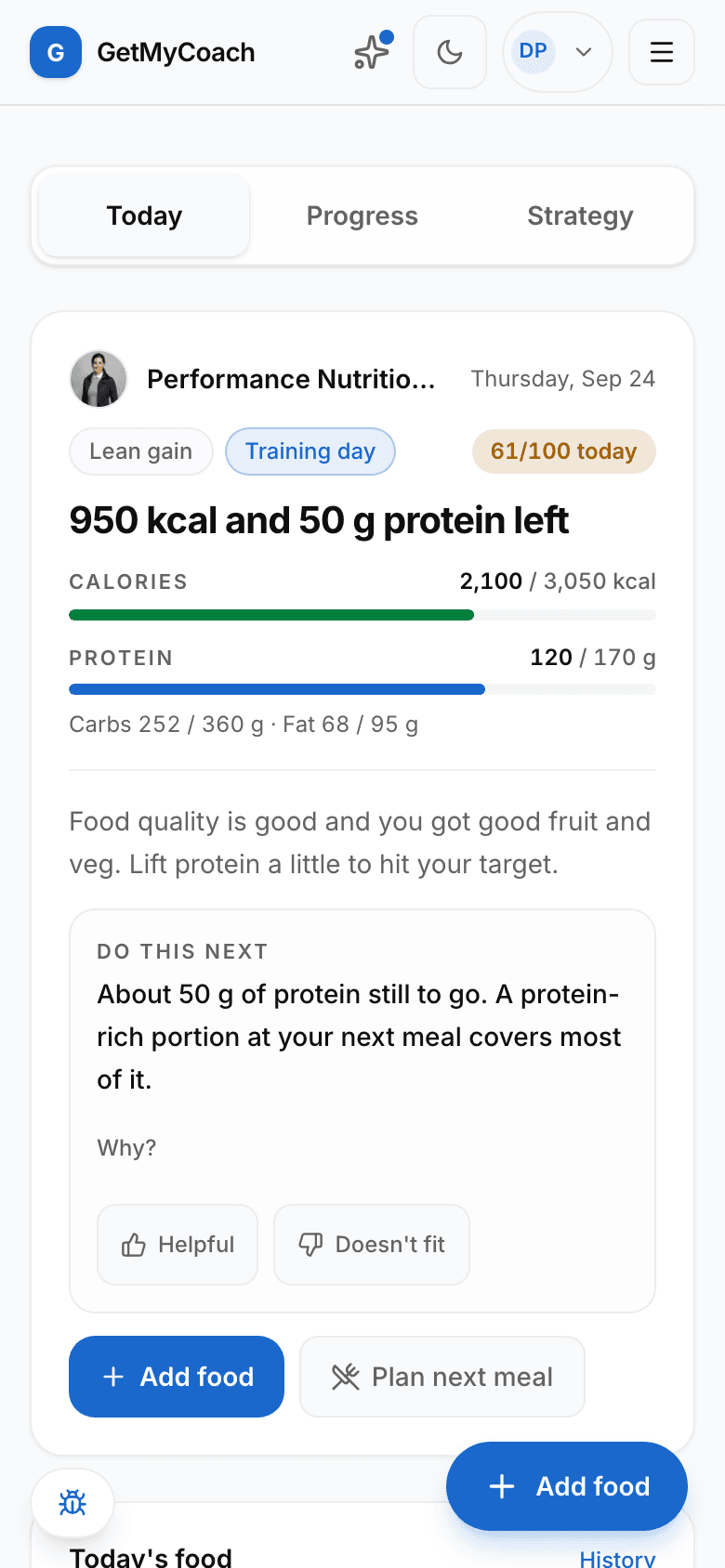
At the end of the day the coach gives one score out of 100 across calories, protein, food quality, training fuel and fibre, with a "Why?" showing which days and values it used. It names one thing to change rather than a list, and where the data is too thin it says so instead of guessing. Protein is also shown per kilogram of body weight — the form your team's target is in. Nutrition works on its own: no training plan is needed, and choosing the nutrition goal does not create one, which is what the weight-loss nutrition plan is built around.
Written-down days also make a stall readable. If the scale stops moving and you cannot see why, why you are not losing weight in a calorie deficit walks through the ordinary explanations before the exotic ones.
Both halves in one place
The medicine takes the weight off. Protein and lifting decide what is left. GetMyCoach holds a daily calorie and protein target you can set to your team's numbers, and a strength plan built around the days and equipment you actually have.
A strength plan you can keep for months
The training side does not need to be complicated, and on a deficit it should not be. It needs to be repeatable.
In GetMyCoach you pick the goal — "feel stronger and fitter" matches this situation — and answer four things: your experience level, the days a week you can train, how long a session can realistically be, and what equipment you have, whether that is a full gym, a pair of dumbbells at home or nothing at all. The General Fitness Coach builds full-body strength sessions from that, with a set, rep and load target for every exercise and a progression rule so the plan knows what to ask of you next time.
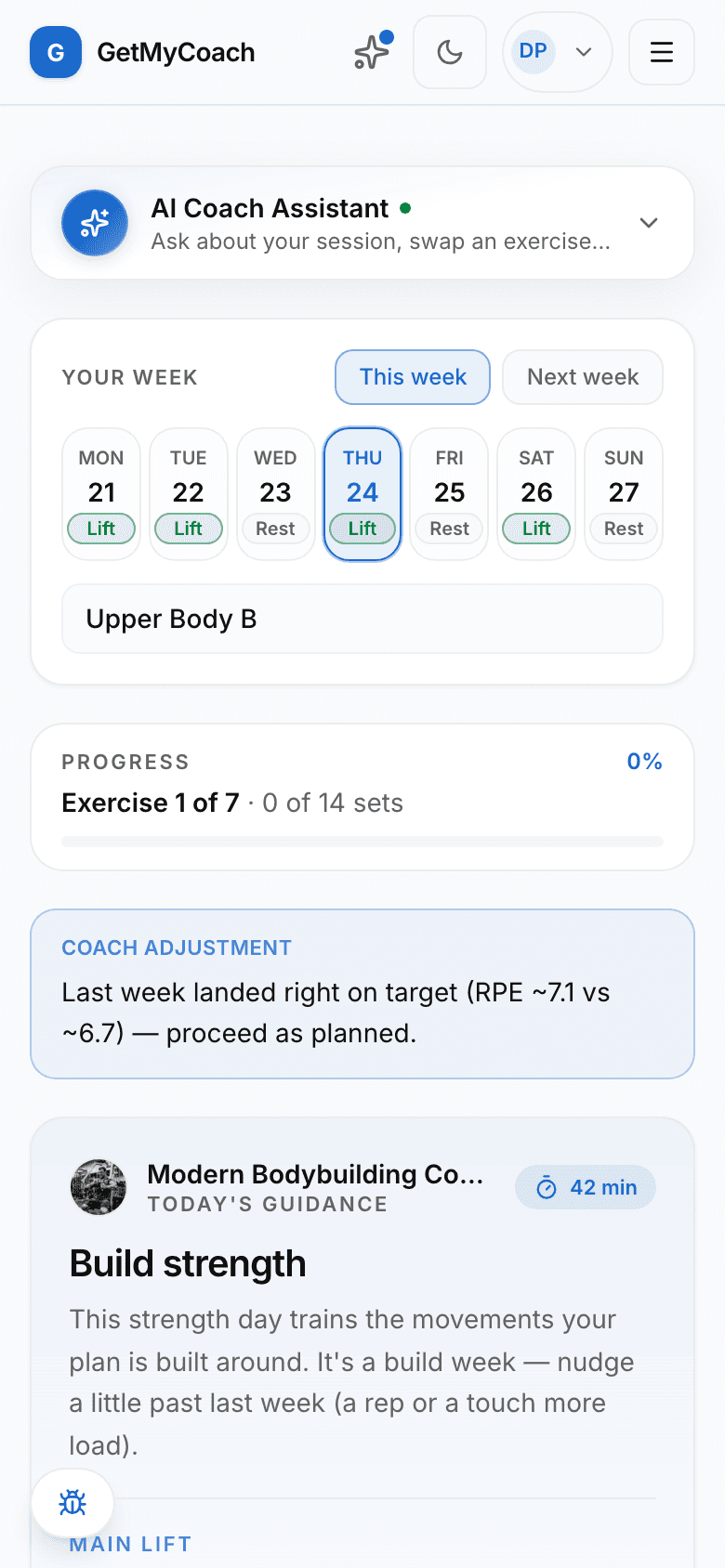
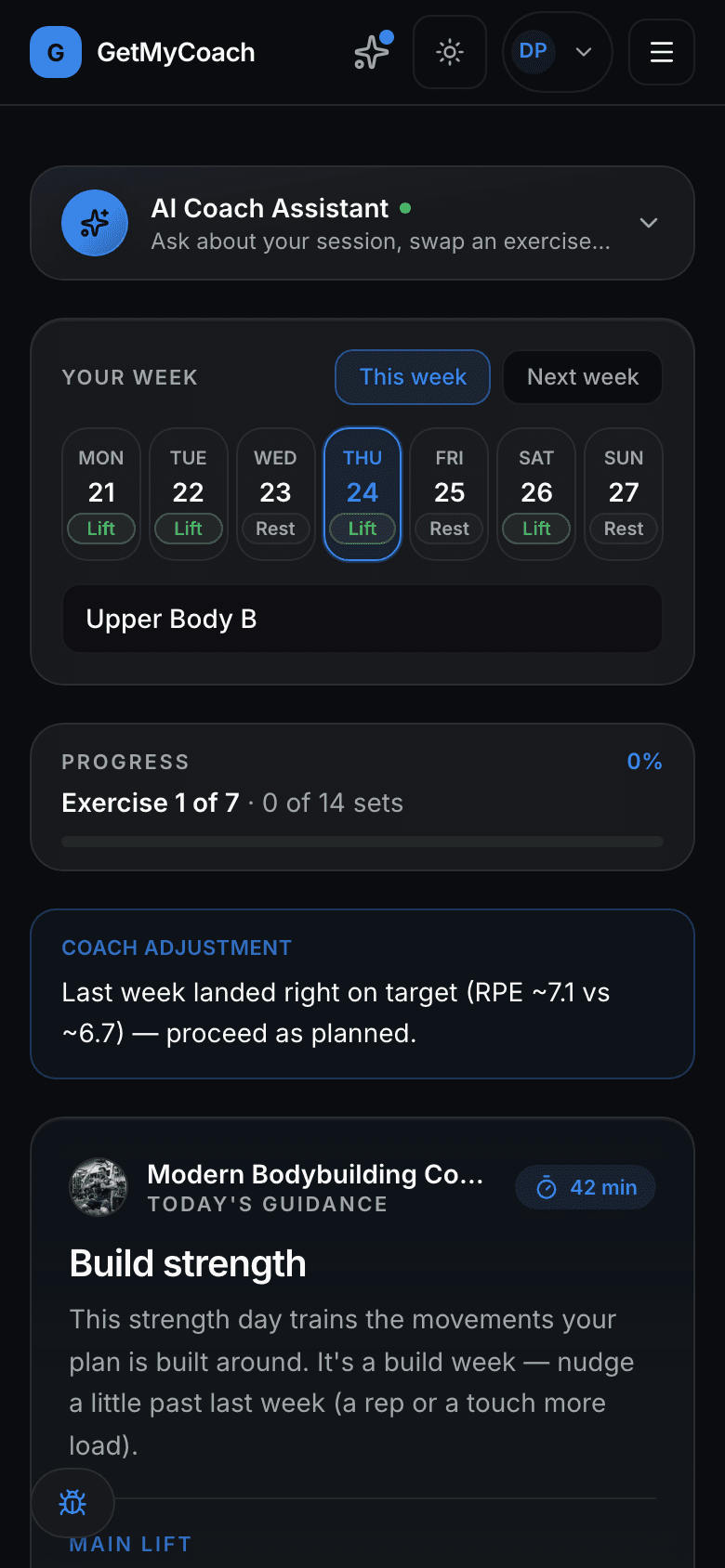
Logging the sets rather than just doing them matters here specifically: holding your working weights while your body weight falls is the clearest practical sign the loss is going the way you want, and it is invisible unless it is written down. Two sessions a week is a defensible floor; three is better if the days exist. Two you will actually do beats four you abandon in week three — the same reason our guide to the first four weeks starts slower than most people expect.
One honest limit: the plan does not know you are on a GLP-1 medicine and does not adjust itself for your therapy. It is a strength plan built around your days, equipment and level — the thing that was missing, not a substitute for your treatment team.
When to stop and call your team
Some of this section matters more than everything above it.
- Anything gastrointestinal that is not settling — persistent vomiting, diarrhoea, severe abdominal pain — belongs with your prescriber, who may change the dose. Do not manage it by eating less.
- Losing weight much faster than planned, roughly more than 1.5 to 2 kg a week, is a reason to be reviewed. Unexpected rapid loss can signal undernutrition or something unrelated to the medicine.
- Signs of undernutrition — new hair loss, constant cold, dizziness, unusual fatigue, weak hands — are not the price of treatment.
- Disordered eating. These medicines can worsen an eating disorder, which is why screening before starting one is recommended. If the appetite suppression has started to feel like permission — skipping meals deliberately, fear of eating normally again, relief at eating almost nothing — that is a conversation with a professional, not a target to track. In Switzerland, start with your GP or an eating-disorder service; PEP maintains a directory of specialists and helplines.
- Micronutrients. Strong appetite suppression plus a narrowed diet raises the risk of deficiencies in vitamin D, B12, folate, iron, calcium and magnesium. Whether you need bloods or a supplement is your team's call, not an app's.
No tracker, plan or article replaces the people treating you.
Frequently asked questions
Should I exercise while taking Ozempic or Wegovy?
Yes, and the authorisation assumes you will — Wegovy is approved in Switzerland as an adjunct to a reduced-calorie diet and increased physical activity. Expert consensus asks for at least 150 minutes a week of moderate-to-vigorous aerobic activity plus resistance training; if that is not reachable yet, a structured smaller plan or 4,000 to 6,000 steps a day is the accepted stepping stone. Clear the specifics with your doctor if you have heart, joint or blood-sugar issues.
Does Ozempic make you lose muscle?
Some of the weight lost is fat-free mass, as with any weight loss, and the reported share varies enormously — roughly 15% to 60% across trials. Lean mass is not muscle, though: it includes organs, bone and body water, and MRI evidence suggests the muscle changes are largely proportionate to the weight lost rather than pathological. The share you personally lose is the part you can influence.
How much protein should I eat on a GLP-1 medicine?
International consensus suggests 1.2 to 1.5 g per kg of actual body weight per day during weight loss, and at least 0.8 g/kg during maintenance. That is lower than the 1.6 to 2.2 g/kg band used for hard-training athletes, partly because body-weight-based targets overshoot in people carrying a lot of fat mass. If your treatment team gave you a number, use theirs.
What kind of training protects muscle best?
Resistance training at moderate-to-high intensity, two to three times a week, covering the major muscle groups. Aerobic work belongs in the week for cardiovascular and metabolic health, but it is not what preserves lean mass in a deficit. In the meta-analysis of older adults with obesity, adding resistance training to a calorie deficit removed almost all of the lean-mass loss dieting alone produced.
Can I strength train if the medicine makes me feel weak or nauseous?
Train, but scale it. Nausea and low energy are common during dose escalation and often settle. On a bad day, keeping the session and cutting the volume — same exercises, fewer sets — preserves the habit far better than cancelling. What does not belong on a bad day is a personal-best attempt. Persistent vomiting, dizziness or faintness means stopping and speaking to your prescriber.
Will training make me lose weight faster on a GLP-1?
Not dramatically, and that is the wrong thing to ask of it. In the year-long trial the combination did hold more weight off than either alone, but the clearer effect was on composition: body fat fell about twice as far, and the exercise arms were the ones associated with increased lean mass and better fitness. Train for what the loss is made of, not for its speed.
Do I need protein powder?
No — it is a convenience, and a genuinely useful one here, because a drink is easier than a meal when solid food is unappealing and it closes a 25 to 30 g gap at the end of a day. Food first where you can manage it: quark, skyr, cottage cheese, eggs, fish, lean meat, tofu and legumes are denser in protein per mouthful than most people assume.
What happens to muscle if I stop the medicine?
Weight regain after stopping is well documented, and the concern is that regained weight tends to return with a higher proportion of fat than what was lost. That makes an established training habit more valuable after the prescription than during it. Whether and how to stop is a decision for your prescriber.
The bottom line
- The medicine decides how much; you influence what it is made of. The reported lean-mass share ranges from about 15% to 60% across trials — another way of saying it is not fixed.
- Resistance training is the lever with the best evidence. Two to three sessions a week at moderate-to-high intensity, holding your loads while your body weight falls.
- Protein is the second lever, at 1.2 to 1.5 g/kg during the loss phase — with your treatment team's number overriding any general figure.
- Warning signs are not the price of treatment. Rapid loss, signs of undernutrition, or eating that has begun to feel disordered all belong with your team.
Build the half the prescription does not cover
Tell GetMyCoach your level, the days you have, how long a session can be and what equipment you own. The General Fitness Coach builds full-body strength sessions with loads and a progression rule, and logs every set — so you can see whether your strength is holding while your weight comes down.
Sources
- Bundesamt für Gesundheit (2024). WEGOVY, Novo Nordisk Pharma AG — Neuaufnahme in die Spezialitätenliste per 1. März 2024 — quotes the Swissmedic indication of 15 February 2022 (adjunct to a reduced-calorie diet and increased physical activity; BMI ≥30, or ≥27 to <30 with a weight-related condition) and the reimbursement limitation
- Swissmedic. Ozempic® (semaglutidum) — authorised in Switzerland for adults with inadequately controlled type 2 diabetes as an adjunct to diet and exercise
- Sievenpiper JL, Ard J, Blüher M, et al. (2026). Nutritional and lifestyle supportive care recommendations for management of obesity with GLP-1-based therapies: an expert consensus statement using a modified Delphi approach. Obesity Pillars 17:100228 — 52 consensus statements; protein 1.2–1.5 g/kg during weight loss and ≥0.8 g/kg in maintenance; ≥150 min moderate-to-vigorous activity plus resistance training; resistance training at moderate-to-high intensity for lean-mass preservation
- Neeland IJ, Linge J, Birkenfeld AL (2024). Changes in lean body mass with glucagon-like peptide-1-based therapies and mitigation strategies. Diabetes Obes Metab 26(Suppl 4):16–27 — reported lean-mass reductions range from about 15% to 60% of total weight lost; lean mass includes organs, bone and water, and MRI-based muscle changes appear adaptive
- Lundgren JR, Janus C, Jensen SBK, et al. (2021). Healthy weight loss maintenance with exercise, liraglutide, or both combined. N Engl J Med 384(18):1719–1730 — the combination roughly doubled the fall in body-fat percentage versus either alone (−3.9 vs −1.7 and −1.9 points); exercise was associated with increased lean mass
- Sardeli AV, Komatsu TR, Mori MA, Gáspari AF, Chacon-Mikahil MPT (2018). Resistance training prevents muscle loss induced by caloric restriction in obese elderly individuals: a systematic review and meta-analysis. Nutrients 10(4):423 — six randomised trials; resistance training removed 93.5% of the lean-body-mass loss caused by caloric restriction alone (−0.05 kg vs −0.76 kg)
- Kokura Y, Ueshima J, Saino Y, Maeda K (2024). Enhanced protein intake on maintaining muscle mass, strength, and physical function in adults with overweight/obesity: a systematic review and meta-analysis. Clin Nutr ESPEN 63:417–426 — 47 studies (n=3218); higher protein significantly protected muscle mass (SMD 0.75, 95% CI 0.41–1.10) but not strength or physical function; practical line above ~1.3 g/kg/day
- Alissou M, et al. (2026). Impact of semaglutide on fat mass, lean mass and muscle function in patients with obesity: the SEMALEAN study. Diabetes Obes Metab 28(1):112–121 — 106 patients over 12 months: fat mass −18%, lean mass −3 kg by month 7 then stable, grip strength +4.1 kg, sarcopenic obesity 49% → 33%